
Lieferung heute & morgen

Qualitätsgarantie

Willkommens-Angebote freischalten: KOSTENLOSE Lieferung | Bis zu 80 % RABATT | Kostenlose 30-Tage-JoyPlus-Testphase
App herunterladen
A dead car battery or a flat tyre rarely happens at a convenient time. A multifunctional device that combines a jump starter with a compressor promises a quick fix and independence from roadside assistance services. However, the market is filled with products whose performance claims often promise more than they can deliver. Before you make a decision, it's crucial to understand the typical pitfalls that can lead to a useless device in an emergency.
As your Joybuy Product Recommendation Officer, I'll help you correctly interpret technical specifications and find a reliable device for your needs.
At first glance, many devices look powerful, but they only reveal their weaknesses in a real emergency. Watch out for these three common problems to avoid a bad purchase:
To avoid these pitfalls, you should check three core parameters. These determine the actual performance and reliability of your device.
The peak current is the maximum amperage the device can deliver for a short time. More importantly, however, this power must be sufficient for your engine.
A good compressor is not just defined by its maximum pressure.
The battery capacity, specified in watt-hours (Wh) or milliampere-hours (mAh), determines the device's endurance. A higher capacity allows for multiple jump-start attempts or fully inflating several tyres.
Additional features like an integrated power bank with jump starter and compressor for charging smartphones via USB, a bright LED light with an SOS function, and a clear, easy-to-read display complete a well-thought-out package.
Based on these objective criteria, we have identified several models that represent a suitable solution for specific user groups.
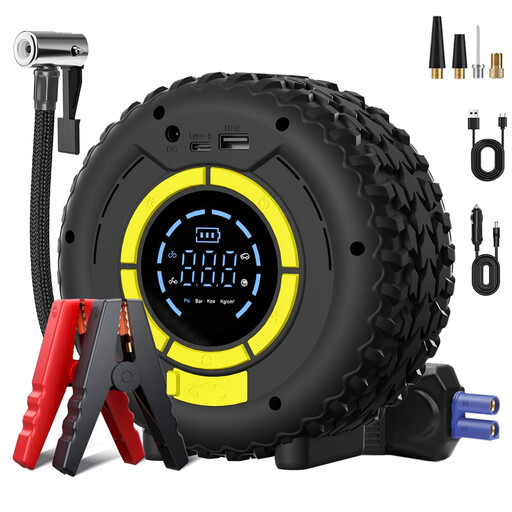
Why it's a good fit: It provides a solid basic feature set for the most common breakdowns with standard cars. The combination of a jump starter, compressor, and power bank covers essential emergencies without breaking the bank. Ideal for commuters and city vehicles.
The device focuses on providing sufficient power for petrol engines and a functional 150 PSI compressor. It avoids the trap of exaggerated but practically useless performance claims for this vehicle class.
Excellent multifunctionality (jump starter, compressor, power bank, LED) in a compact and lightweight body (approx. 600 g).

Why it's a good fit: With a very high peak current, this device is specifically designed for vehicles with large displacement engines (up to 9.0L petrol / 8.0L diesel, according to the manufacturer), where standard units would reach their limits. It provides the necessary power reserves for demanding conditions.
It delivers the high power required for large engines, avoiding the pitfall of underpowered devices. According to the manufacturer, its cooling technology reduces heat build-up and prevents the compressor from overheating.
Very high peak current of 4500A and 10 intelligent safety features, including reverse polarity protection and a spark-proof design.
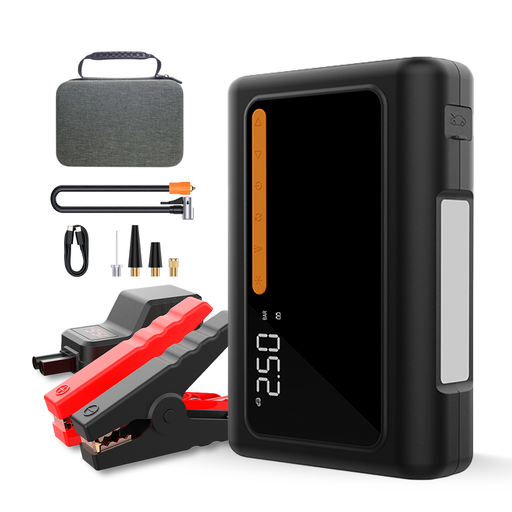
Why it's a good fit: Its sodium-ion battery technology makes it extremely durable and reliable in both heat and cold. Ideal for users who demand absolute operational safety under all circumstances and value longevity.
It solves the core problem of self-discharge and the limited lifespan of conventional batteries. According to the manufacturer, it remains ready for use even after long-term storage and maintains its functionality over thousands of cycles.
Sodium-ion battery for an extreme temperature range (-40°C to 80°C), very low self-discharge, and a high cycle life.
We have compiled a complete, up-to-date list of products that fully meet these strict selection criteria and all applicable safety regulations.
Most manufacturers recommend charging the device every 3 to 6 months to maintain battery health and ensure it's ready for use. Models with very low self-discharge, such as those with sodium-ion batteries, require less frequent maintenance charging. Please check the manufacturer's specifications for details.
No. The peak current is an important indicator, but the battery capacity (Wh), the quality of the jumper cables, and the integrated safety features (e.g., reverse polarity protection, short-circuit protection) are just as relevant. A well-designed overall system that is matched to your vehicle type is crucial for reliable performance.
Most units come with adapters for car, motorcycle, and bicycle tyres, as well as sports balls. The maximum pressure of up to 150 PSI is sufficient for these applications. However, these compact, portable compressors are generally not designed for the very large tyres found on trucks or agricultural vehicles.