For course feedback away from a mains socket, a portable keyboard is a good fit if its power supply, connection and layout suit your existing device. Choose between replaceable batteries and a pre-charged battery, depending on the length of your planned sessions. Logitech Support lists two CR2032 batteries for the Keys-To-Go 2, while Keychron Germany lists Bluetooth, 2.4 GHz wireless and wired operation for the B1 Pro. A separate keyboard does not replace your screen or give you access to your course materials.
Who is a portable keyboard suitable for?
Editing feedback without access to a charging point
If you’ll be entering comments for a long time while out and about, your first consideration should be how the keyboard is powered. Logitech Support lists two CR2032 button-cell batteries for the Keys-To-Go 2; according to the manufacturer, the Keychron B1 Pro is rechargeable.
Switching between multiple devices
If you switch between a smartphone, tablet or laptop while reading and replying, check the connection and operating system support for each device you plan to use. Samsung says the Smart Keyboard Trio 500 can connect to up to three devices; the options available may vary depending on the device.
Travelling light
If you carry your keyboard around regularly, its size and key protection matter just as much as the space you need to type comfortably. Logitech Support gives the Keys-To-Go 2 a weight of 222 g; compare its dimensions with your bag and your preferred typing experience.
What should you look for when buying?
Compact keyboard with replaceable batteries
A good fit if: you can’t plan to recharge while you’re out and about, and want to carry suitable spare batteries.
Trade-off: You’ll need to replace the batteries rather than recharge them; used batteries must be collected separately.
Rechargeable keyboard with multiple connection options
A good fit if: you can charge it before travelling and want to switch between devices.
Trade-off: You can’t recharge a flat battery without a power source. For 2.4 GHz wireless, the device you’re connecting to needs a suitable port for the receiver.
Keyboard designed for a specific device
A good fit if: you use a compatible Apple device and want a keyboard explicitly listed with a German layout.
Trade-off: Apple says the Magic Keyboard (USB–C) – German lasts around a month or longer before needing a charge; this figure is not directly comparable with battery-life claims from other manufacturers.
If you’re choosing a separate portable keyboard for course feedback without mains power, these four considerations can help you narrow down the right option for your everyday needs.
| Buying priority |
What to look for |
Who is it most important to? |
| Power supply |
Check the battery type or charging port, as well as the conditions behind any battery-life claims. |
If I’m typing for a long time away from a mains socket, it matters whether I can change the batteries or charge the keyboard beforehand. Around 33% of consumers put power supply first. |
| Connection and compatibility |
Check support for the specific device and operating system; for 2.4 GHz wireless, make sure there’s a suitable port for the receiver. |
If I switch between a smartphone, tablet or laptop, I need a connection that works with my devices. Around 27% of consumers prioritise device compatibility. |
| Size and key protection |
Compare the dimensions and carrying solution with the space available in your bag or on your desk. |
If I carry my keyboard around often, I want to be able to store it safely without having too little room to type. Around 20% of consumers put portability first. |
| German layout and typing experience |
Check the language variant actually selected and the function keys you need; “ISO” alone doesn’t confirm a German layout. |
If I write comments regularly, I want a familiar key layout. Around 20% of consumers prioritise layout and typing experience. |
Common buying pitfalls
-
“Wireless” doesn’t mean you can ignore the power supply
The models covered here use different types of power. Manufacturers’ battery-life claims aren’t based on a shared testing method, so they aren’t necessarily directly comparable.
Check the battery type or charging port, and plan how you’ll power the keyboard during your longest session away from a mains socket.
If you choose a model with replaceable batteries, make sure you have suitable spares. Used batteries should go in collection boxes or to local collection points, not in your household waste.
-
Assuming “ISO” means a German layout without checking
The Keychron B1 Pro product page lists other language variants alongside DE-ISO. So “ISO” on its own doesn’t tell you which key labels the selected variant has.
Before ordering, check the language variant selected and the key labels shown or described.
-
Expecting a separate keyboard to be a complete mobile workstation
According to Logitech, the cover on the Logitech Keys-To-Go 2 protects the keys. It doesn’t indicate that the keyboard has a built-in screen stand or provides access to course materials.
Separately, check how you’ll prop up your mobile device and access the course materials you need.
Depending on the equipment you already have, you may need a suitable stand for your mobile device.
Key brands at a glance
Logitech
The Keys-To-Go 2 is designed for typing on the move and comes with a key cover; the Pebble Keys 2 K380s is another compact Bluetooth range.
- Logitech Support lists a weight of 222 g, support for several platforms and two CR2032 batteries for the Keys-To-Go 2.
- For the Pebble Keys 2 K380s, Logitech Support lists two AAA batteries and a weight of 415 g including batteries. These details don’t apply to the Keys-To-Go 2.
Keychron
The B1 Pro is aimed at anyone looking for a slim, rechargeable model with several connection options and a selectable DE-ISO variant.
- Keychron Germany lists Bluetooth, 2.4 GHz wireless and wired operation; the battery life of up to 1,200 hours is a manufacturer claim.
- The product page also includes other language variants. “ISO” alone doesn’t confirm German key labels.
CHERRY
The KW 9100 SLIM is a low-profile keyboard that can use Bluetooth or a 2.4 GHz receiver.
- CHERRY lists a built-in lithium battery with USB-C charging and an integrated metal plate.
- If you need a particularly compact travel model, check separately that its size and weight suit your bag.
Samsung
The Smart Keyboard Trio 500 is designed for switching between compatible mobile devices; its model number is EJ-B3400.
- Samsung describes Bluetooth pairing and switching between up to three devices.
- Samsung says that pairing steps and available options may vary depending on the connected device.
Apple
The separate Magic Keyboard (USB–C) – German is a rechargeable keyboard for compatible Apple devices.
- Apple gives its weight as 239 g and says it can be used for around a month or longer before charging.
- Check the minimum operating system versions listed for your device. This model isn’t an iPad-specific Keyboard Folio.
Joybuy products for portable course feedback
The following Joybuy products include portable keyboards with different power supplies, connections and designs. Before choosing, pay particular attention to the layout and support for your device.
 No image available
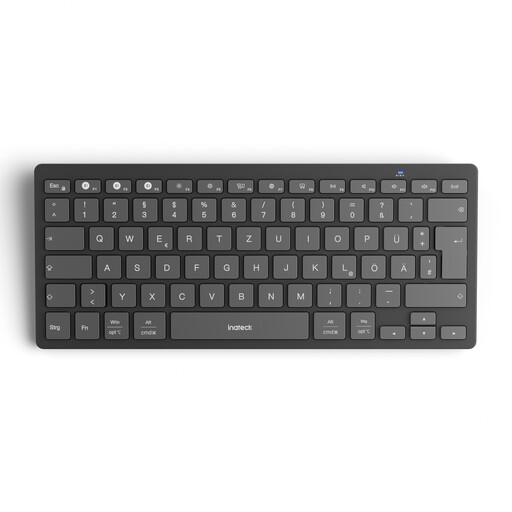
Inateck KB01003G Bluetooth keyboard, QWERTZ
For typing on the move with up to three connected devices; according to the product details, the keyboard runs on two included AAA batteries.
The listed key travel is 1.5 mm; the keycaps measure 15 × 15 mm.
View at Joybuy
 No image available
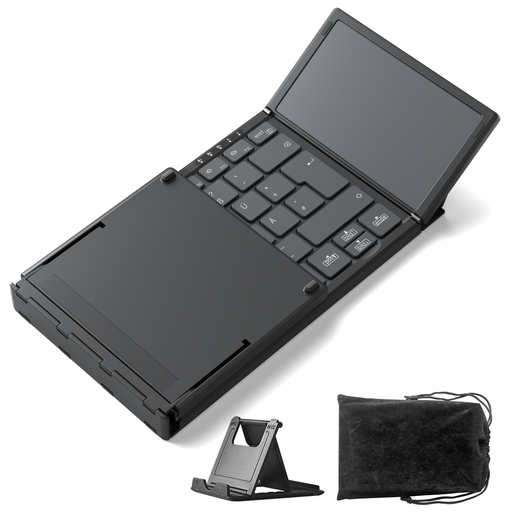
Inateck N0153BK foldable mini keyboard with touchpad
For frequent travel: the keyboard folds up and can connect to up to three Bluetooth devices, according to its description.
When folded, it measures 7.1 × 4.5 × 0.7 inches and weighs 228 g; key travel is 15 mm.
View at Joybuy
 No image available
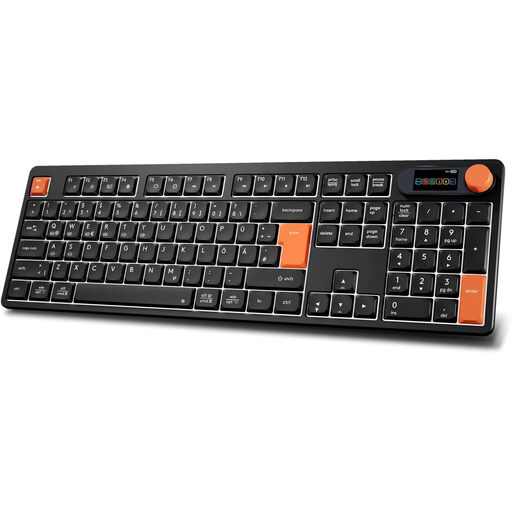
Wireless QWERTZ keyboard with LCD and rotary dial
For anyone who wants to choose between different connection types; Bluetooth, 2.4 GHz wireless and USB-C are listed.
The product details list four Bluetooth connections, a rechargeable 2,000-mAh battery, backlighting and a QWERTZ layout.
View at Joybuy
 No image available
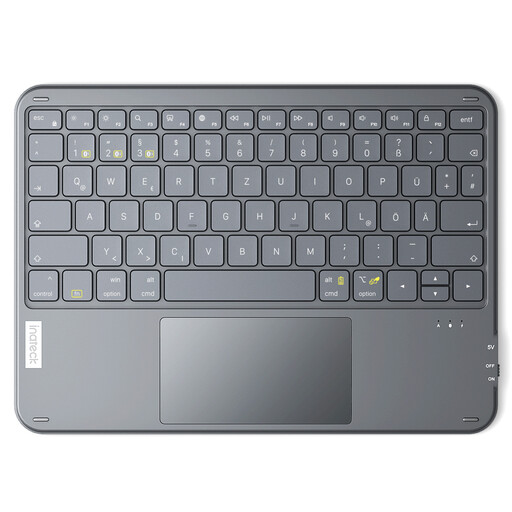
Inateck KB01105 tablet keyboard with touchpad
For typing on the move with a German QWERTZ layout and integrated touchpad; according to the description, it can connect to up to three Bluetooth devices.
It is listed as 5 mm thick, weighing 228 g, with up to 150 days on standby after a full charge.
View at Joybuy
 No image available
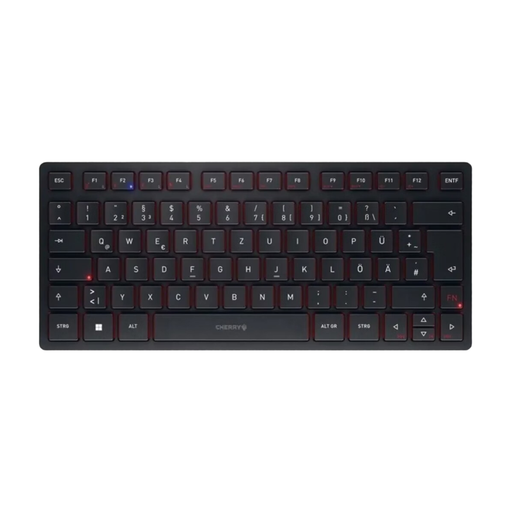
CHERRY KW 9200 MINI multi-device keyboard
For switching between multiple devices: according to the description, you can connect up to four devices via Bluetooth, 2.4 GHz or USB-C.
The keyboard has a rechargeable battery and is described as having a UK English layout. Check the key layout if you need a German one.
View at Joybuy
Frequently asked questions
Do I need a mains socket to pair a Bluetooth keyboard?
You don’t need a mains socket for the pairing steps described, as long as the keyboard and device you’re connecting to are switched on and ready to use. Samsung describes turning on the Smart Keyboard Trio 500, selecting the Bluetooth connection and confirming a code that appears on screen; check the battery level beforehand.
Can I read course feedback using just the keyboard?
No. A separate keyboard is an input device and needs a compatible smartphone, tablet or computer with a screen. Whether you can access course feedback without an internet connection also depends on the course app and the data available in it; being away from mains power doesn’t automatically mean you’re offline.
How should I dispose of batteries and a keyboard in Germany?
Used batteries and electrical equipment must not go in household waste. Germany’s Federal Environment Agency recommends using battery collection boxes in shops or local collection points, and free take-back schemes for electrical equipment. Remove any removable batteries before handing in the device.
What compliance information does the Federal Network Agency list?
For its market surveillance, the Federal Network Agency lists checks including the CE marking, an identifiable product and manufacturer, German instructions with any required warnings, and a declaration of conformity. A product description alone doesn’t prove that a specific item meets every requirement.
Can I compare battery-life claims for different keyboards directly?
Not necessarily: manufacturers’ claims aren’t based on a shared testing method. Logitech lists two CR2032 batteries for the Keys-To-Go 2, while Apple says the Magic Keyboard (USB–C) – German lasts around a month or longer before needing a charge. Choose based on the power type and how you plan to use it, rather than comparing the figures directly.


