Presenting colour-critical design work
If you want to assess colours together, the colour space and display mode should match your file. Manufacturer calibration claims are a useful starting point, but they do not verify your entire colour workflow.


Choose your portable monitor based first on the colour space of your design and the video and power connections available on your source device. A display with a suitable sRGB mode is an obvious choice for sRGB files, while a DCI-P3 model is better suited to a workflow designed for that colour space. Manufacturers’ claims about colour gamut and calibration, such as those from ASUS and ViewSonic for specific models, are no substitute for checking your entire colour workflow.
If you want to assess colours together, the colour space and display mode should match your file. Manufacturer calibration claims are a useful starting point, but they do not verify your entire colour workflow.
If you want to switch between a laptop and another source device in your hotel room, check the video output, monitor input and power supply in advance.
If the two of you want to look at details and text in a limited space, clear image quality, a suitable viewing position and a screen finish that works with the lighting all matter.
Choose a monitor to suit your design, your source device’s connections and the space available for reviewing it together.
| Requirement | What to check before buying | Who is this particularly important to? |
|---|---|---|
| Assessing the colours in your design | Compare the file’s target colour space and display mode with the specifications for the specific model. For decisions where accuracy is essential, check your own colour workflow. | If I want to assess colours with someone else, the display mode needs to match my file’s target colour space. Around 33% of consumers put accurate colour assessment first. |
| Video signal and power supply | For single-cable operation with the ASUS PA148CTV, ASUS Germany requires USB-C with DisplayPort Alt Mode and at least 10 W of power delivery from the source device. If using HDMI, check the power supply separately. | If I’m switching between source devices in a hotel, I want to know in advance that the video signal and power supply will work. Around 25% of consumers prioritise connections and power supply. |
| Reading details together | Lenovo Germany lists the ThinkVision M14d as 14 inches with 2240 × 1400 pixels; AOC Germany lists the 16T20E2 as 15.6 inches with Full HD resolution. Check the screen size, resolution, stand angle and space on the table. | If we’re checking details together at a small table, I need clearly readable text and a suitable viewing angle. Around 25% of consumers focus on readability when sharing the screen. |
| Easy to carry | Lenovo Germany lists the ThinkVision M14d at a net weight of 600 g; AOC Germany describes the 16T20E2 as having a magnetic cover that doubles as a stand. Also factor in a case, cables and any power supply you may need. | If I’m taking the monitor with me, I consider its weight, packed size, protection and the cables I’ll need. Around 17% of consumers prioritise ease of transport. |
USB-C alone doesn’t tell you whether the source device can send a video signal and power the monitor through the same cable. For single-cable operation with the PA148CTV, ASUS specifies DisplayPort Alt Mode and at least 10 W of power delivery from the connected device.
Before travelling, check your source device’s video output, power delivery and cable. Depending on the connection, you may also need to pack a suitable cable or a separate power source.
DCI-P3 and sRGB refer to different colour spaces. ViewSonic lists 100% DCI-P3 for the VP16-OLED, but that doesn’t automatically mean an sRGB design will be displayed in the right mode.
Choose the target colour space and display mode to suit your specific design file.
An HDMI input carries a video signal; it doesn’t mean the monitor is powered through that cable. AOC lists Mini-HDMI and USB-C as separate connection options for the 16T20E2.
If you plan to connect via HDMI, check how the specific monitor model is powered.
ASUS positions the ProArt PA148CTV for creative work. ASUS Germany lists a 14-inch IPS touchscreen with USB-C and Micro-HDMI for this model.
According to Lenovo Germany, the ThinkVision M14d is a 14-inch IPS monitor with a 16:10 aspect ratio and 2240 × 1400 pixels.
According to ViewSonic Europe, the ColorPro VP16-OLED is a 15.6-inch OLED monitor with USB-C, Micro-HDMI, a tripod mount and a hood.
AOC Germany describes the 16T20E2 as a 15.6-inch Full HD IPS monitor with Mini-HDMI, USB-C and a cover that doubles as a stand.
Dell Germany lists the Pro 14 Plus P1425 as a 14-inch IPS monitor with 1920 × 1200 pixels and a 16:10 aspect ratio.
This selection includes portable monitors for design presentations, with a range of screen formats and connection options. For each model, check that its colour space, display mode and power supply suit your needs, and that you have enough table space.
 No image available
For reviewing design work together on the go, provided your source device has compatible connections.
15.6 inches, 1920 × 1080 pixels, 60 Hz, IPS, HDMI and USB-C; the cover doubles as a stand.
 No image available
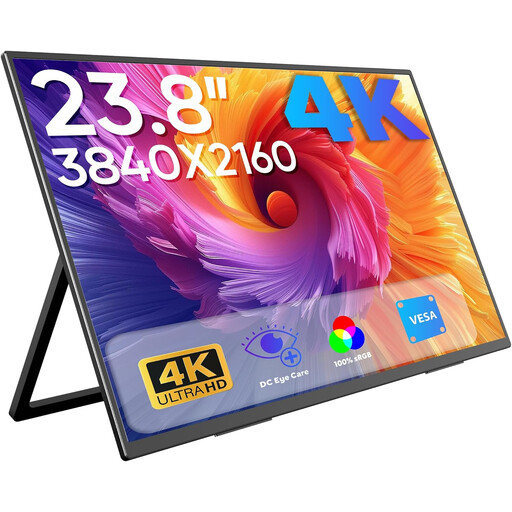
For reviewing fine details together, if you have room for the larger screen on your table.
3840 × 2160 pixels, 60 Hz, 100% sRGB according to the product listing, USB-C and Mini-HDMI.
 No image available
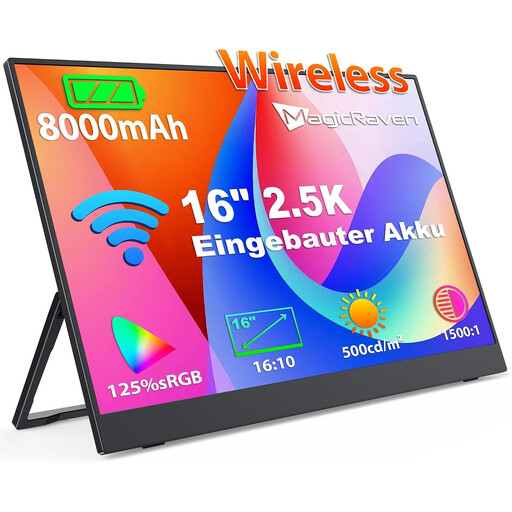
For presentations without a direct cable connection, if your source device supports AirPlay or Miracast.
IPS, 2.5K, built-in 8000 mAh battery and support for AirPlay and Miracast; the product listing also states 125% sRGB.
 No image available
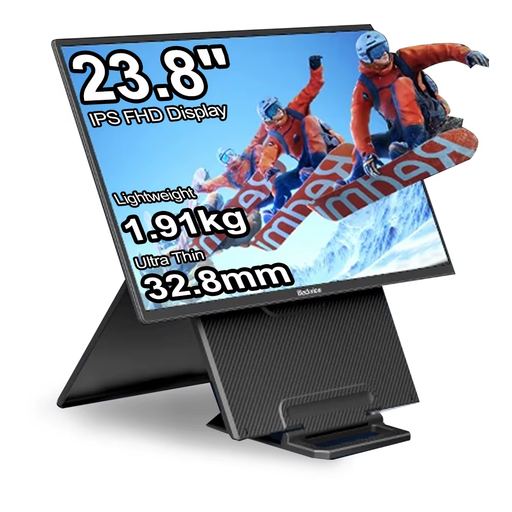
For an sRGB design with different source devices, if the available inputs suit your setup.
IPS, 1920 × 1200 pixels, 100 Hz and 100% sRGB according to the product description; two USB-C ports and Mini-HDMI.
 No image available
For reviewing work together when you want to position the monitor flexibly on the table.
IPS, 1920 × 1200 pixels, 16:10, two USB-C ports and Mini-HDMI; the monitor is described as having a rotating magnetic stand.
No. For single-cable operation with the ASUS PA148CTV, ASUS requires USB-C with DisplayPort Alt Mode and at least 10 W of power delivery from the source device. This specific requirement applies to the model mentioned; check the connections and power supply for your own setup.
No. A wider or different colour space isn’t automatically better suited to an sRGB file. ViewSonic lists 100% DCI-P3 for the VP16-OLED; check the selected colour mode and make sure it matches your design’s target colour space.
Check the right colour mode, how readable your file is at the planned display size and the viewing angle on the table. Specifications for colour space, resolution and stand function can help you shortlist a monitor, but they’re no substitute for testing it with your source device and file.
When planning what to pack, consider the cover, cables and any power supply as well as the monitor itself. Lenovo Germany lists the ThinkVision M14d at a net weight of 600 g; that isn’t the weight of your complete travel kit.