People checking fine details
If you need to read measurements, labels or lines on a floor plan, compare the screen size and resolution with how your planning software displays them.


First, use a typical section of your floor plan to check whether the screen size and resolution show the details clearly in your software. Then check your computer’s video output and power supply. A larger or higher-resolution display may be useful for fine plan details, while a more compact device takes up less room. Touch is mainly relevant if your computer and planning software support it.
If you need to read measurements, labels or lines on a floor plan, compare the screen size and resolution with how your planning software displays them.
If you use different computers or connections while travelling, check the video output, compatible cables and power supply for your complete set-up.
On a small hotel desk, you’ll need room for your laptop, monitor and any paperwork. The stand, cables and packed dimensions should all factor into your choice.
Suitable if: You regularly check labels and fine lines, and can compare a typical section of your floor plan with the display’s size and resolution.
The trade-off: More pixels don’t guarantee better readability; scaling and the display size set in your software also matter.
Suitable if: You’re not sure which video output your computer has and want to check whether an alternative signal path, such as Mini-HDMI, will work.
The trade-off: An extra video input doesn’t automatically solve the power supply question; the cables and power source need to suit your set-up.
Suitable if: Space on your hotel desk is limited and you want to make changes directly on the plan.
The trade-off: A smaller screen may mean zooming in more often; touch and stylus input need to work with your computer and software.
| Buying priority | What to check | Who is this important to? |
|---|---|---|
| Reading floor plan details | View a typical section of your plan at the intended display size; compare the screen size and resolution. | If I need to reliably make out measurements and fine lines, how my usual section of the plan is displayed matters most. Around 36% of consumers put readability of details first. |
| Connecting video and power | Check the computer’s video output, the monitor’s input, the right cable and the power source as one complete connection. | If I use different devices while travelling, I want to know in advance whether the video signal and power supply will work together. Around 29% of consumers prioritise connections and power. |
| Transport and set-up | Check the dimensions, space needed, stand, case and cables for the specific model. | If I work at a small hotel desk and need to take the monitor with me, the set-up and packed size are essential. Around 21% of consumers focus first on portability and space requirements. |
| Making changes directly on the plan | Check that touch and, where applicable, stylus input work with your specific computer and planning software; check what’s included. | If I want to make changes directly on the second screen, I need an input method that works with my software. Around 14% of consumers put direct input first. |
Having the right connector shape alone doesn’t prove that your computer can output video over USB-C. An extra video input also doesn’t answer the question of how the monitor will be powered.
Before buying, check the full connection from your source device’s video output, through the cable, to the monitor input, as well as the power source required.
Depending on the connections, you may also need a compatible cable, an adaptor or a separate power source.
More pixels alone don’t tell you whether small labels will be easy to read with the scaling in your planning software.
Check a representative floor plan using the software and display size you intend to use while travelling.
A display’s touch and stylus features don’t tell you whether the entire input process will work with your computer and planning software.
Only prioritise direct input if you need it, and check compatibility as well as whether a stylus, if required, is included.
If you want to write directly on the display, check in advance whether a suitable stylus is included or needs to be bought separately.
AG Neovo lists a 15.6-inch 4K OLED display, USB-C and Mini-HDMI for the N1651.
According to Lenovo, the ThinkVision M14t Gen 2 combines a 14-inch display with 2240 × 1400 pixels, touch and stylus support.
ASUS describes the ZenScreen MB16AHV as an anti-glare 15.6-inch Full HD model with USB-C and Mini-HDMI. The MB16AHG is also 15.6 inches and, according to the manufacturer, has a 144 Hz refresh rate.
According to AOC, the 16T20E2 has a 15.6-inch Full HD IPS display, USB-C video input and Mini-HDMI; its case also serves as a stand.
According to MSI, the PRO MP165 E6 is a portable 15.6-inch Full HD IPS display with an HDMI port.
Here you’ll find portable monitors to compare for resolution, connectivity and space requirements when reviewing hotel room floor plans.
 No image available
An option to consider if you want to view a detailed section of a floor plan on a portable screen.
Listed in the product name: 2560 × 1600 pixels, 16:10, 144 Hz, Mini-HDMI and Type-C. Check your computer’s video output and the power supply required.
 No image available
An option to consider if you’re looking for a portable 16-inch display for floor plan content.
Listed in the product name: IPS display, 2560 × 1600 pixels, 16:10, USB-C and HDMI. Readability also depends on the scaling in your planning software.
 No image available
An option to consider if you want to set up a monitor with a stand on different desks.
Listed in the product name: 15.6 inches, 1920 × 1080 pixels, 60 Hz, IPS display, HDMI, USB-C and built-in stand. Full HD has fewer pixels than higher-resolution displays; how clearly fine labels appear also depends on the software display settings.
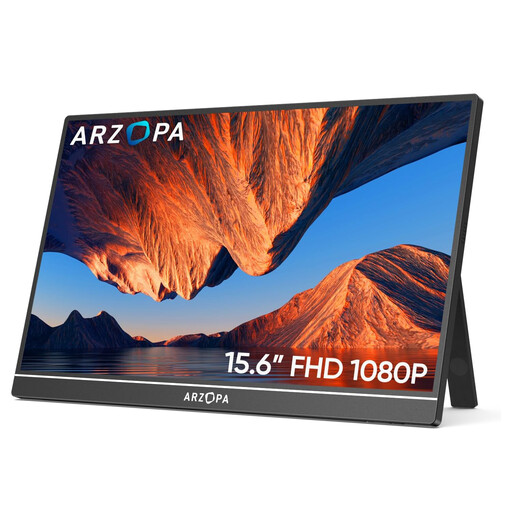 No image available
An option to consider if you’re looking for a portable 15.6-inch monitor with more than one listed connection option.
Listed in the product name: 1920 × 1080 pixels, IPS display, USB-C and HDMI. Product information lists a weight of 780 g; how clearly fine labels appear also depends on the display size set in your planning software.
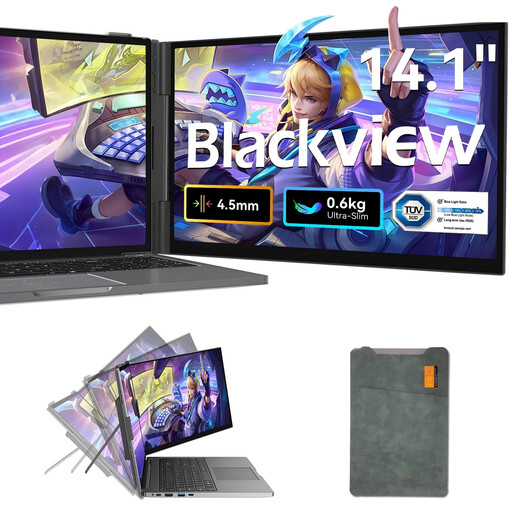 No image available
An option to consider if you want a smaller display with a built-in stand for travelling and desk use.
Listed in the product name: 14 inches, 1920 × 1080 pixels, IPS display, 600 g and 4.5 mm, plus a built-in stand. Full HD has fewer pixels than higher-resolution displays; check how clearly fine details appear in your software.
No, not just because the labels are small. More pixels are a display feature; readability also depends on the screen size and the display size set in your planning software. Check a typical section of your plan at the intended display size before making resolution your deciding factor.
No, the connector shape alone isn’t enough to confirm this. Check whether your laptop can output video over USB-C, and whether the input, cable and power supply are compatible with the monitor. ASUS specifically notes that the laptop port needs to support display output for the MB16AHV.
Check whether your laptop, monitor and paperwork will all fit on the desk space you plan to use. Also compare the stand, case, cables and power source required. According to the manufacturer, the case for the AOC 16T20E2 also serves as a stand; check what’s included in the specific offer.
When you buy as a consumer from a retailer, faulty goods are generally covered by a statutory warranty for at least two years from receipt. Many online purchases are also covered by a right to cancel, usually within 14 days. These consumer rights don’t automatically apply to purchases from private individuals or business purchases; a voluntary manufacturer’s guarantee doesn’t replace the statutory warranty.
Goods sold in the EU must meet the relevant product safety requirements. Certain product groups, including electrical and electronic equipment, may need to carry the CE marking. By affixing the CE marking, the manufacturer declares that the product complies with the relevant EU rules; it isn’t a general independent quality mark. Check the information provided for the specific device and power supply.