Anyone working on presentations with lots of sources
If you want to keep your draft, research and notes in view at the same time, usable screen space and resolution are important factors to consider.


When working on presentations in the library, first check whether your laptop can send a video signal and provide enough power through the connection you plan to use. A USB-C port alone does not guarantee video output. Next, consider how much space you have: a more compact display is easier to fit on a small table, while a larger or higher-resolution model gives you more screen space but takes up more room in your bag and in the library. Touch and OLED only matter if you’ll actually use those features.
If you want to keep your draft, research and notes in view at the same time, usable screen space and resolution are important factors to consider.
If you take your monitor with you regularly, it should be easy to carry and stable on the table space available.
Before choosing, check whether your laptop can transmit video and provide enough power over USB-C, or whether you’ll need HDMI and a separate power supply.
First, check your laptop’s video output and power supply. Then compare screen space and carrying dimensions, and only consider specialist features if you have a specific need for them.
| Consideration | What to check when buying | Who is it important for? |
|---|---|---|
| Connection compatibility | Check whether your laptop and monitor can transmit video through the USB-C port you intend to use with DP Alt Mode, or through HDMI. A USB-C port alone does not confirm video output. | If I want to open my slides and sources on a second screen, my laptop must be able to output a video signal. Consumers who put connection compatibility first are likely to account for around 36%. |
| Usable screen space | Compare the aspect ratio and native resolution: Lenovo lists 1920 × 1200 pixels for the ThinkVision M16, while LG lists 2560 × 1600 pixels for the 16MQ70. | If I want to view slides alongside research or notes, the usable space on my desk matters. Consumers whose main priority is screen space are likely to account for around 29%. |
| Portability and desk space | Allow for the monitor, stand, case and cables. Verbatim lists a weight of 540 g for Display #49590; Lenovo lists 980 g for the ThinkVision M16. | If I take the monitor with me regularly and set it up on a small library table, a portable design is important. Around 21% of consumers are likely to prioritise portability. |
| Power supply | Check the requirements of the specific model against the power output of your laptop’s port. LG requires DP Alt Mode and USB-PD output of more than 7.5 W for the 16MQ70; this requirement does not apply to all monitors. | If there’s no socket available at my library desk, I want to know whether my laptop can power the monitor. Consumers for whom power supply is the main concern are likely to account for around 14%. |
For a USB-C connection to carry a video signal, both your laptop and monitor must support the required video mode. Otherwise, the screen may stay blank even if the port fits.
Check your laptop’s port specifications and the requirements of the monitor you’re considering before choosing a model.
If the ports don’t match, you may also need a suitable adapter.
According to the manufacturer, Verbatim Display #49590 needs a separate power supply when connected via HDMI.
Check the connections and what’s included with your chosen model, and consider whether there’ll be a socket available where you’ll be working.
For HDMI use, you may need a separate power source as well as the signal cable.
These features serve different purposes. For example, the ASUS MQ16FC datasheet lists a glossy screen and no speakers. Make sure features like these suit the way you work.
Start with connectivity, power supply and the screen space you need. Consider extra features afterwards, and only if they serve a specific purpose when you’re working on presentations.
The range includes compact models for use on the go, with specifications varying from model to model.
The ThinkVision range offers portable second screens in a variety of sizes and specifications.
The +view 16MQ70 is a 16-inch model with a 16:10 aspect ratio.
The ZenScreen range includes a variety of specifications; the MQ16FC is a 16-inch OLED model.
The 16T3EA is a portable Full HD monitor with a built-in stand.
This selection includes compact 14-inch models and larger 16-inch displays for working on presentations. Before choosing, check in particular whether your laptop and monitor can transmit video through the connection you plan to use, and how the specific model is powered.
 No image available
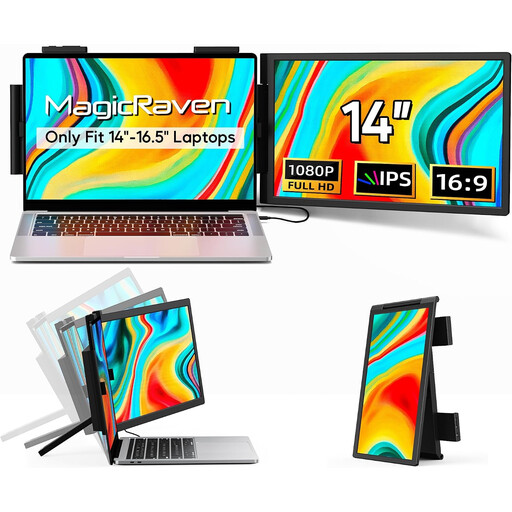
A compact second-screen option, provided your laptop can output video through the connection you choose.
14 inches, Full HD at 1920 × 1080 pixels, IPS and 60 Hz.
Connections: HDMI, USB-A and USB-C. The product name states that it is designed for laptops from 14 to 16.5 inches; compatible operating systems listed are Windows, Mac and Android.
 No image available
The 16:10 format is worth considering if you’re looking for a compact second screen for slides and supporting material.
14 inches, 1920 × 1200 pixels and IPS.
Connections listed in the product name: USB-C and Mini-HDMI.
 No image available
A compact screen with an adjustable stand, ideal if you want to set up your monitor on a library table.
14 inches, FHD and IPS; the product listing specifies a profile of 18.2 mm and a 1.5 W speaker.
The product name lists laptops from 13 to 17.3 inches as compatible device sizes.
 No image available
The larger format may suit you if you want more screen space for your slides and supporting material, but remember to allow for more desk space.
16 inches and 16:10. The product name also mentions a retractable, rotating magnetic stand.
The product name lists PC, smartphone, tablet and MacBook as compatible devices.
 No image available
A larger display option if you want more screen space for your slides and supporting material.
16 inches, 16:10, IPS and 2560 × 1600 pixels.
The product name lists USB-C and HDMI, as well as HDR, 500 nits and 8 bit.
No, the shape of the port alone is not enough. Both your laptop and monitor must support the required video signal, and you should also check the power requirements of the specific model. LG explicitly requires DP Alt Mode and USB-PD output of more than 7.5 W for the 16MQ70.
Connect a compatible monitor using the appropriate video cable. If you want to view your slides and sources separately, select the extended display mode on your laptop rather than mirroring the screen. Check the power supply too: according to the manufacturer, Verbatim Display #49590 needs a separate power supply for HDMI.
Disconnect the cables before packing your monitor away, and use a protective case that fits the model. Follow the care instructions provided by the relevant manufacturer when cleaning it.
No. When you buy consumer goods in Germany, you have statutory rights against the seller; the German Federal Government describes a general two-year period. A manufacturer’s warranty is separate from these rights. Online purchases are also generally covered by a 14-day right of withdrawal; the Verbraucherzentrale gives the point of reference as the conclusion of the contract or receipt of the goods ordered. The terms depend on the individual contract.
Products covered by relevant EU harmonisation legislation must carry the CE marking in accordance with the applicable rules. Your Europe states that monitors with a screen area of more than 100 cm² require a WEEE label; energy labelling also applies to computer monitors covered by EU display regulations. The labels required for a specific model depend on the product and the regulations that apply.