Readers of detailed manuals
If you want to keep text, tables and technical drawings open alongside your work application, weigh readability and screen space against the room you have available.


When choosing a portable monitor, first check whether typical PDF pages are easy to read at your usual zoom level. Then make sure your laptop or tablet has the right video output and can supply power. A 14-inch model usually takes up less space on your desk and is easier to carry, while 15.6- to 16-inch models offer a larger viewing area but need more room. Touch is mainly useful if you want to interact with or annotate the manual directly on the extra screen.
If you want to keep text, tables and technical drawings open alongside your work application, weigh readability and screen space against the room you have available.
If you use a laptop or tablet on the move, the video connection, cable and power supply need to be compatible with that specific device.
If you repeatedly set up and pack away your workstation between client appointments, portability, a protective case and a practical stand are important things to consider.
Check a typical manual page at the zoom level and scaling you plan to use. Then make sure the connections and power supply are compatible with your device, and decide how much screen space you can carry and set up between appointments.
| Buying priority | What to check before buying | Who it matters most to |
|---|---|---|
| Readability | Check a typical manual page at a suitable zoom level, scaling and viewing distance; consider the aspect ratio, anti-glare finish and tilt. | If you need to read text and technical drawings reliably on the extra screen, how they actually appear is crucial. Around 31% of consumers put readability first. |
| Connectivity and power | Check the video output of the specific device port, along with the cable and power supply; for HDMI, also check whether a separate power input is needed. | If you want to use the monitor with a particular laptop or tablet, its video output and power supply must be compatible with that device. Connectivity is the top priority for around 31% of consumers. |
| Portability and set-up | Consider the monitor’s dimensions and weight, as well as what’s included, the stand and the desk space available. | If you regularly pack the screen away between client appointments and set it up in different locations, portability and an easy-to-use stand matter. Around 25% of consumers prioritise portability. |
| Touch controls | Check touch support for the exact model, as well as the operating system, connection method and any stylus accessories you may need. | If you want to browse or edit the manual directly on the extra screen, the controls need to work with your device and application. Around 13% of consumers put touch first. |
The USB-C connector alone doesn’t confirm that the port can output video. Without a compatible video output, the monitor won’t display a picture.
Check whether the specific device port supports DisplayPort Alt Mode. If you’re using HDMI, also allow for a separate power supply if your chosen model needs one.
More pixels won’t automatically make a PDF page appear larger. The text size you see also depends on zoom and your operating system’s scaling.
Open a typical manual page using the settings you plan to use on the move, then choose the screen size and resolution that work for you.
These features aren’t essential for displaying a static manual. Touch only matters if you actually want to interact directly with the extra screen.
First, check readability, connections, power supply and portability. Consider specialist features only if you have a specific use for them.
The ThinkVision M14t Gen 2 and M16 offer different screen sizes for use on the move.
The Pro 14 Plus P1425 is a compact 14-inch option for an extra screen to view documents.
The gram +view 16MR70 combines a 16-inch screen with a cover that doubles as a stand.
The ZenScreen MB16AHVE offers USB-C and Mini-HDMI as different ways to connect.
The 16T20E2 is a 15.6-inch Full HD option with USB-C and Mini-HDMI.
This selection includes portable extra monitors in compact and larger formats for reading manuals on the move. Compare the display specifications listed with how you typically view PDFs, and check that your device has the connections you need.
 No image available
The 16:10 format is worth considering if you want to view manual pages on a portable extra screen.
15.3 inches; 1920 × 1200 pixels; IPS; 60 Hz.
 No image available
The 16:10 format and larger screen are worth considering if you want more space to view manual pages.
16 inches; 2560 × 1600 pixels; 16:10; Mini-HDMI and Type-C.
 No image available
This larger format may suit you if you want to view manual pages on a portable screen and use the connection types listed.
16 inches; 2560 × 1600 pixels; 16:10; IPS; USB-C and HDMI.
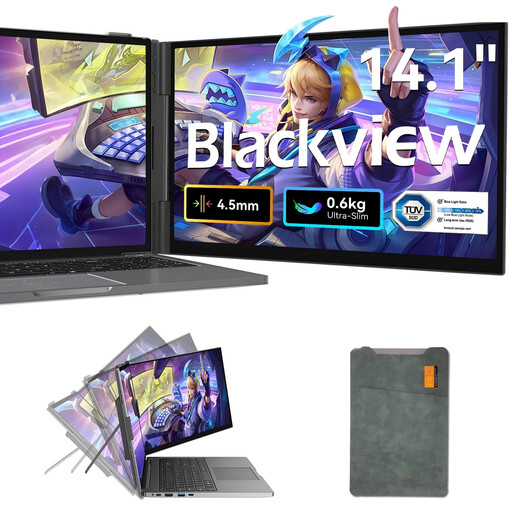 No image available
The compact 14-inch format and built-in stand are useful if you move the screen around frequently.
14 inches; FHD; IPS; 600 g; 4.5 mm; built-in stand.
 No image available
The built-in adjustable stand can make it easier to set up the extra screen at your destination.
15.6 inches; 1920 × 1080 pixels; IPS; USB-C and Mini-HDMI.
Not necessarily. The specific port must support DisplayPort Alt Mode for video and provide the required power. ASUS recommends checking this for the MB16AHVE; as an alternative, the manufacturer describes using HDMI together with USB-C as a power input.
Check the stand and orientation options for the specific model. According to LG, the included cover for the 16MR70 acts as a stand in both portrait and landscape orientations. Then rotate and scale the PDF view to suit.
For online purchases made by consumers from a trader, the EU generally provides a 14-day right to withdraw and a minimum two-year legal guarantee against the seller for faulty goods; exceptions and details apply. These consumer rights don’t automatically apply to purchases made on behalf of a business.
CE marking is required before electrical and electronic equipment covered by the relevant EU regulations can be placed on the market. It is the manufacturer’s declaration of conformity, not an independent product quality mark. The German Environment Agency explains that municipal collection points generally accept waste electrical equipment free of charge.