Photographers with colour-critical portfolios
When you discuss colours and tonal values with clients, colour gamut and accuracy specifications, as well as the lighting at the viewing location, are important factors to consider.


For colour-critical discussions, documented colour gamut and colour accuracy specifications are important; if distracting light is an issue, positioning and shielding matter too. Before you buy, check that your camera, laptop or smartphone can output a compatible video signal and power the monitor. A lightweight IPS model and an OLED model with a wide colour gamut won’t necessarily meet these needs equally well.
When you discuss colours and tonal values with clients, colour gamut and accuracy specifications, as well as the lighting at the viewing location, are important factors to consider.
For presentations at off-site appointments, you need a portable screen that you can position to suit the lighting conditions.
If you switch between a camera, laptop or smartphone depending on the appointment, the video output, cables and power supply need to suit your setup.
First decide whether you need to assess colours or mainly show images. Then check the lighting conditions at the location, along with the video connection and power supply.
| Buying consideration | What to look for | Who is this important for? |
|---|---|---|
| Colour reproduction | Check the colour gamut and accuracy specifications for the exact model, as well as its picture mode and the lighting at the presentation location. ASUS specifies 100% DCI-P3 and ΔE ≤ 2 for the MQ16AH; Lenovo gives 100% sRGB for the ThinkVision M14t Gen 2. | If you want to assess colours and tonal values with clients, look for clear specifications for the exact model you’ll be showing. Around 28% of consumers put colour reproduction first when choosing. |
| Connectivity and power | Check the source device’s video output, the picture mode supported by the monitor input, the cable and the power supply for the complete setup. AOC specifies USB-C with DisplayPort Alt Mode for the 16T20E2. | If you switch between a camera, laptop and smartphone, you’ll want a compatible video connection and sufficient power at the location. Around 22% of consumers prioritise connectivity and power supply. |
| Visibility in changing light | Check the screen finish, viewing angle and suitable shielding at the actual location. For the MQ16AH, ASUS distinguishes between typical brightness of 360 cd/m² and HDR peak brightness of 400 cd/m²; ViewSonic describes the VP16-OLED as having a foldable glare shield. | If you present in different locations, you’ll want to take distracting reflections and ambient light into account when positioning the monitor. Around 22% of consumers prioritise visibility in changing light. |
| Portability and positioning | Consider the weight and screen size of the exact model, as well as its stand and the accessories you’ll actually need. Lenovo lists the ThinkVision M14t Gen 2 as 14 inches and 700 g. | If you take the monitor to off-site appointments, look for a portable device that you can position to suit each location. Around 17% of consumers prioritise easy transport and setup. |
| Features you need | Before buying, decide whether you need colour checking, touch functionality or specialised shielding, and check that the connections you actually need are available. A single colour gamut figure doesn’t prove the colour accuracy of the entire setup. | If the essential features are enough for your presentation, you’ll want to choose extras only when you really need them. Around 11% of consumers prioritise the functions they need without unnecessary extras. |
Whether an image appears depends on the source device’s video output and the picture mode it supports. With HDMI, you may also need a USB connection for the touch function.
Before your appointment, test the complete setup with the device, cable and monitor you plan to use.
Depending on your setup, you may need a compatible cable, a different video connection or an additional power source.
ASUS’s specifications distinguish between typical and HDR peak brightness, and list the MQ16AH as having a glossy screen. ViewSonic describes the VP16-OLED as having a hood to shield it from distracting ambient light.
Check reflections, viewing angles and picture mode at the planned viewing location. Only compare brightness figures if they were measured under comparable conditions.
Different model names can refer to products with different features. So you can’t assume that specifications for one version also apply to another just because their names are similar.
Check the full model name and the features that matter to you before relying on a review or product specification.
The ColorPro VP16-OLED is designed for reviewing images on the go, where a glare shield can be useful at the viewing location.
The ZenScreen OLED MQ16AH is a potential option for mobile presentations where colour gamut specifications and different video connections matter.
The ThinkVision M14t Gen 2 is worth considering if you’re looking for a compact touchscreen with documented sRGB coverage.
The 16T20E2 and 16T2 are different portable monitor options, so you should compare them based on their individual features.
The A1 is an IPS option for showing prepared photos; the Z1RC is part of a separate product range with a higher resolution.
The portable monitors below offer different options, from basic Full HD IPS models to devices with a higher resolution or specified colour gamut coverage. For each model, check that the connections and power supply are compatible with your source device.
 No image available
For presenting your portfolio on the go, provided your source device has a compatible video connection.
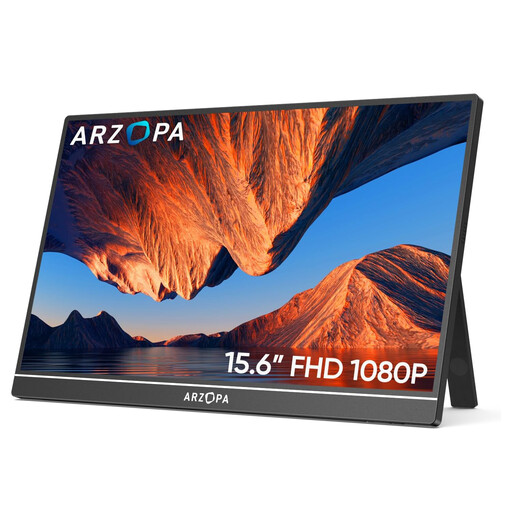
The product name specifies a 15.6-inch FHD display with an IPS panel, HDR, built-in speakers, HDMI and USB-C.
 No image available
For viewing detailed portfolios, if the higher resolution suits your presentation setup.
The product name specifies a 16-inch IPS display with 2560 × 1600 pixels, plus USB-C and HDMI. No specific brightness figure can be assumed for this model.
 No image available
For presenting on the go, if an FHD portable display suits your video signal.
The product name specifies an IPS panel, HDR, USB-C and built-in speakers. Check your source device’s video output and available power supply.
 No image available
For viewing a colour-conscious portfolio, if the sRGB coverage stated in the product name meets your selection criteria.
The product name also specifies a built-in stand, speakers and USB-C. Check that the connections and positioning will work for your appointment.
 No image available
For showing prepared photos on the go, if colour-critical assessment isn’t your main priority.
The product name specifies an IPS display with 1920 × 1080 pixels, plus USB-C and HDMI. The UK Joybuy product page lists 65% sRGB for the A1; bear this figure in mind when assessing colour-critical portfolios.
Only if that particular camera outputs a compatible video signal and the plug and cable fit the monitor input. ViewSonic describes a Micro-HDMI camera connection for the VP16-OLED; you should also check the USB-C power supply for your setup.
No. Check the source device’s video output, supported picture mode, cable and power supply separately. AOC specifies USB-C with DisplayPort Alt Mode for the 16T20E2; for touch functionality via HDMI on the 16T2, an additional USB connection is needed.
If possible, try out the positioning and viewing angle at the planned viewing location. ViewSonic says the VP16-OLED can be used with its foldable stand and foldable glare shield; a shield won’t eliminate every challenging lighting condition.
Your statutory rights in relation to faulty goods apply against the seller and are separate from any voluntary guarantee. For distance sales to consumers, there is generally a right to cancel within 14 days; exceptions and the exact start of the cancellation period depend on the contract.
The EU lists screens and monitors with a surface area of more than 100 cm² as equipment that must carry WEEE marking; the crossed-out wheelie bin indicates separate collection. The manufacturer is responsible for meeting the applicable requirements and affixing the CE marking. This does not establish whether an individual offer is compliant.