What should you look for when choosing one?
First, check that you’ll be able to read your manual pages clearly at your intended work location and power the monitor from your existing device. Then consider weight, positioning, power supply and how you’ll use the screen.
| What you need |
What to check before buying |
Who it matters most to |
| Reading manual pages |
Compare the screen size, aspect ratio, resolution and surface with a typical page; consider the positioning and lighting at your work location. |
If I need to make sense of lengthy instructions or small drawings, a suitable display matters more to me than a high pixel count alone. Around 25 % of consumers put readability first. |
| Video connection |
Check the laptop or tablet’s video output, the monitor input and the cable; for USB-C, make sure DP Alt Mode and power delivery are supported. |
If I switch between a laptop and tablet, I want to know whether each device actually outputs a video signal. Around 25 % of consumers prioritise device compatibility. |
| Transport and positioning |
Compare the weight and dimensions with your bag, and check that the stand and tilt suit the available work surface. |
If you often carry the screen and set it up on different or limited surfaces, pay particular attention to its size when packed and how securely it stands. This is the main consideration for around 20 % of consumers. |
| Power supply |
Check separately whether a mains adaptor, suitable USB-C port or battery is available for the monitor and source device; don’t treat mAh figures as a promise of battery life. |
If there’s no reliable mains socket on site or I want to preserve my computer’s battery, I plan for both devices to have power. Around 20 % of consumers put power supply first. |
| Touch controls |
Check compatibility with your operating system, connection and PDF software. |
If I want to interact with pages or enter information directly on the extra screen, touch matters to me; it isn’t essential for reading alone. Around 10 % of consumers prioritise touch controls. |
Joybuy products for reading manuals on the go
This selection includes portable monitors with different screen sizes and connection or power options for reading manuals on the go. Before buying, check compatibility with your source device and the conformity information for the specific listing.
 Image unavailable
PM14R, 14 inches, 16:10, 1920 × 1200
The 16:10 format may suit longer manual pages if it matches your preferred layout.
IPS display; USB-C and Mini-HDMI listed as inputs. Check that your laptop or tablet has the right video output.
View at Joybuy
 Image unavailable
Blackview DCM6 PRO, 14 inches
The laptop extender design may suit you if you want to use the extra monitor with a compatible laptop.
FHD display with 1920 × 1080 pixels and a built-in stand. The listed extender compatibility covers laptops from 13 to 17.3 inches.
View at Joybuy
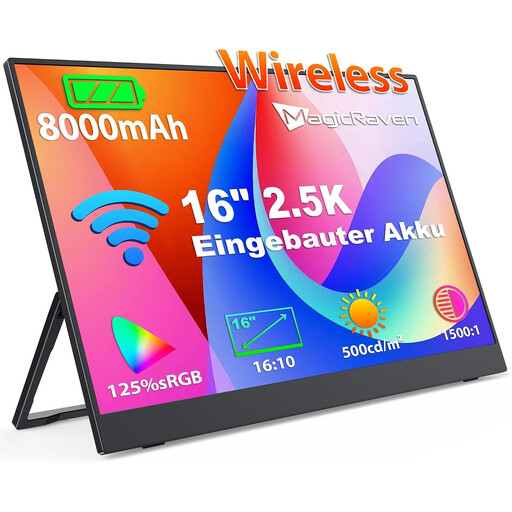 Image unavailable
Portable 16-inch monitor, 2.5K, 8000 mAh battery
The built-in battery may be useful if there’s no suitable power source for the monitor at your work location.
An IPS panel, 1600p resolution and support for AirPlay and Miracast are listed. Check compatibility with your source device; the battery capacity alone doesn’t tell you how long it will last.
View at Joybuy
 Image unavailable
UPERFECT, 15.6 inches, 1920 × 1080
The larger 15.6-inch format may suit you if you want more physical screen space for documents at your work location.
IPS display with 1920 × 1080 pixels; USB-C listed. Compare the dimensions with your carrying bag and check your device’s video output.
View at Joybuy
 Image unavailable
UPERFECT, 15.6 inches, 100% sRGB
The 15.6-inch screen may be a good option for manuals when you have a fixed place to set it up.
IPS display with 1920 × 1080 pixels and an integrated adjustable stand. USB-C and Mini-HDMI are listed as connections; check compatibility with your source device.
View at Joybuy
Frequently asked questions
Is a USB-C port on my laptop enough for video and power?
No. The specific port must support the required video transmission and provide enough power. For a full USB-C connection to the TD1655, ViewSonic explicitly requires DisplayPort 1.2 Alt Mode and power from the source device; check the specifications for both devices.
How should I position the screen for reading lengthy instructions?
Choose a screen format, stand and tilt that suit your manual pages and the place where you’ll set it up. Lenovo lists an adjustable stand for the M14d. ASUS lists automatic rotation via DisplayWidget Center for the MB16AHVE; check whether this feature works with your software.
Is a portable monitor automatically suitable for outdoor use?
No. Don’t assume a model is weatherproof unless this is explicitly confirmed. ASUS lists an operating temperature of 5 to 35 °C for the ZenScreen Go MB16AHP; this is a manufacturer specification for this model, not a general certification for outdoor use.
Which marking is relevant for products sold in Germany?
CE marking is required when the relevant harmonised EU rules require it for the product. The German Federal Network Agency lists marking and manufacturer information among the checks carried out as part of market surveillance; CE isn’t an independent quality mark for readability or durability.
What happens if a product develops a fault after purchase in Germany?
Your statutory rights against the seller and a voluntary guarantee are two different things. If a product is faulty, the first remedy may be repair or replacement; your specific rights depend on the purchase and the circumstances.


