What should you look for when buying?
When working on a train, the screen size, connection and power supply should suit both your laptop and the space available.
| What matters |
What to check before buying |
Who will find this most important? |
| Usable screen space |
Screen size, aspect ratio and native resolution; check how it looks with your usual text-scaling settings. |
If I want to read recipe text and sources at the same time, I need a practical amount of screen space for documents. Around 33% of consumers put readable screen space for text and sources first. |
| Video signal and power |
Check video output from the specific USB-C port, power requirements, cables and whether a separate power source is needed. |
If I can’t count on having access to a power socket while travelling, the connection and power supply need to work with my laptop. Around 27% of consumers prioritise connectivity and power. |
| Desk space and portability |
Check the monitor’s dimensions and the stand when open against the space available alongside your laptop and seat; consider the weight and case when travelling. |
If I need to set up and pack away my laptop and monitor together, the whole setup matters. Around 27% of consumers see desk space and portability as their main concern. |
| Assessing recipe photos |
Check the resolution and colour gamut specifications for the specific model; for colour-critical work, look for suitable independent test results. |
If I’m assessing photos or layouts, image quality matters more to me than screen space for text alone. Around 13% of consumers put image quality first. |
Joybuy product selection
These portable second screens are options for working with recipe text and photos on the go. The selection includes compact 14-inch models and larger displays.
 No image available
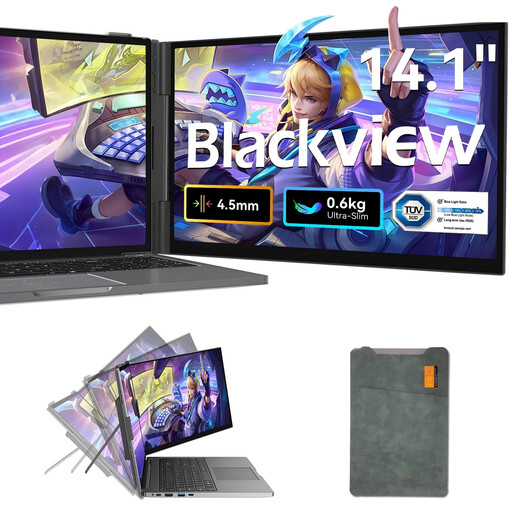
Blackview SCM6, 14 inches
The integrated stand and compact design could make this an appealing extra display for your laptop.
FHD at 1920 × 1080 pixels, IPS, 600 g and 4.5 mm thick. The product name states that it’s designed for laptops from 13 to 17 inches.
View at Joybuy
 No image available
Blackview DCM6 PRO, 14 inches
The clamp mount described could be a good fit if you want to attach a second screen directly to your laptop.
1920 × 1080 pixels, IPS and one USB-C port for video and power. According to the description, the clamp mount is designed for laptops from 13 to 17.3 inches.
View at Joybuy
 No image available
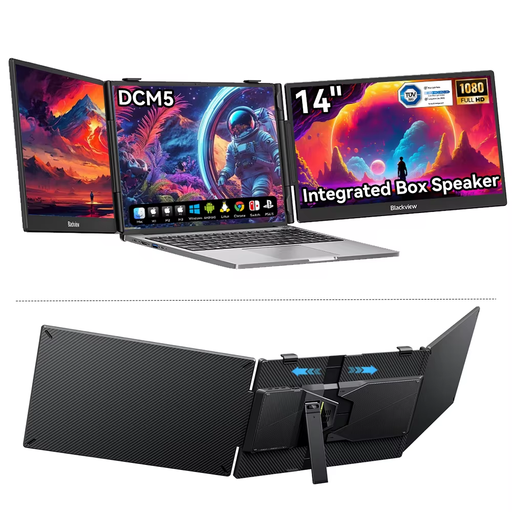
Blackview DCM5, 14 inches, 16:9
The 14-inch size is a compact way to add extra screen space, while its 16:9 aspect ratio differs from the 16:10 document-focused models.
IPS LCD second display. According to the description, it’s compatible with Windows PCs, MacBooks and mobile devices.
View at Joybuy
 No image available
UPERFECT, 16 inches, 2560 × 1600
The larger display could be useful for viewing recipe text alongside image previews, but it takes up more space on a train table than a 14-inch monitor.
QLED display in 16:10 format with 2560 × 1600 pixels. The product name also lists 144 Hz.
View at Joybuy
 No image available
UPERFECT, 15.6 inches, Full HD
The larger screen could make it easier to view text and recipe photos; check that it fits on the train table you’ll be using.
1920 × 1080 pixels, IPS, plus USB-C and Mini HDMI ports. UPERFECT lists 100% sRGB; this manufacturer’s claim isn’t an independent test of colour accuracy.
View at Joybuy
Frequently asked questions
Is a USB-C port on my laptop enough for video and power?
No, the socket shape alone isn’t enough. ASUS requires a USB-C port with display functionality for the MB166C; ViewSonic lists DisplayPort 1.2 Alt Mode and power from the source device for the TD1655. Check the specifications for your laptop port and test the monitor and cable together.
Can I rely on having a table and a power socket on an ICE train?
You can’t count on having a table at every seat or a power socket exclusively assigned to you. Deutsche Bahn lists fixed or fold-down tables at many seats and, as a general rule, one power socket per pair of seats in 2nd class; selected train models have one per seat.
What else do I need for a portable monitor with HDMI?
It depends on the model: according to the manufacturer, the Verbatim #49590 monitor also needs the included power adapter for HDMI. Check how your chosen monitor is powered and which cables are included.
What are my rights in Germany if the monitor is faulty, and how should I dispose of it?
For consumer purchases, you’re generally entitled to at least two years of statutory rights against the seller if the product is faulty; a voluntary guarantee doesn’t replace these rights. Electrical waste must be collected separately, for example at a local authority recycling centre. The European Union explains your statutory rights for faulty goods, while the German Environment Agency provides information on separate collection of electrical waste.
Does a CE marking prove that a specific monitor has been safety-tested?
No. As part of its market surveillance, the German Federal Network Agency checks, among other things, that the CE marking is correct and that manufacturer information and German instructions are provided. This general regulatory practice doesn’t certify the conformity of any specific product mentioned here.


