First, choose a portable monitor with a video connection and power requirements that suit your laptop: a USB-C port alone does not guarantee video output. For writing and research at a small library table, a compact screen may be the better fit; for larger photo previews, consider a bigger display, while bearing in mind that it will take up more space. If you want to edit travel photos with accurate colours, an advertised colour gamut alone does not prove that the individual device displays colours accurately.
Who are portable monitors for?
Laptop writers
If you want to edit journal entries while keeping research or notes open alongside them, first check that your laptop has a compatible video connection and that the monitor is easy to set up. Dell Germany outlines the display and connection features of the P1425.
Writers with a small table
When your laptop, documents and extra screen all have to share a small space, it’s important to balance screen size against the room available. Dell Germany and Lenovo Germany list models with different screen sizes.
Travel photo editors
If you add photos to your journal, consider whether a larger preview is enough or whether you need to assess colours accurately. ASUS lists display features for the ZenScreen OLED MQ16FC; a colour gamut figure alone does not prove that the individual device displays colours accurately.
What should you consider when choosing one?
First, check whether your laptop can output a picture through the connection you plan to use. Then choose a screen size and power supply to suit the space and your workflow at the library table.
| What matters |
What to check before buying |
Who is this important to? |
| Video connection |
Video output from your laptop port, the monitor input and a suitable cable. VESA / DisplayPort explains that DisplayPort over USB-C uses Alternate Mode; the port on the source device must support this function. |
If I want to have journal entries and sources open side by side, my laptop must actually be able to output a picture through the connection I choose. Around 36% of consumers prioritise a reliable video connection. |
| Desk space |
Dimensions including the stand, and the amount of desk space available. Dell lists the P1425 as 14 inches, while Lenovo lists the ThinkVision M16 as 16 inches. |
If there’s little room left beside my laptop and documents, I need a setup that fits on the table. Around 29% of consumers say desk space is their main consideration. |
| Photo viewing |
Screen size, resolution and surface finish. ASUS lists 95% DCI-P3 for the MQ16FC; this manufacturer’s claim alone does not prove colour accuracy. |
If I add travel photos to my journal, I want a preview that suits my workflow; for accurate colour assessment, I need more than a colour gamut figure. Around 21% of consumers prioritise how images look on screen. |
| Power supply |
The power output of your laptop port and whether the monitor may need a separate power supply. The auvisio EZM-220 product description lists USB-C power or a mains adapter. |
If there’s no power socket available where I’m working, I want to know in advance whether my planned setup will get enough power. Around 14% of consumers say power supply is their main consideration. |
Common buying misconceptions
-
A USB-C port on your laptop guarantees video output
For DisplayPort over USB-C, the relevant laptop port must support video output. The shape of the port alone doesn’t tell you whether it does.
Check the specifications for the specific laptop port and compare them with the monitor and cable.
-
A colour gamut figure proves colour-accurate photo editing
ASUS lists 95% DCI-P3 for the MQ16FC. This figure alone doesn’t prove how accurately the individual device reproduces colours.
Consider whether you need a photo preview or accurate colour assessment. For the latter, check for suitable evidence of colour accuracy and make sure it meets your workflow needs.
-
Screen size alone is enough to plan your workspace
A 16-inch monitor takes up more desk space than a 14-inch model. At a library table, you’ll also need room for the stand, laptop and documents.
Measure the available space and allow for the dimensions of the complete setup.
Key brands at a glance
Dell
The portable P1425 is a 14-inch option for working with text and sources when desk space is limited.
- Dell lists a resolution of 1920 × 1200 pixels, a 16:10 aspect ratio and an anti-glare surface for the P1425.
- Its smaller screen gives you less physical space for photo previews than a larger display. You’ll need to check compatibility with your own laptop separately.
Lenovo
The ThinkVision M16 gives you a larger display, while the ThinkVision M14t Gen 2 is designed for people who want to use touch or a pen.
- Lenovo lists a 16-inch screen and two USB-C ports with DisplayPort Alt Mode for the M16. For the M14t Gen 2, Lenovo lists a 14-inch screen with touch and pen support.
- These features apply to the specific model described and shouldn’t automatically be assumed to apply to the other one.
ASUS
The ZenScreen range includes various portable IPS and OLED models. The MQ16FC is an option for viewing images.
- ASUS lists a 16-inch OLED panel with a resolution of 1920 × 1200 pixels for the MQ16FC.
- ASUS lists a glossy surface and an advertised DCI-P3 colour gamut. This figure is not independent proof of colour accuracy.
Verbatim
The PMT-14 is a 14-inch option for people who want to use touch input when annotating.
- Verbatim lists Full HD and touch functionality for the PMT-14.
- Check that your device and preferred input workflow are supported.
auvisio
The EZM-220 is a 15.6-inch Full HD option with HDMI and USB-C video connections.
- The product description says it can draw power via USB-C from a mobile device or be used with a mains adapter.
- Whether it can draw power from your laptop depends on the port and its power output. The specifications do not prove that the device’s colour accuracy has been tested.
Portable monitors at Joybuy
These products are for anyone who wants to use a portable second screen with a laptop for journal entries, research or photo previews. Screen size, connections and setup options vary by model.
 No image available
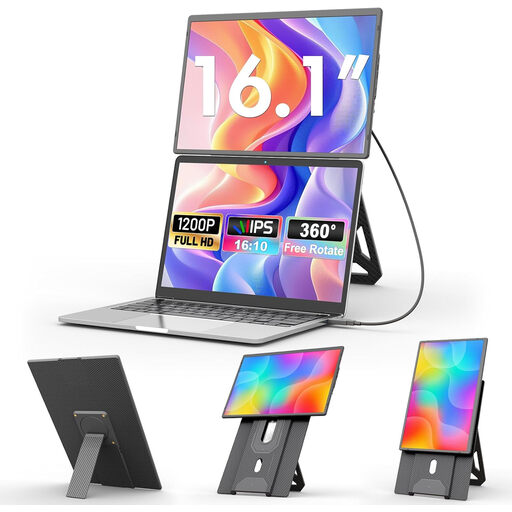
KEFEYA 16-inch monitor, FHD 1200P
A 16-inch option if you’d like to view larger previews on a second screen alongside your journal entries.
The title lists FHD 1200P and a magnetic stand that rotates through 360°. The product description lists USB-C and HDMI; USB-C can carry video, audio and power. Your laptop port must support video output.
View at Joybuy
 No image available
UFYQL M156F04, 15.6-inch FHD IPS monitor
The 15.6-inch screen gives you more workspace if there’s room for a second screen at your library table.
Listed features include FHD 1080P, an IPS display, USB-C and HDMI connections. The smart cover can be used as an adjustable stand. Your laptop port must support video output over USB-C.
View at Joybuy
 No image available
Arzopa Z1RC 2.5K, 16-inch monitor
A 16-inch option for journal entries and larger photo previews, provided you have room for the extra screen space.
The product title lists a resolution of 2560 × 1600 pixels, a 16:10 aspect ratio, IPS, HDR and 500 Nits. USB-C and HDMI are listed as connections. Your laptop port must support video output over USB-C.
View at Joybuy
 No image available
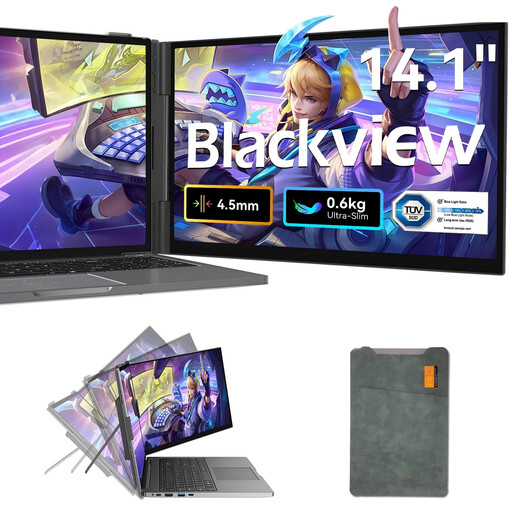
Blackview SCM6, 14-inch FHD IPS monitor
A compact 14-inch option if you want to view journal entries and research on an extra screen while keeping portability in mind.
The title lists FHD IPS, 600 g, 4.5 mm and a built-in stand. It also says the model is designed for 13–17-inch laptops. For video over Type-C, the laptop port you use must support video output.
View at Joybuy
 No image available
UPERFECT 15.6-inch FHD IPS monitor
An option for consumers who want a larger screen for text and travel photos on their laptop.
The product description lists FHD 1920 × 1080, IPS, USB-C and Mini-HDMI, as well as an adjustable built-in stand and VESA compatibility. It also claims 100% sRGB; this alone does not confirm the colour accuracy of the individual device.
View at Joybuy
Frequently asked questions
Is a USB-C port on my laptop enough to connect a monitor?
No. The port alone doesn’t confirm that it can output a picture. Check your laptop’s specifications to see whether that specific port supports video output, for example via DisplayPort Alt Mode, then make sure it’s compatible with the monitor and cable.
How can I set things up if there’s no spare power socket at the library table?
Check whether your monitor can receive both a video signal and enough power through the USB-C connection you plan to use. The auvisio EZM-220 product description also lists a mains adapter as an alternative, which means you’ll need a suitable power socket.
Does a manufacturer’s guarantee replace my rights if a product is faulty?
No. If you buy from a business seller, you have a statutory two-year legal guarantee against the seller from the date you receive the goods. Your Europe points out that an additional commercial guarantee does not replace these rights.
Can I put an old monitor in household rubbish in Germany?
No. Electrical and electronic waste must be collected separately. The German Environment Agency lists municipal recycling centres as one way to return it; if the monitor has removable batteries, follow the guidance for disposing of those too.
What does the CE marking mean when I’m buying a product?
It is the manufacturer’s own declaration that the product meets the EU requirements that apply to the marking. The Federal Network Agency does not describe it as an independent quality mark for picture quality or suitability for photo editing.


