Screening in daylight
You want to show project videos in a room with tall windows, where you can do little to reduce the incoming light. Pay particular attention to the brightness figures and the light conditions on the projection surface.


If tall windows let in plenty of daylight during your screening, consider brightness and the projection surface first – not just how compact the battery-powered projector is. If there’s no nearby socket and you can darken the room, a battery-powered projector may be more practical. Check the battery life and image brightness in the same operating mode, as well as the connections and throw distance. A manufacturer’s brightness figures alone can’t tell you how clearly the image will show up in your room.
You want to show project videos in a room with tall windows, where you can do little to reduce the incoming light. Pay particular attention to the brightness figures and the light conditions on the projection surface.
You move between the allotment and a community room, so you may need a built-in battery. The key question is whether the battery life and image quality in battery mode suit your planned screening.
You bring your videos on a laptop or another playback device. Check in advance that its output is compatible with the projector’s input and that you can position the projector where you intend to use it.
| What matters | What to check before buying | Who is it important to? |
|---|---|---|
| Visibility in daylight | Check the brightness figure and how it was measured, along with the image size and the amount of light falling on the projection surface. | If tall windows can barely be shaded, a clearly visible image is my top priority. Around 36% of consumers put daylight visibility first. |
| Use without a power socket | Check for a built-in battery, and confirm the battery life and image brightness in the operating mode you actually plan to use. | If I take the projector to different places, I need enough battery life to use it away from mains power. Around 29% of consumers prioritise being able to use their projector independently of the mains. |
| Playing your own videos | Check that the playback device’s output matches the specific projector input, and try playing an original file. | If my footage is on a laptop or another device, I need to check the connection before the screening. This is a priority for around 21% of consumers. |
| Positioning in the room | Measure the projector’s position, throw distance and available screen area; test the alignment where you plan to set it up. | If seating, windows and available space limit where the projector can point, it needs to fit the room. Around 14% of consumers prioritise finding a suitable position. |
For the XGIMI MoGo 4 Laser, COMPUTER BILD describes the image in battery mode as significantly dimmer. Anker quotes the Mars 3 Air’s battery life in Eco mode.
Compare battery life and brightness in the same mode you plan to use, and, if possible, test the projector in the actual lighting conditions.
For a longer screening, you may need to connect the projector to the mains or use compatible battery accessories, depending on the model.
The manufacturer describes the Aurzen BOOM Mini as mains-powered. COMPUTER BILD points out that the model has no battery.
First decide whether mains power will be available at your screening location or whether you need a projector with a built-in battery.
An advertised screen size alone doesn’t tell you how clearly the image will show up in the lighting conditions or on the surface at your venue.
Plan around the image size you need and the amount of light falling on the projection surface, rather than choosing by maximum diagonal size alone.
The EB-FH54 is a portable Full HD projector powered by mains electricity. The Lifestudio Pop range includes more compact smart projectors.
The Elfin Flip 4K is a compact model, while the MoGo 4 Laser has a battery for mobile screenings.
The GV50 combines a built-in battery with an adjustable base to suit different positions.
The BOOM Mini is a portable Full HD projector with an HDMI connection and mains power.
The Mars 3 Air is a battery-powered model with HDMI and Full HD resolution.
This selection focuses mainly on portable battery-powered projectors, as well as models whose product names mention HDMI playback or flexible positioning.
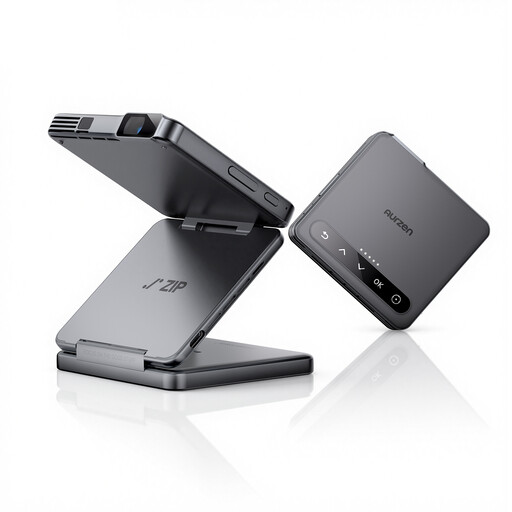 No image available
For screenings in different locations without a power socket, the product title mentions a built-in battery with up to 1.5 hours of battery life.
The title also mentions 5,000 mAh, ToF autofocus and 4K support.
 No image available
For screenings without a power socket, the product title mentions a built-in battery with 2.5 hours of battery life.
The title mentions Full HD 1080p, 450 ISO lumens, Google TV and an EA SPORTS FC 26 Game Code.
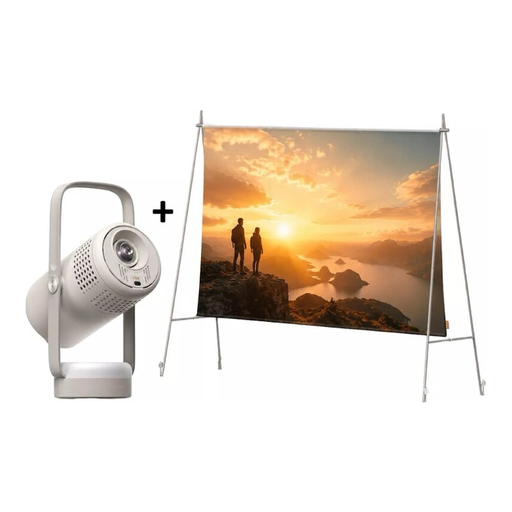 No image available
According to the product title, this set is designed for mobile screenings and includes a built-in battery, projection screen and stand.
The title mentions FHD 1080p, 250 ISO lumens and JBL Audio.
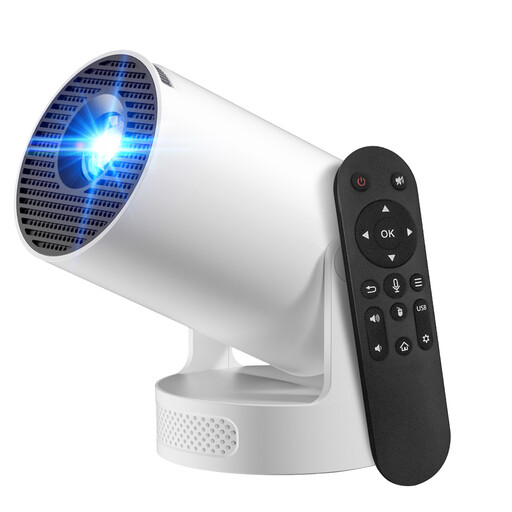 No image available
If you want to play your own videos from a compatible playback device, the product title mentions HDMI and laptop compatibility.
The title also mentions USB stick compatibility, 50–100% digital zoom and 180° rotation.
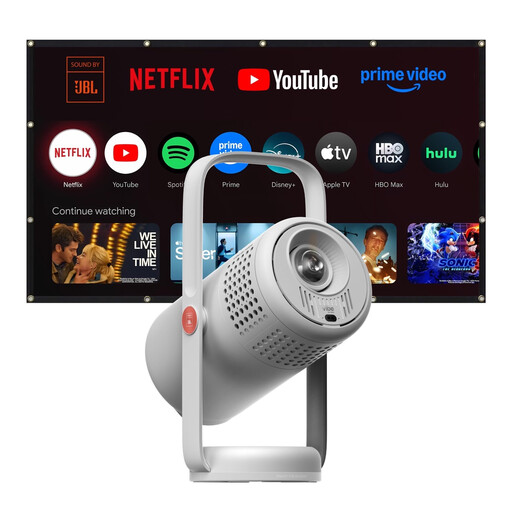 No image available
The product title mentions an integrated 160° stand, which you’ll need to take into account when positioning the projector.
Other features listed in the title include 1080p, 250 ISO lumens, autofocus and keystone correction.
Not just because it’s compact or has a particular brightness rating. As a general guide, Epson recommends at least 2,500 lumens for rooms with windows. This isn’t a fixed buying threshold and doesn’t guarantee a clearly visible image in your room. Check the light levels and image size at your venue, and see whether you can darken the room.
Check that your playback device’s output matches the input on the specific projector, then try playing an original file. The product specifications for the Aurzen BOOM Mini and Acer PD1800 both list an HDMI input.
Check whether your set-up needs mains power, a suitable cable or a projection surface, and which accessories are included with the specific offer. XGIMI says that the PowerBase stand for the MoGo 4 is sold separately.
The German Federal Network Agency explains that by applying the CE marking, the manufacturer declares under its own responsibility that the product meets the relevant requirements. It isn’t an independent assessment of a specific offer.