
Lieferung heute & morgen

Qualitätsgarantie

Willkommens-Angebote freischalten: KOSTENLOSE Lieferung | Bis zu 80 % RABATT | Kostenlose 30-Tage-JoyPlus-Testphase
App herunterladen
A big screen wherever you want it—on the wall, the ceiling, even in a tent. The idea of a 360-degree portable projector is appealing. However, the market is filled with devices whose marketing promises often dazzle more than the projected image. Before you invest, it's crucial to understand the common pitfalls that lead to disappointment and wasted money.
As your Joybuy Product Recommendation Officer, I'll help you objectively evaluate technical specs and find a device that truly meets your needs.
Many devices look impressive on paper but prove to be unusable in practice. Pay close attention to these three points:
To make an informed decision, focus on these objective technical features.
Don't confuse "supported" resolution with native resolution. A projector might be able to process ("support") a 4K signal, but it can only display it at its much lower native resolution. For a clear and detailed picture, the native resolution should be at least 1920x1080 pixels. Therefore, specifically look for a Full HD mini projector (1080p). Anything less results in a visible pixel grid and blurry text.
A modern projector must offer versatile connectivity. Look for the following standards:
The 360-degree feature is more than just a gimmick when implemented correctly. A good ceiling projector needs a stable, freely pivoting joint that holds its position. Combined with automatic image correction (auto keystone and autofocus), the image aligns itself within seconds, whether you're projecting onto a slanted attic wall or vertically onto the ceiling.
To illustrate the criteria mentioned, we present a model designed for versatile use cases.
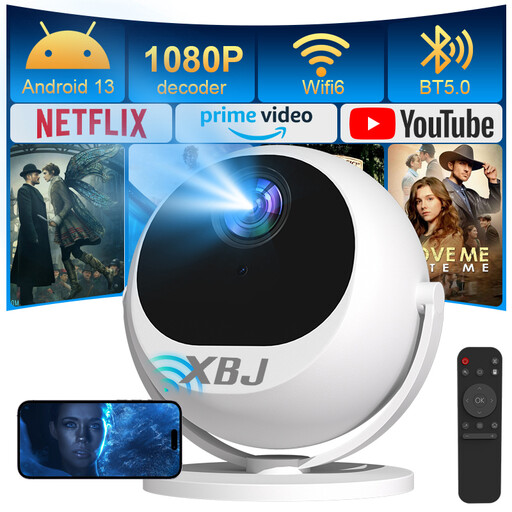
Why This Fits Their Persona: Ideal for users in city apartments or families looking for a hassle-free entertainment solution for the bedroom, balcony, or occasional movie nights in the garden. The combination of portability and smart features makes it a versatile companion.
This model addresses the core problems directly: It features native 1080p resolution, auto-focus and auto-keystone correction for quick setup, and supports WiFi 6 for stable streaming.
The key advantage is the 360° rotation combined with automatic image adjustment. This allows for projection on almost any surface without manual tweaking.
We have compiled a complete, up-to-date list of products that meet these strict selection criteria and rigorous safety standards.
1. How many ANSI lumens do I really need? For a darkened room (e.g., a bedroom in the evening), 300 to 500 ANSI lumens are often sufficient for a vibrant image. If you plan to use the projector in rooms with some ambient light, you should consider models with 800 ANSI lumens or more. For daylight use, most portable models are not bright enough.
2. Can a portable projector completely replace a TV? It depends on the use case. For the bedroom or as a flexible secondary solution, a projector is a great alternative. It offers a huge, immersive picture and is space-saving. However, as the main device in a brightly lit living room, portable projectors reach their limits in terms of brightness and contrast. Additionally, the lifespan of the light source is limited, and the integrated sound is often not comparable to a soundbar.
3. Does ceiling projection work with any 360-degree projector? Not necessarily. A successful projector for ceiling projection requires three things: a stable joint that maintains the set angle, reliable automatic keystone correction, and a cooling system that works efficiently even in a tilted position to prevent overheating. Check if the device is explicitly designed for this type of use.