Daytime viewers by the window
If tall windows brighten the room, first consider whether you can shade the projection surface and where the image would be easy to see.


With plenty of daylight coming through tall windows, a bright, repositionable mains-powered projector is the more obvious choice, provided there’s a power socket where you want to set it up. If you can darken the room and need to go cable-free, a battery-powered projector may suit you better. Epson Germany says the brightness you need depends on your surroundings, so check the image area, native resolution and focus with your subtitles from your planned viewing position. No lumen figure on its own proves that subtitles will remain readable when direct sunlight falls on the projection surface.
If tall windows brighten the room, first consider whether you can shade the projection surface and where the image would be easy to see.
Check the native resolution and focus where the subtitles appear, and assess them from your usual seat.
If you often move your projector or want to watch without a power socket, weigh the convenience of a battery against the lighting conditions in each location.
A good fit if: Daylight is a regular factor and there’s a power socket within reach of your chosen spot.
The trade-off: A mains cable limits cable-free use. And even greater brightness is no substitute for checking how the projector performs with your windows and screen.
A good fit if: You move between rooms or want to watch without a power socket, and can block out the light from the windows.
The trade-off: Check the stated battery life for the way you plan to use it. Manufacturers’ lumen figures based on different measurement methods aren’t directly comparable.
A good fit if: Daylight falls directly on the image area or makes subtitles hard to see.
The trade-off: Curtains, a different position for the image or a smaller projection may mean giving up the freedom to watch in daylight or the screen size you want.
Epson Germany recommends choosing the brightness you need based on your surroundings. That makes the image area and shading important buying considerations, too, if you have tall windows.
| What matters to you | What to look for when buying | Who is it important to? |
|---|---|---|
| Picture in daylight from windows | Check whether daylight falls on the projection surface and whether you can shade it. Only compare brightness figures that use the same stated measurement method. | If daylight falls on my image area, a picture I can see matters more than having the smallest possible device; around 36% of consumers put light from windows first. |
| Readable subtitles | Check native resolution and focus at the bottom of the image, from your seat and at your planned image size. | If I want to read subtitles from my usual seat, I check the text in the actual image area; around 29% of consumers prioritise subtitle readability. |
| Moving it around and battery power | Check whether it has a built-in battery, the stated battery life for your intended picture mode, and whether there’s a power socket at your destination. | If I often move my projector or want to watch without a power socket, going cable-free matters more to me than having as much brightness to spare as possible; around 21% of consumers put moving between locations first. |
| Streaming and subtitles | Check the specific app, the title you want and the subtitle options on the playback setup you plan to use. | If I want to watch particular dramas with the subtitles I want, I check that I can access those exact titles; around 14% of consumers prioritise easy playback. |
ANSI, ISO and unspecified lumen figures aren’t automatically equivalent. Heimkinoraum explains that different measurement methods make direct comparisons difficult; image size and light falling on the projection surface matter, too.
Start by comparing figures that are stated on the same basis. Plan how you’ll shade the area and assess the picture where you intend to use it, rather than assuming a manufacturer’s figure alone guarantees readability in direct sunlight.
A handle or stand makes it easier to move a projector, but doesn’t prove that it can run without mains power.
Check the exact model version to see whether it has a built-in battery, how it’s powered and what battery life applies to your intended mode.
Depending on the model, you may need a power socket and cable where you set it up; a battery accessory is sold separately for some devices.
An app listed on a product page doesn’t prove that the specific title you want or your preferred subtitles will be available on the playback setup you plan to use.
Before buying, check the app, title and subtitle settings on the device you intend to use. If necessary, find out whether a compatible external playback device is an option.
If you need an external playback device, you may also need extra space and a suitable power supply for it.
The GP520 and GV50 offer different approaches: a repositionable 4K mains-powered projector and a Full HD model with a built-in battery.
The HORIZON S Max and Halo+ (New) represent a repositionable mains-powered projector and a Full HD battery model.
The Lifestudio Flex EF-71 is a portable Full HD projector with an adjustable stand and Google TV.
According to the manufacturer, the Cosmos Laser 4K is a portable laser projector with a handle and 4K UHD.
The Freestyle 2nd Gen is designed for flexible projection angles and portable use.
Here you’ll find portable projectors with a stated native resolution of 1080p and different features for positioning and power. Check subtitle readability from your planned viewing position; lumen figures don’t prove a projector is suitable when direct daylight falls on the image area.
 No image available
The stated native resolution and rotating function may be useful for subtitles and changing your setup location.
Native 1080p, 1.000 ANSI lumens, autofocus and keystone correction, plus 90° rotation, are specified. It supports 4K, but its native resolution is 1080p.
 No image available
The built-in battery may be useful if you want to watch somewhere without a power socket.
Native 1080p, 800 ANSI lumens, Google TV and a stated battery life of up to 2 hours. Plan to use mains power for longer viewing.
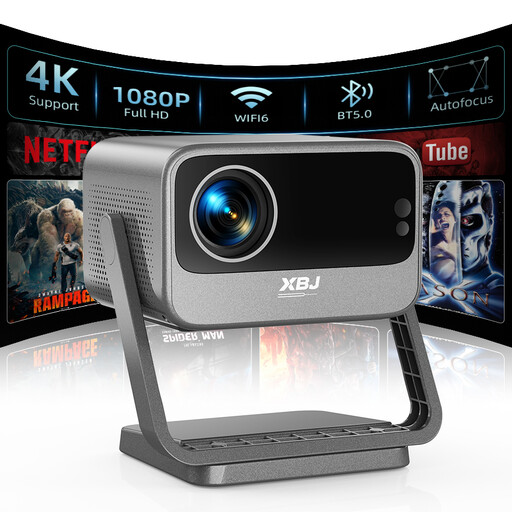 No image available
The rotating stand is a feature that may be useful when choosing a flexible projection location.
Native 1080p, 700 ANSI lumens, a stand that rotates through 280°, autofocus and keystone correction are specified.
 No image available
The stated native resolution and automatic picture correction may help when planning your subtitles and setup.
Native 1080p, 900 ANSI lumens, Android 14, 180° rotation and automatic keystone correction are specified.
First decide where the image will go and where you’ll sit, then consider whether you can realistically darken the room. Compare native resolution and brightness figures measured on the same basis, but, if possible, assess the focus and subtitles using your intended playback setup in the actual lighting conditions. A larger stated maximum image size doesn’t prove that subtitles will be easier to read.
Check the stand, distance from the projection surface and power supply at the new location. BenQ gives the GV50 a battery life of up to 2,5 hours; XGIMI gives the Halo+ (New) a battery life of 2,5 hours. These are manufacturer claims, so check whether the battery will last for your chosen picture mode and the length of your viewing session.
When you buy from a trader, you’re generally entitled to a legal guarantee of at least two years from the date you receive the goods; your point of contact is the seller. Your Europe outlines this EU-wide minimum requirement. For many online purchases, you’ll also generally have a 14-day right to cancel, as explained by Verbraucherzentrale; exceptions and the circumstances of your contract should be taken into account. A voluntary manufacturer’s guarantee or retailer returns policy is separate from these rights.
No. According to the German Environment Agency, discarded electrical and electronic equipment must be disposed of separately from household waste. Local collection points generally accept old electrical equipment free of charge.