A portable projector can work well for locally stored museum films, provided you test your actual files in advance using the built-in player or a tested HDMI source. A USB port alone doesn’t guarantee playback. Match brightness and power supply to the room lighting, image size and film length. A battery makes it easier to move between locations, but it doesn’t guarantee a bright enough picture or the battery life you need. Under Section 52(3) of the German Copyright Act (UrhG), you need the rights holders’ consent to screen a film publicly; whether a screening is public is determined under Section 15(3) of the UrhG.
Which selection criteria matter to you?
Teams using local film files
If you want to show films from a storage device, test your actual files using the playback method you plan to use, rather than relying on a USB port or streaming features alone. BenQ’s documentation for the GP100 describes playing content from a USB stick with VLC, but doesn’t promise support for every file format.
Teams in rooms with ambient light
If you can’t darken the museum room completely, consider image size and brightness together, and test the projection under the lighting conditions you expect to use.
Mobile screening teams
If you move between screening locations or can’t always rely on a power socket, check the battery life in the picture mode you plan to use, as well as the projector’s weight for transport.
What should you look for when buying?
| What matters |
What to check before buying |
Who is it most important for? |
| Local film files |
Test your actual video and audio files, including subtitles, with the USB player you plan to use or an HDMI source. |
If our film needs to play from our own storage device, I want to test the entire playback setup in advance. Around 36% of consumers say local playback is their main concern. |
| Visibility in ambient light |
Check the picture size you want under the planned room lighting, and take into account the unit used for the brightness rating. |
If we can’t darken the screening room completely, I want to see whether the picture will remain visible at our venue. Around 29% of consumers prioritise visibility in ambient light. |
| Use without a power socket |
Compare the full screening time with the battery life in the picture mode you need, including set-up and breaks. |
When we’re screening at different venues, I want to be able to show the film without relying on a dependable mains connection for the projector. Around 21% of consumers prioritise use without a power socket. |
| Set-up and sound |
Check that the projection distance suits your desired picture width, and test speech clarity from the seats you plan to use. |
When we set up in different locations, I want to arrange the screen area and clear speech so they work for the audience. This is a priority for around 14% of consumers. |
Pitfalls when buying a projector for museum films
-
“Has USB” doesn’t automatically mean our films will play
A USB reader and instructions for using a player don’t prove that every video or audio file, or every subtitle, will work. For the GP100, BenQ describes using VLC to play content from a USB stick, but this doesn’t mean it supports every format.
Play your intended files from start to finish and check the picture, sound and subtitles. If the built-in player isn’t suitable, test a source device connected to the selected projector’s HDMI input.
An external source device and the cables you need mean extra equipment and more set-up work.
-
The maximum battery life won’t necessarily apply in every picture mode
XGIMI quotes up to 2.5 hours of video playback for the MoGo 4, specifically in Eco mode. This doesn’t tell you how long the projector will run in another brightness mode.
Compare the film’s running time with the battery life in the mode you actually need, and carry out a full test run.
-
A free museum film night doesn’t automatically mean you don’t need permission
Under Section 52(3) of the German Copyright Act (UrhG), a film may only be screened publicly with the rights holders’ consent. Free admission alone doesn’t replace that consent.
Beforehand, check and document the screening rights required for the specific film and planned event. The relevant provision is set out in the Copyright Act, published by the Federal Ministry of Justice and the Federal Office of Justice.
Brands to consider
BenQ
The GP100 and GV50 cater for different power and portability needs.
- BenQ specifies 1,000 ANSI lumens, HDMI and a USB-A reader for the mains-powered GP100. The manufacturer lists a built-in battery, HDMI and a USB-A reader for the GV50.
- According to BenQ, the GP100 weighs 2.9 kg; the GV50 is rated at 500 ANSI lumens. The manufacturer’s specifications don’t guarantee visibility in every room or playback of every museum film file.
XGIMI
The MoGo 4 could be an option if portability and use without a power socket are important to you.
- XGIMI lists a built-in battery for the MoGo 4 and up to 2.5 hours of video playback in Eco mode.
- Check the battery life in the picture mode you need, and test playback of your local film files separately.
ViewSonic
ViewSonic describes the M1E Max as a lightweight projector with a built-in battery and a rotatable stand.
- ViewSonic lists a weight of under 1 kg and native Full HD resolution. The rotatable stand is useful when you’re setting up in different locations.
- The product specifications don’t confirm that your specific film files will play. According to ViewSonic, a USB-C port alone doesn’t prove that it supports video input.
Epson
The Lifestudio range includes portable smart projectors, but portability doesn’t automatically mean battery-powered operation.
- Epson describes the range as featuring Google TV and an integrated audio system.
- Check whether the specific model has a battery and supports local file playback. The features listed for the range don’t confirm that every model has a battery or will play your files.
Joybuy products for mobile film screenings
This selection includes portable projectors for screenings using local film files. Check the playback method, set-up and power supply at the venue.
 No image available
XGIMI MoGo 4, Full HD 1080p, 450 ISO lumens, Match Night EU Edition with EA SPORTS FC 26 game code
Could be worth considering if you’re looking at a portable projector with a battery; test your actual film files before the screening. XGIMI quotes up to 2.5 hours of video playback in Eco mode, not as the battery life for every picture mode.
The product title lists Full HD 1080p, 450 ISO lumens, Google TV and Harman Kardon Audio. ISO lumens aren’t directly comparable with ANSI lumen ratings.
View at Joybuy
 No image available
Projector compatible with HDMI and USB sticks, with automatic picture correction and 180° rotation
Could be worth considering if you need flexibility in projection angle; check your actual film files and intended playback method in advance.
The product title lists a 50–200-inch image size, 50–100% digital zoom, Wi-Fi 6, Bluetooth and 180° rotation. The compatibility stated in the title is no substitute for testing your files.
View at Joybuy
 No image available
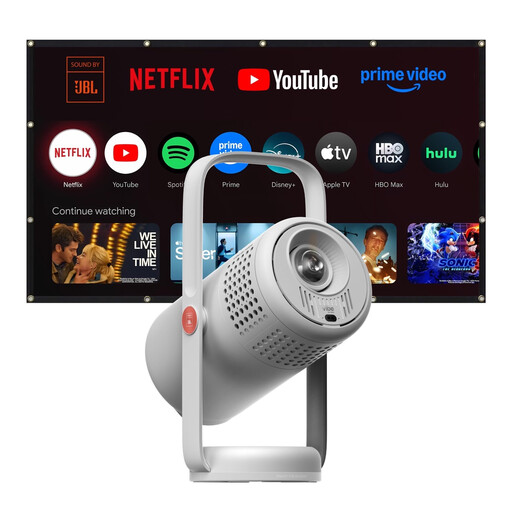
XGIMI Vibe One, portable mini projector, 1080p, 250 ISO lumens
Could be suitable for moving between screening locations; check in advance that it’s compatible with your local film files.
The product title lists 1080p and 250 ISO lumens. The product description also mentions a built-in 160° stand, autofocus and keystone correction.
View at Joybuy
 No image available
XGIMI Elfin Flip Laser, native 1080p, 1600 ISO lumens
Could be a good fit if you’re looking for a portable model for different screening locations; test local playback with the files you actually plan to use.
The product title lists native 1080p, 1600 ISO lumens and a foldable design. ISO lumens and ANSI lumens are different units and shouldn’t be treated as directly equivalent.
View at Joybuy
 No image available
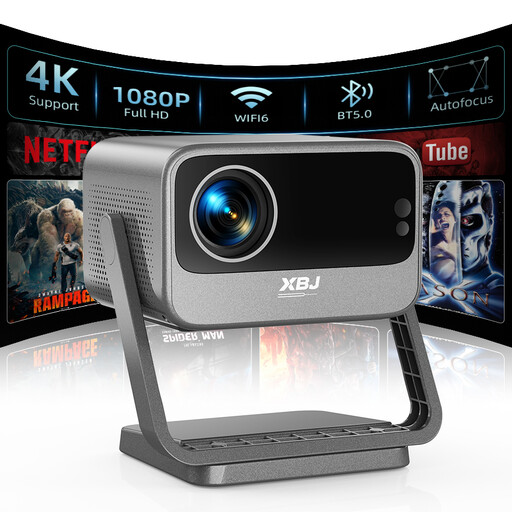
XBJ portable projector, native 1080p, 700 ANSI lumens
Could be worth considering for a flexible set-up; check in advance how you’ll play your film files and whether the sound will be loud enough for the room.
The product title lists native 1080p, 700 ANSI lumens and a stand that rotates by 280°. “4K-supported” in the title doesn’t mean the native resolution is 4K.
View at Joybuy
Frequently asked questions
Is a USB port enough to play our films straight from a stick?
No. The port alone doesn’t prove that your films will play. For the BenQ GP100, BenQ lists a USB-A reader and describes using VLC for content on a USB stick. Even so, test your actual files, including sound and subtitles. If they don’t work, try an HDMI source device that you’ve tested separately.
What should we test before the first screening?
Test the complete set-up under the lighting conditions you expect to use, with the planned seating arrangement. Check the picture size, focus and speech clarity. If you’re using battery power, make sure your test run in the required picture mode covers the planned screening time.
Can we screen a film publicly at the museum if admission is free?
Free admission alone isn’t enough: under Section 52(3) of the German Copyright Act (UrhG), a film may only be screened publicly with the rights holders’ consent. Check who can grant that consent for the specific film and planned screening. Whether an event is public is determined under Section 15(3) of the UrhG; the relevant source is the legislation published by the Federal Ministry of Justice and the Federal Office of Justice.


