What should you look for when buying?
First, work out the screen width you want based on the available distance between the projector and screen. Then decide whether your rooms are better suited to a darkened space and battery power, or to a larger planned image with mains power.
| Buying criterion |
What to check |
Who it matters to |
| Detail from the back rows |
Consider the distance between the projector and screen separately from the desired screen width and viewing distance. BenQ Germany explains throw ratio as the projection distance divided by the image width. |
If I want to assess facial expressions and movement from right at the back, I need a suitable screen width and clearly visible detail. That’s why around 36% of consumers prioritise detail from the back rows. |
| Picture in ambient light |
Consider the room lighting, image size and intended operating mode together. Don’t assume ANSI and ISO lumens are directly comparable; what matters is visibility on the planned screen area. |
If the room can’t be fully darkened, I need a picture that’s easy to see in the actual lighting conditions. That’s why around 29% of consumers prioritise visibility in ambient light. |
| Transport and setup |
Check the weight, setup options, available sockets and battery life in the image mode you want to use. Battery-life figures may depend on specific conditions or extra accessories. |
If we often change the screening location, I want to be able to set up the projector and accessories easily. That’s why around 21% of consumers prioritise a portable setup. |
| Playback and dialogue |
Test a complete sample file using the playback device you plan to use, and check the picture and sound from the back row. If you’re using a laptop, the right connections and possibly an external audio solution are important. |
If we pause scenes and discuss dialogue together, I need reliable playback and clear speech. That’s why around 14% of consumers prioritise playback and dialogue clarity. |
Joybuy products for mobile screenings
Portable projectors for mobile screenings of theatre recordings and flexible setup.
 No image available
ETOE Dolphin 2, portable RGB laser projector
The built-in battery suits screenings in places without a socket near the setup.
Native 1080p, 800 ANSI lumens, HDMI 2.1 and a built-in battery. The description also mentions an adjustable stand.
View at Joybuy
 No image available
XGIMI Elfin Flip Laser 1080P
The portable, foldable design may suit locations where the setup changes regularly.
1080p, 1,600 ISO lumens and autofocus. These specifications apply to the Elfin Flip Laser 1080P, not the Elfin Flip 4K.
View at Joybuy
 No image available
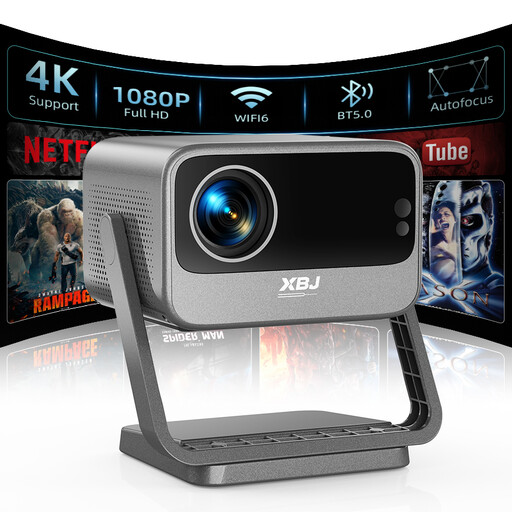
XBJ portable projector, native 1080p
You can compare the native Full HD resolution with your recording and the planned seating position.
Native 1080p and 700 ANSI lumens. The product name also mentions support for 4K input signals, autofocus and automatic keystone correction.
View at Joybuy
 No image available
XGODY Gimbal N6 Pro
HDMI and USB connections are useful for playback through an external device.
Native 1080p, 700 ANSI lumens, plus HDMI and USB compatibility. The product name also mentions autofocus and automatic keystone correction.
View at Joybuy
 No image available
XBJ Outdoor Projector A5Pro, white
The portable design is made for flexible setup; check the picture quality at the location you plan to use for screenings.
Native 1080p and 900 ANSI lumens. The product name mentions autofocus and automatic keystone correction.
View at Joybuy
Frequently asked questions
How can I check whether the image will be large enough from the back row?
Measure the distance from the back row to the screen separately from the distance between the projector and screen. For the latter, use this formula: throw ratio = projector-to-screen distance divided by image width. BenQ Germany explains this calculation; then check the planned screen width using your own recording from the back row.
Can I simply play theatre video files from a USB stick on the projector?
This isn’t confirmed for every model and file format. If you’ll use a laptop to pause and replay scenes, test a complete sample file via its HDMI output and check the picture and sound together.
Can an amateur theatre recording be made, shown or posted online?
There’s no straightforward yes or no without details of the play, music, performers, recording location, permissions and audience. Under Section 77 of the German Copyright Act (UrhG), the right of performing artists to control recordings must be respected; Section 53(7) of the UrhG requires the rights holder’s consent to record public performances of a work. Making a recording available to the public online is a separate right under Section 19a of the UrhG. Check the rights for the specific recording and intended use rather than assuming that permission for an internal screening also allows you to publish it. The Federal Ministry of Justice and the Federal Office of Justice publish the legislation.
What happens if the projector develops a fault after purchase?
For a consumer purchase in Germany, statutory rights against the seller are separate from a voluntary manufacturer’s or retailer’s guarantee. The Verbraucherzentrale recommends checking guarantee terms and promised cover before buying; if a fault occurs, the first step is to consider your right to have the product repaired or replaced.
What does the CE marking on a projector mean?
EU consumer information lists electrical and electronic equipment among the product groups that may be subject to CE marking requirements. Check the marking and details for the specific device. The CE mark is the manufacturer’s declaration of conformity, not an independent quality mark for picture performance.


