
Lieferung heute & morgen

Qualitätsgarantie

Willkommens-Angebote freischalten: KOSTENLOSE Lieferung | Bis zu 80 % RABATT | Kostenlose 30-Tage-JoyPlus-Testphase
App herunterladen
A portable tyre inflator can be a handy companion on the road when you need to adjust tyre pressure after a long drive, a temperature change, or an extended period of standing. For drivers, electric vehicle owners, motorcyclists, cyclists and campers, however, it's not just about a high PSI rating. What really matters are the right connectors, realistic battery performance, and a pressure gauge that's easy to read.
A claim of "150 PSI" or "160 PSI" looks impressive at first glance. However, the recommended values for most car tyres are considerably lower. What's far more important are airflow rate, inflation time, temperature management, and suitability for the specific tyre type. A mini compressor rated at 150 PSI may be fine for bicycle tyres or occasional top-ups, but it isn't automatically suitable for van, motorhome or trailer tyres.
A cordless tyre inflator works independently of a 12-volt socket. That's convenient on the go, but it does require a charged battery. Manufacturer claims about the number of tyres are usually based on specific tyre sizes and pressure ranges. Completely flat car tyres place a much higher demand on the battery. Before buying, you should check battery capacity, charging port, and any required pauses between pumping cycles.
An air compressor with auto-stop finishes the process when the pre-set value is reached. This reduces the risk of over-inflation, but it doesn't replace checking the tyre pressure recommended by your vehicle manufacturer. This is often found on the B-pillar, inside the fuel filler cap, or in the owner's manual. The unit must also be correct: bar, PSI and kPa should not be confused.
A portable air compressor should cover a pressure range that suits your intended uses. For cars, motorcycles and bicycles, flexible adjustment ranges are ideal. However, the maximum pressure rating alone doesn't tell you about speed. A higher airflow rate in L/min or SLPM can reduce the practical inflation time for larger tyres.
Many compact battery-powered models are explicitly not designed for heavy commercial vehicles, certain motorhomes or trailers. Checking the product description is therefore more important than relying on a general claim of suitability.
A digital tyre pump should clearly show both the current pressure and the target value. Multiple units make it easier to use across vehicles and bicycles with different requirements. Models like the AstroAI Tire Inflator L7S are described as supporting PSI, bar, kPa and kg/cm². When setting the pressure, always choose the target value based on your vehicle or tyre specification, not the device's maximum rating.
A battery-powered tyre inflator is ideal for emergencies where no socket is available. A corded 12-volt pump, on the other hand, can enable longer use as long as the vehicle is positioned appropriately. With such devices, the motor should be run according to the manufacturer's instructions to avoid unnecessarily draining the vehicle battery.
Also useful are:
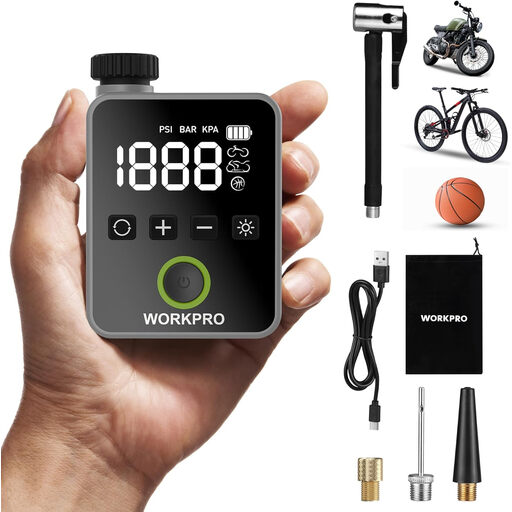
Why this product fits the profile: This compact, cordless device weighs 270 g according to the product description and measures 10.5 × 7.3 × 3.5 cm. It can be stored in a glovebox, rucksack or bicycle luggage.
The pressure range of 3 to 140 PSI, four modes and automatic shut-off make selecting the target value more straightforward than with a basic one-button pump.
LED display, four attachments, torch, SOS mode and power bank function; according to the product information, not suitable for lorry or trailer tyres.
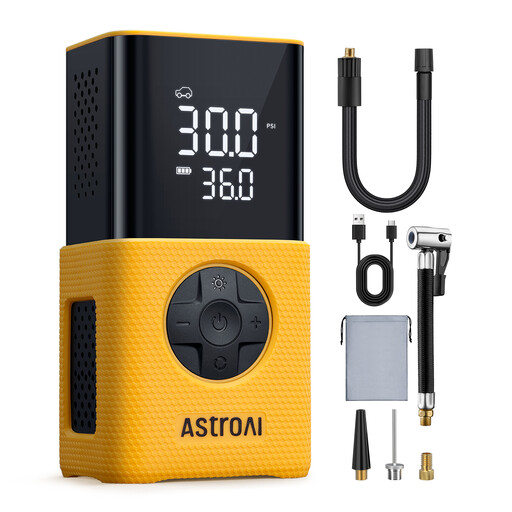
Why this product fits the profile: This model combines a digital display, five modes and a 4000 mAh battery. According to the product description, the airflow rate is 17 L/min and the adjustment range is 3 to 150 PSI.
The display supports multiple pressure units, while pre-settable values and auto-stop simplify operation during repeated top-ups.
USB-C input and output, LED light with three modes and a claimed capacity from the seller of up to eight tyres under defined conditions.

Why this product fits the profile: The 7500 mAh battery and stated airflow rate of 35 L/min are aimed at users who frequently top up car, motorcycle or bicycle tyres.
The digital display, four preset modes, manual range of 4 to 160 PSI and auto-stop reduce the risk of incorrect operation when switching between vehicles.
According to the seller, up to 45 minutes of cordless runtime, power bank function and LED light with illumination and strobe modes.
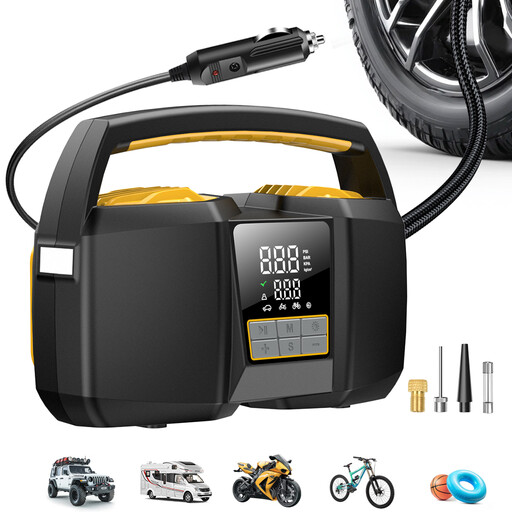
Why this product fits the profile: This corded electric tyre pump for car tyres is powered via a 12-volt socket and, according to the description, comes with an extended power cable.
The power supply doesn't need to be charged in advance. The long cable can reach all four wheels without having to reposition the compressor multiple times.
Designed for car, motorcycle and bicycle tyres; LED light included. For extended use, the stated cooling breaks should be observed.
We've put together a complete, regularly updated list of products that fully meet these strict selection criteria and the safety regulations in force in the EU.
The required value depends on the vehicle, axle load and tyre size. The vehicle manufacturer's specification is what matters, often given in bar. A maximum rating of 150 PSI on the device does not mean the tyre can be inflated to that pressure.
The runtime depends on battery capacity, tyre size, starting pressure and target value. Claims such as "up to five tyres" or "up to 45 minutes" only apply under the manufacturer's specific test conditions. For longer journeys, the battery should be fully charged beforehand; a USB-C port can make recharging easier.
Many models are designed for this purpose, provided the right adapters are included. A tyre pump for car, motorcycle and bicycle use should have a suitable valve connector or the appropriate nozzles. For balls and air mattresses, a separate needle or cone adapter is usually required.