If you want to choose the screen yourself, a mini PC with a separate monitor is a good starting point. If you’d prefer the computer and display to be one device, consider an all-in-one. When choosing a specific configuration, compare the RAM, available SSD space and operating system with the design software you use. For print colours, the screen and a colour profile suited to the printing conditions also matter.
Which computer is right for you?
Designers with limited desk space
If you want to keep space free beside your screen for input devices, you can place a mini PC separately from the monitor or choose an all-in-one with an integrated screen. Apple and MSI describe mini PC models for a workspace you put together yourself, while Lenovo also offers an all-in-one.
Designers working with image-heavy poster files
If you work with large images or several design files, compare the computer’s exact specifications with the requirements of your software. Adobe recommends 16 GB of RAM or more for Photoshop 27.x.
Designers who are thinking about print
If you need to assess colours for a printing process, your choice should take both the screen and the right colour profile into account. The European Color Initiative provides ICC profiles and characterisation data for different printing processes.
What should you look for when buying?
Mini PC with a separate monitor
A good fit if: you want to choose the screen independently of the computer or keep using it later.
Things to consider: you’ll need to buy a monitor and, if required, input devices separately. Check the ports, RAM, SSD and operating system for the specific configuration.
All-in-one desktop
A good fit if: you want the computer and screen together as a single device on your desk.
Things to consider: the display is part of the device. One Neo-50a configuration described by Lenovo has a matt 23.8-inch display with 99% sRGB and 8 GB of RAM; these specifications apply to that specific configuration.
Compact desktop with a separate monitor
A good fit if: you can set aside a permanent spot for it and easy access to components or servicing matters to you.
Things to consider: a compact design doesn’t tell you what’s inside. Lenovo says the ThinkCentre M75q Gen 5 provides tool-free access to the SSD and memory modules; check the exact version.
| Priority |
What to check before buying |
Who it matters most to |
| Space and choice of screen |
Measure the space for the computer and room for cables; check that the video outputs match your preferred monitor. For an all-in-one, check the display specifications. |
If I want to keep space for input devices beside the screen on my small desk, I need to know where the computer will fit and what screen options I have. Around 36% of consumers are primarily concerned with space requirements and screen choice. |
| RAM and available storage |
Compare the RAM, available SSD space and operating system with your software’s requirements. For Photoshop 27.x, Adobe recommends 8 GB of RAM as a minimum, 16 GB or more as the recommended amount, and 100 GB of available hard drive space. |
If I’m working with large images or several designs, I don’t want to judge the setup by the SSD’s stated capacity alone. Around 29% of consumers focus primarily on RAM and space for image-heavy files. |
| Colours for print |
Check the display specifications and ask the printer about the printing conditions and the right ICC profile. |
If I need to assess colours for a printed poster, I want to consider the screen and printing process together. Around 21% of consumers focus on assessing colours for print. |
| Upgradability and what’s included |
Check whether the specific version includes RAM, an SSD and an operating system, and which components you can access. |
If I want to upgrade the computer later or use it fully equipped from the outset, I’ll check the exact version and what’s included. Around 14% of consumers pay particular attention to upgradability and a complete setup. |
Avoid common misconceptions
-
Confusing the stated SSD capacity with available working space
The stated SSD capacity doesn’t tell you how much space will be left for projects after setup and the operating system are installed. Adobe recommends 100 GB of available hard drive space for Photoshop 27.x.
Compare the space that’s actually available with what your projects need, rather than relying on the SSD’s stated capacity alone.
-
Assuming a barebone is a ready-to-use mini PC
The GMKtec NucBox M6 Ultra is also sold as a barebone without RAM, an SSD or an operating system.
Before comparing options, check what’s included in the version you’ve selected. Depending on what comes in the box, you may need to choose and set up missing components separately.
-
Assuming a display guarantees accurate print colours
Display specifications alone don’t determine how a poster will look under specific printing conditions. There are ICC profiles suited to different printing processes.
Check the display specifications and ask the printer which colour profile and printing conditions apply to your order and paper.
Key brands at a glance
Apple
The Mac mini is suited to a compact macOS workspace where you choose the monitor separately.
- For the M6 base configuration described, Apple lists 16 GB of unified memory and a 256 GB SSD; other configurations are available.
- Choose an SSD capacity and monitor to suit your projects; these specifications alone don’t establish a general performance advantage.
Lenovo
The ThinkCentre range includes compact computers for use with a separate monitor, as well as all-in-one models.
- Lenovo says the ThinkCentre M75q Gen 5 provides tool-free access to the SSD and memory modules.
- One M75q configuration described lists 24 GB of RAM but no storage capacity. For one Neo-50a configuration, Lenovo lists 8 GB of RAM and a 23.8-inch display with 99% sRGB. These specifications don’t apply to every version.
MSI
The Cubi NUC 1M range is designed for a workspace with a separately chosen monitor.
- MSI lists two SO-DIMM slots, along with HDMI and Thunderbolt 4, for the range.
- The range includes different processor and operating system options, so check the specifications of the version you’re buying.
GEEKOM
The A5 Pro 2026 Edition is described as a Windows mini PC for a workspace with a separate monitor.
- For the version with Ryzen 5 7530U, the manufacturer’s website lists 16 GB of RAM, a 1 TB SSD and expandable storage.
- Manufacturer claims about noise levels or suitability for specific workloads aren’t independent test results.
HP
The Pro Mini 400 G9 is a compact Windows desktop; check the full product number to compare like for like.
- For version 938A5EA#ABD, HP lists 8 GB of RAM and a 256 GB SSD.
- This configuration has less RAM than Adobe’s recommendation of 16 GB or more for Photoshop 27.x. Don’t assume other HP versions have the same specifications without checking.
Joybuy products for a workspace with a separate monitor
The mini PCs below are designed for a workspace where you choose the monitor separately. Compare their exact specifications with the software you use and the space available.
 No image available
Apple Mac mini M6, 16 GB, 256 GB SSD
If you want to choose your screen separately, check that the ports match your monitor; you’ll need to connect a display.
12-core CPU, 12-core GPU, 16 GB of unified memory, 256 GB SSD, Thunderbolt 4, HDMI and macOS.
The product description states that the keyboard and mouse are sold separately.
View at Joybuy
 No image available
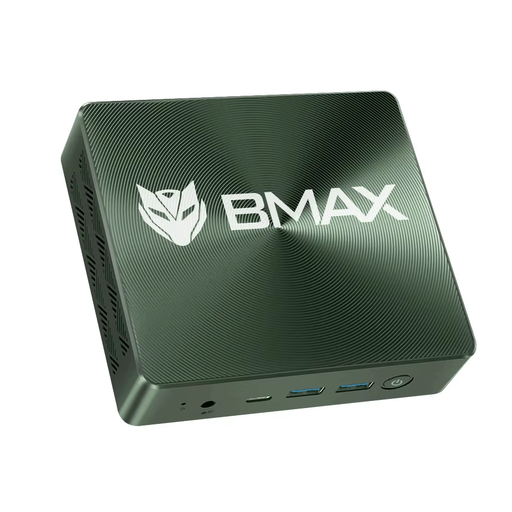
BMAX B6 Pro, Intel Core i5-1030NG7, 16 GB, 512 GB SSD
If you’re looking for a mini PC to use with a separate monitor, check that the ports and software compatibility suit your workspace.
16 GB LPDDR4, 512 GB NVMe SSD and Windows 11; the product description states that it supports output to up to three 4K displays.
View at Joybuy
 No image available
ACEMAGIC AK1PLUS, Intel Celeron N5095, 16 GB, 256 GB SSD
If space is limited, compare the case dimensions with the space available and check that the ports suit your monitor.
16 GB LPDDR4X, 256 GB M.2-2280 SATA SSD, two HDMI outputs and Windows 11 Pro. The case measures 128 × 128 × 51.5 mm.
View at Joybuy
 No image available
FIREBAT mini PC, AMD Ryzen 7 7735HS, 16 GB, 512 GB SSD
If you want to connect several screens, check that the stated display support matches your monitors and ports.
16 GB RAM, 512 GB SSD, two M.2 slots, USB4 and, according to the product title, support for three displays.
View at Joybuy
 No image available
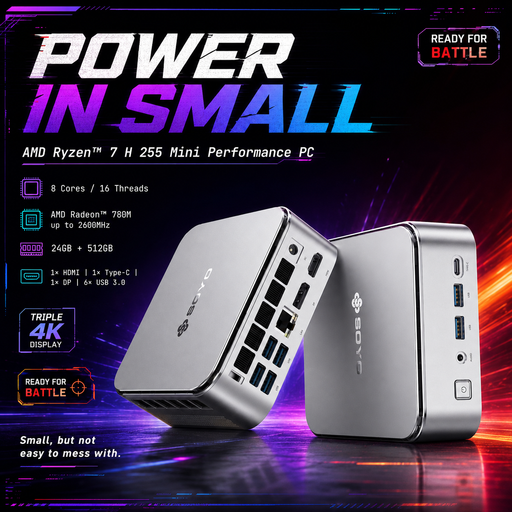
SOYO S4PLUS, Ryzen 7 H 255, 24 GB, 512 GB SSD
If you want to fit the computer into a small space, compare the case dimensions with the space available and check that the video outputs suit your monitor.
24 GB LPDDR5, 512 GB PCIe 3.0 SSD, HDMI, DisplayPort and Type-C. The case measures 128 × 128 × 47.6 mm.
View at Joybuy
Frequently asked questions
Is 8 GB of RAM enough for designing my posters?
For Photoshop 27.x, Adobe lists 8 GB as the minimum requirement and recommends 16 GB or more. Check the requirements for other software and for using several programmes at once; Photoshop’s minimum isn’t a general recommendation for every workflow.
Can I mount a mini PC behind my monitor?
That depends on the specific mini PC and monitor mount. MSI lists a 100 × 100 mm VESA mount for the Cubi NUC 1M. Also check that the mount fits your monitor and that there’s enough room for ports and cables.
Why aren’t PC specifications alone enough to assess print colours?
A processor or display specification on its own doesn’t determine how a poster will look under specific printing conditions. The European Color Initiative provides ICC profiles and characterisation data for different printing processes. Ask the printer which profile applies to your order and paper.
What are my rights when buying online in Germany if I change my mind or receive faulty goods?
For online consumer contracts, you generally have a 14-day right to cancel from the day you receive the goods. Your statutory rights against the seller are separate from any voluntary guarantee; if something is faulty, the seller will generally have the opportunity to put it right first. The Verbraucherzentrale explains these rights and possible exceptions; you should also check the specific contract.


