Hosts with a large gratin dish
If you want to cook everything together in one dish, measure it, including the handles, and compare its dimensions with the oven’s usable shelf area and height.


A built-in oven could be a good choice for a sharing-sized potato gratin, provided the dish fits in the usable oven cavity and the housing unit and connection are suitable. If you don’t have space for a built-in model, a freestanding mini oven may work, as long as the dish fits and the appliance can be positioned safely. Measure the filled dish, including its handles, and compare it with the interior of the specific oven. The Bayerische Kartoffel recipe for potato gratin gives instructions for both fan oven at 180 °C and conventional heat at 200 °C. Follow the temperature and covering instructions in your own recipe.
If you want to cook everything together in one dish, measure it, including the handles, and compare its dimensions with the oven’s usable shelf area and height.
If you need a freestanding appliance, check not only that your dish will fit, but also that you have enough worktop space and can meet the positioning requirements for the specific model.
If you’ll use the oven for other dishes too, compare the heating functions you need, energy consumption and cleaning requirements rather than focusing only on making gratin.
| Buying consideration | What to check | Who should pay particular attention? |
|---|---|---|
| Will the gratin dish fit? | Measure the dish, including its handles, and compare it with the usable shelf area and height of the specific oven. A measurement for round dishes doesn’t automatically mean a rectangular dish will fit. | If I’m making gratin in one large dish to share, I don’t want to find out it’s too wide or too tall only when I try to put it in the oven. Around 36% of consumers say that making sure their dish will fit is their main concern. |
| Will the oven fit in my kitchen? | For a built-in oven, check the housing unit dimensions and connection. For a worktop model, check its external dimensions, the space available and the safety clearances specified in the instructions. | If there isn’t a suitable space for a built-in oven, I need a freestanding alternative and a safe place to position it. For around 29% of consumers, available space is their top priority. |
| Does it have the right heating functions? | Check whether the model has a fan setting and, if your recipe calls for it, separately selectable top and bottom heat. Follow the temperature and covering instructions in your recipe. | If my recipe calls for a specific heating function or switching between functions, I want to be able to follow those instructions while cooking. Around 21% of consumers focus on having the heating functions they need. |
| How much effort do operating and cleaning involve? | For household ovens that require an energy label, compare the energy consumption per standard cycle for conventional heating and fan cooking. Consider cleaning methods separately from how you plan to use the oven. Verbraucherzentrale and the European Commission explain the energy figures for ovens covered by the relevant requirements. | If I use my oven regularly, I want to take running costs and cleaning effort into account when choosing. For around 14% of consumers, ongoing costs and maintenance are their main concern. |
The oven cavity’s volume alone doesn’t confirm that a particular baking dish will fit on the shelf. A size given for round baking tins doesn’t prove that a rectangular dish with handles will fit either.
Measure the whole dish and compare its width, depth and height with the usable space inside the specific oven.
If the dish doesn’t fit, you may need to use a different one or cook in more than one batch.
A recipe may call for conventional heat and give different temperatures or covering instructions for each heating function. The term ‘fan oven’ doesn’t override the recipe instructions.
Check that the oven’s selectable heating functions match your recipe, and follow its temperature, shelf position and covering instructions.
A built-in oven needs a suitable housing unit and connection. For a worktop model, follow the positioning instructions for that specific appliance. Under § 13 NAV, work on fixed electrical installations may only be carried out by the authorised parties named there.
Before ordering, check the installation instructions and what’s included in the service. For any work on the fixed electrical installation, contact an installation company registered to carry it out.
Depending on your circumstances, installation, connection work or collection of an old appliance may involve extra practical steps.
Pyrolysis is a cleaning function, not something you need to bake gratin. According to NDR, a pyrolytic cleaning cycle uses additional energy.
Choose a cleaning method that suits how you’ll use the oven, and consider its stated energy consumption as well as its heating functions.
Bosch makes built-in ovens. For the HBA272BB3, Bosch Hausgeräte Deutschland lists 3D hot air, as well as pyrolytic and hydrolytic cleaning.
Siemens offers built-in ovens. For the HB572ABS3, Siemens Hausgeräte Deutschland lists 3D hot air, as well as pyrolytic and hydrolytic cleaning.
Beko makes built-in ovens. For the BBIM12300X, Beko Deutschland lists a 72 l oven cavity and SteamShine steam cleaning.
Rommelsbacher makes freestanding mini ovens. For the BG 1550, the manufacturer lists a 30 l capacity and compatibility with baking tins up to 29 cm in diameter.
Severin makes freestanding mini ovens. For the TO 2068, the manufacturer lists a 20 l capacity and top and bottom heat and hot air, which can be used separately or together.
This selection includes built-in ovens and freestanding mini ovens with baking functions. Before you buy, compare the dimensions of your baking dish with the usable oven cavity and check the positioning or installation requirements.
 No product image available
This model could be suitable as a built-in appliance if the housing unit, connection and dish dimensions are all right.
Specifications include a 70 l oven cavity, hot air, a grill and a pizza function. The product title also lists 3 kW, AquaClean cleaning and an A energy efficiency class.
 No product image available
This built-in model could work for a sharing-sized gratin, provided the oven cavity, housing unit and installation requirements suit your dish and kitchen.
Specifications for this model include a 71 l capacity, 3D hot air and top and bottom heat. The description also lists ten heating functions, a temperature range of 30 to 275 °C and pyrolytic cleaning.
 No product image available
This freestanding model is an option if you’re not looking for a built-in oven and your dish and chosen spot are suitable.
The product title lists a 28 l capacity. Specifications include three heating modes – top heat, bottom heat or both together – a 60-minute timer and three shelf positions.
 No product image available
The description lists casseroles as one of its uses. Check the internal dimensions before choosing your gratin dish.
Specifications include a total capacity of 23 l, two independently controlled cooking zones and 15 programmes. According to the description, you can remove the divider to create a larger cooking area.
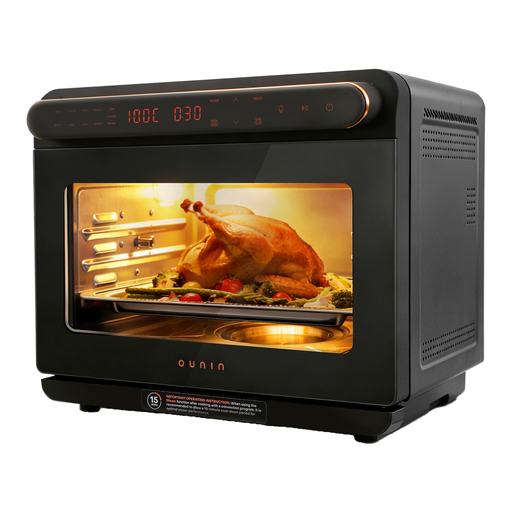 No product image available
This freestanding combination oven could be a good option if you’d like to use steam as well as baking functions, and your dish fits inside.
The product title lists a 24 l capacity, 10-in-1 functionality, a 1-l water tank and a 304 stainless steel interior. Functions listed include Bake and Steam Bake.
No. The Bayerische Kartoffel potato gratin recipe gives instructions for both fan oven at 180 °C and conventional heat at 200 °C. The cooking time and covering instructions apply to that recipe, so follow the guidance in your own recipe.
You can’t carry out work on the fixed electrical installation just as you please. Under § 13 NAV, such work may only be done by the network operator or an installation company listed in its register of installers. Check the connection type and installation instructions for the oven you’ve chosen.
The German Federal Institute for Risk Assessment recommends keeping heated food at a temperature of at least 60 °C throughout when holding it hot. The oven temperature you set doesn’t confirm the temperature of the gratin itself. For longer storage, the Institute recommends cooling food quickly to below 7 °C and reheating it thoroughly later.
No. The European Commission lists small ovens as outside the scope shown for oven energy labelling. For household ovens that are covered, the label shows, among other things, the oven cavity volume and energy consumption per standard cycle for conventional cooking and fan cooking.
No. In Germany, your statutory rights for faulty goods are against the seller. A guarantee is a voluntary extra promise with its own terms and conditions. Check those terms separately, and find out about any costs for installation or collection of an old appliance before you order.