
Lieferung heute & morgen

Qualitätsgarantie

Willkommens-Angebote freischalten: KOSTENLOSE Lieferung | Bis zu 80 % RABATT | Kostenlose 30-Tage-JoyPlus-Testphase
App herunterladen
A power bank with a built-in cable promises ultimate convenience: no tangled cables, no forgotten accessories—just plug in and charge. But the market is flooded with models whose practical advantages quickly turn into frustration. Many users report cables that break after just a few weeks or charging speeds that fall far short of what's advertised.
As a Joybuy Product Recommendation Officer, my job is to guide you through the jungle of technical specs. This guide will reveal the three most common pitfalls when buying and highlight the crucial features you should look for to find a reliable and durable charging solution.
Marketing claims can often promise more than the technology delivers. Pay close attention to these three points to avoid a bad investment:
To avoid these traps, focus on three verifiable technical features. These determine the performance, safety, and longevity of your power bank.
While 10000mAh or 20000mAh are common ratings, capacity in Watt-hours (Wh) is the decisive metric, especially for air travel. It's calculated from the nominal capacity (in Ampere-hours, Ah) and the battery cell voltage (in Volts, V).
Formula: Capacity (Wh) = Nominal Capacity (Ah) × Voltage (V)
For air travel, there is an international upper limit: A power bank is flight-safe if its capacity does not exceed 100 Wh. Models between 100 Wh and 160 Wh often require airline approval. Ensure the Wh value is printed on the casing to avoid issues at the security checkpoint.
The charging power, measured in Watts (W), determines how quickly your devices charge. Modern smartphones and laptops require high wattage for fast charging.
The durability of the integrated cable depends on its design.
Also, ensure that the integrated connectors (e.g., USB-C and/or Lightning) match your primary devices.
Based on the criteria above, we have identified models that offer a well-thought-out solution for specific use cases.
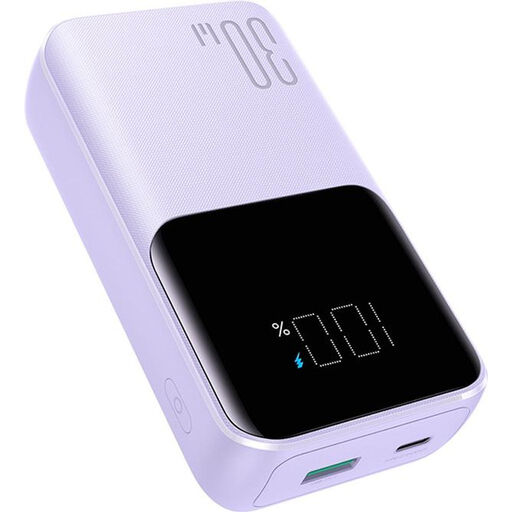
Why This Fits Their Persona: Ideal for users who commute daily between the office, university, and home and need a compact, hassle-free solution for their smartphone (whether Android or iPhone). The small power bank fits into any bag and makes separate cables redundant.
Solves the "wrong cable" problem with two integrated cables (USB-C and Lightning). The 30W power is delivered via the cables and ports and is clearly specified, thus avoiding the slow "fast charging" trap.
Four charging options: Integrated USB-C cable, integrated Lightning cable, USB-C port, and USB-A port. The display shows the battery level as a percentage.
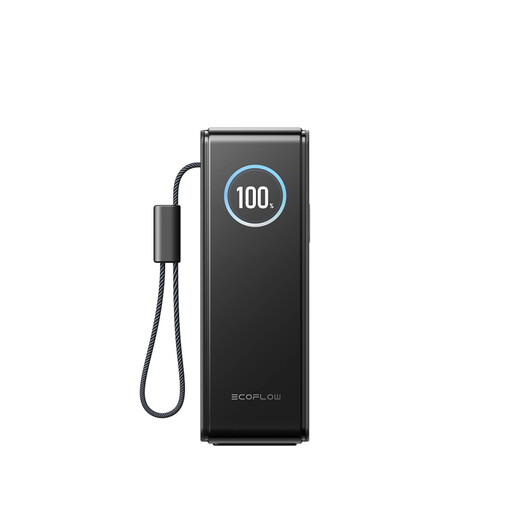
Why This Fits Their Persona: For professionals and travellers who need to power a laptop, tablet, and smartphone simultaneously on business trips or while working remotely. Its high capacity and extreme power output make it a mobile powerhouse.
Addresses the pitfall of insufficient power. With a 170W total output and up to 100W per USB-C port (also via the integrated cables), it is a true power bank for laptops, bypassing the problem of slow charging under load.
Massive Power Output: Charges multiple high-performance devices simultaneously. The 90 Wh capacity is fully flight-safe (under the 100 Wh limit). Two integrated USB-C cables provide flexibility.
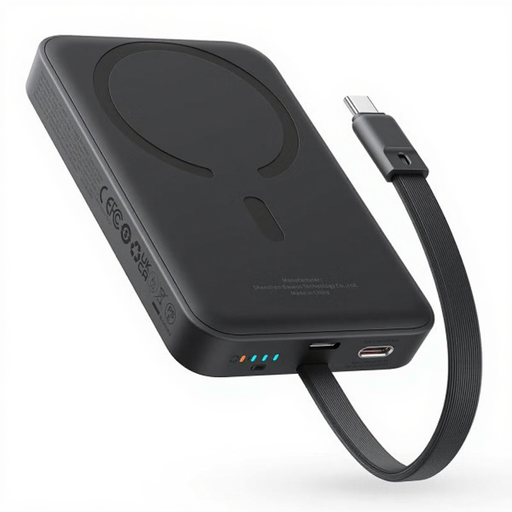
Why This Fits Their Persona: Perfect for iPhone users seeking a seamless charging experience. The MagSafe power bank attaches magnetically to an iPhone for wireless charging, while the integrated USB-C cable offers flexibility for other devices or for recharging the power bank itself.
Combines the convenience of MagSafe with the reliability of a cable. Users aren't solely reliant on wireless charging, which can be slower, but can fall back on 30W fast charging via the cable, thus avoiding the slow-charging trap.
2-in-1 Solution: Magnetic wireless charging (up to 15W) and fast wired charging (up to 30W). The integrated USB-C cable is bidirectional, meaning it can be used to charge devices and to recharge the power bank.
We have compiled a complete, real-time updated list of products that fully meet these strict selection criteria and German safety regulations.
The lifespan heavily depends on quality and usage. Models with reinforced cable joints and durable sheathing (e.g., braided nylon) last significantly longer. For retractable cables, products with mechanisms tested for a high number of cycles (e.g., 10,000+) are a safer bet. With daily use, a high-quality cable should function without issues for at least 1-2 years.
Yes, in most cases. The decisive factor isn't the mAh rating but the value in Watt-hours (Wh). A typical 20000mAh power bank with 3.7V cells has a capacity of 74 Wh (20 Ah × 3.7 V). Since this is below the 100 Wh limit, it is permitted in carry-on luggage. Always check that the Wh value is printed on the casing.
That depends on the power output (in Watts) of the power bank. To effectively charge a laptop, the power bank should deliver at least 65W of power via Power Delivery (PD) through its integrated USB-C cable. Models with lower power output might be able to slowly charge a laptop when it's turned off, but they cannot power it during operation. Therefore, always check the exact output specifications of the integrated cable before purchasing.