
Lieferung heute & morgen

Qualitätsgarantie

Willkommens-Angebote freischalten: KOSTENLOSE Lieferung | Bis zu 80 % RABATT | Kostenlose 30-Tage-JoyPlus-Testphase
App herunterladen
A power bank with a built-in USB-C cable saves you carrying an extra charging cable when you’re out and about. Depending on its design, it can fit in a jacket pocket, rucksack or work bag. That makes it a practical choice for everyday use, business trips, studying or camping, whether you use a smartphone, tablet or laptop.
However, a high capacity or wattage doesn’t automatically mean a power bank is right for you. Three common buying mistakes can make a power bank impractical after a short time:
A 10,000 mAh USB-C power bank is often enough for everyday smartphone use. It offers a good balance between weight and reserve power. A 20,000 mAh power bank is better suited to longer working days, multiple devices or several charging sessions.
For air travel, the mAh rating isn’t the only thing that matters: you also need to check the energy capacity in watt-hours (Wh). This can be calculated as follows:
Wh = mAh × volts ÷ 1,000
Depending on the cell voltage, models with a capacity of 20,000 to 25,000 mAh are often below 100 Wh. Even so, travellers should check the requirements of their airline. Lithium power banks must be carried in hand luggage, not checked baggage. This doesn’t mean every airline will automatically allow them.
Power output is measured in watts. For smartphones, 20 to 30 W is often enough when using compatible USB-C PD technology. Tablets may need more power, depending on the model. A laptop power bank should deliver at least the USB-C PD wattage required by your laptop. Many compact laptops need 65 W, while more powerful devices may require 100 W or more.
Check the following details:
A rating such as “up to 170 W” describes the maximum possible total output. It doesn’t mean every connected device will automatically receive 170 W.
Choose a portable power bank that suits how you’ll carry it. Compact 5,000 or 10,000 mAh models are handy for short trips and as an emergency reserve. Larger versions provide more power, but weigh considerably more.
When choosing a power bank with a built-in cable, check:
A magnetic power bank or wireless power bank can charge your smartphone without a connector. The actual output depends on device compatibility, positioning and the standard used. For many models, charging by cable is faster and more energy-efficient than wireless charging.
The products below cater to a range of needs. Technical details are based on the information provided for each product.
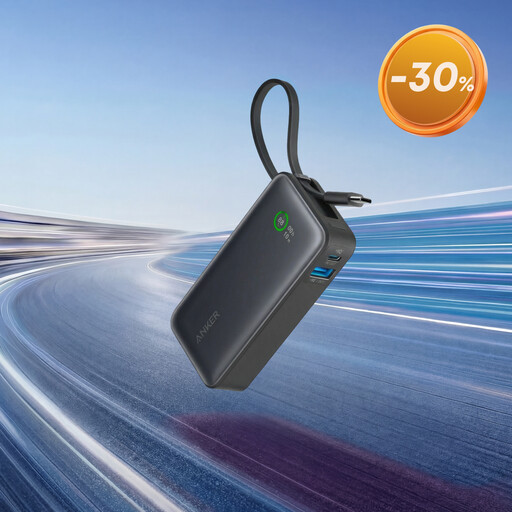
Why this product suits this user: Its compact design, 10,000 mAh capacity and 30 W output make it well suited to everyday use with smartphones and smaller USB-C devices.
The 30 W output and built-in USB-C cable are clearly specified, rather than relying on a vague fast-charging claim.
10,000 mAh, 30 W bidirectional charging and the option to use the USB-C port and built-in cable at the same time.
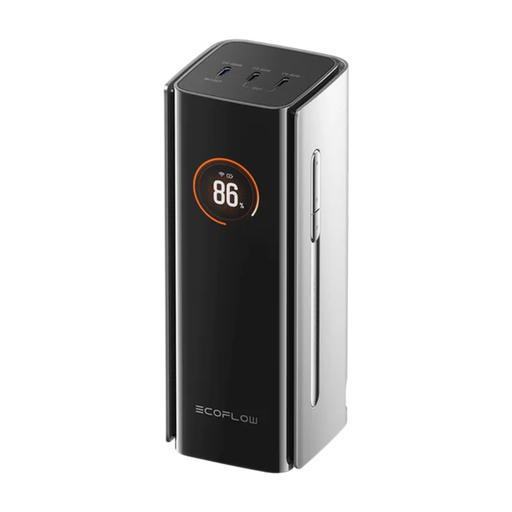
Why this product suits this user: Multiple USB-C outputs, an LCD display, app support and a 60 cm retractable cable make this a good choice for people with several devices.
The display shows the charge level and power data, making it easier to see how power is distributed across multiple ports.
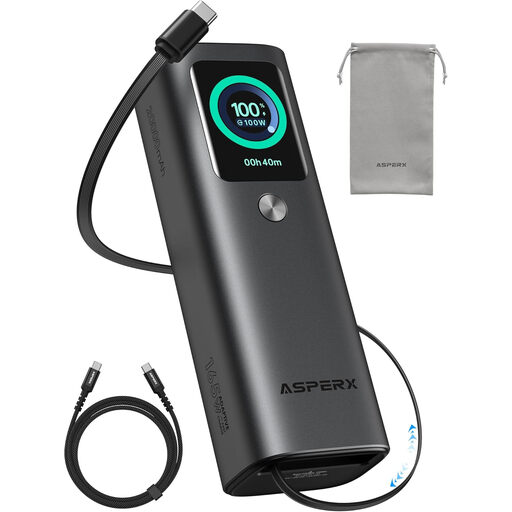
Why this product suits this user: With two USB-C ports, USB-A and a 60 cm cable, this model is a good fit for professionals, students and travellers carrying a laptop, tablet and smartphone.
The 165 W total output is backed up by specific figures, such as 100 W and 65 W when used simultaneously. This makes it easier for laptop users to assess what to expect.
74 Wh, TFT display, two USB-C PD outputs of up to 100 W and a built-in cable.
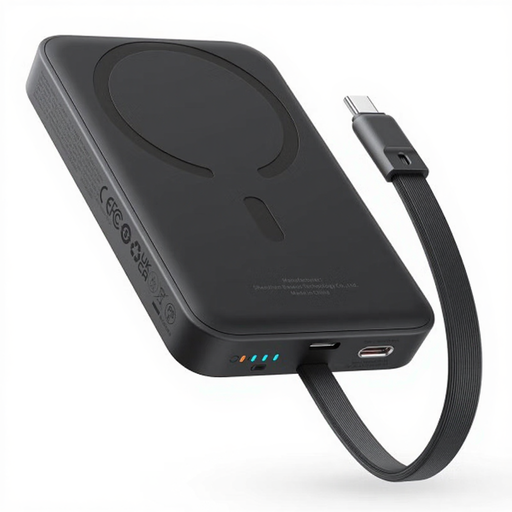
Why this product suits this user: The combination of a USB-C cable, USB-C port and wireless charging makes it a good fit for users with compatible iPhone, Samsung and other devices.
Wired output of up to 30 W and wireless output of up to 15 W are listed separately. This gives you a realistic idea of the convenience on offer.
10,000 mAh, built-in bidirectional Type-C cable, magnetic attachment and LED display.
We’ve put together a complete, regularly updated list of products that meet these strict selection criteria and fully comply with the safety regulations in force in the EU.
Before buying and while using your power bank, keep the following points in mind:
Its lifespan depends on charging cycles, temperature, storage conditions and wear and tear on the cable. Retractable cables shouldn’t be pulled sideways. Stop using the product if its capacity drops or the cable shows visible damage.
Yes, provided the power bank delivers the required USB-C PD output and your laptop supports USB-C charging. 65 W may be enough for smaller laptops, while more power-hungry models may need up to 100 W or more. Always check the laptop manufacturer’s specifications.
Many models in this capacity range are below 100 Wh, but whether yours is allowed depends on its converted energy rating and the airline’s rules. Power banks must be carried in hand luggage. Check your airline’s requirements directly before travelling.