
Lieferung heute & morgen

Qualitätsgarantie

Willkommens-Angebote freischalten: KOSTENLOSE Lieferung | Bis zu 80 % RABATT | Kostenlose 30-Tage-JoyPlus-Testphase
App herunterladen
A low battery on your smartphone, tablet, or laptop often happens at the most inconvenient times—during an important trip, while working remotely, or at the end of a long day. An external battery, also known as a power bank or portable charger, offers a reliable solution. However, the market is vast, and technical specifications can be confusing.
This guide will help you understand how power banks work and make an informed decision. We'll explain the most important features, such as capacity, charging power, and ports, to help you identify the perfect model for your needs.
Choosing the right model depends on your personal usage habits. Three key criteria are crucial: capacity, charging power, and form factor.
The capacity of a power bank is measured in milliampere-hours (mAh) and describes the amount of energy it can store.
Pay attention to the Rated Capacity. Due to energy loss during voltage conversion, the actual usable capacity is always slightly lower than the advertised cell capacity. Reputable manufacturers list this value in the technical specifications.
The charging speed, measured in watts (W), determines how quickly your devices are charged. A fast-charging power bank is essential for most users today.
Besides the core functions, design and practical extras also play a role. Integrated cables save you from carrying separate charging cables. A display that shows the exact battery level and charging output offers more control than simple LED indicators. Size and weight are also important factors, especially if the power bank will be carried in a bag daily.
Based on the criteria mentioned, we have compiled a selection of models that cover different use cases.

Why it stands out: This model from Lofree combines functionality with a unique design. The integrated, warm-toned LED backlight with various modes turns the power bank into a stylish accessory while also serving as a gentle ambient light. Its compact form makes it ideal for a handbag.
Pros:
Who is it for? For style-conscious users looking for a compact and attractive power bank for daily use to power their smartphone and headphones on the go.
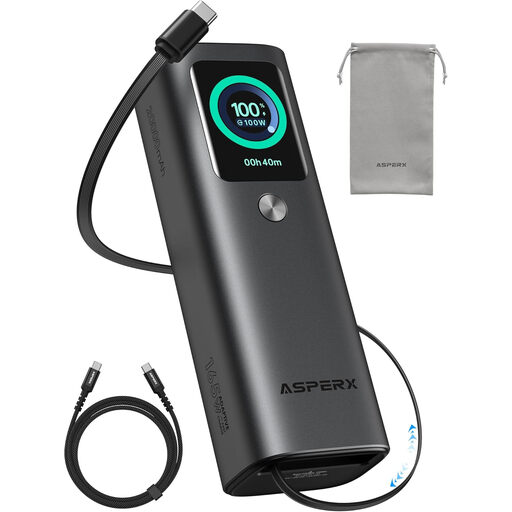
Why it stands out: With a total output of 165W and two powerful USB-C ports, this power bank is designed to power demanding devices like laptops. The integrated, retractable USB-C cable and the informative TFT display highlight its focus on professional users.
Pros:
Who is it for? For professionals, travellers, and power users who need a high-performance power bank for a laptop, tablet, and smartphone, and need to fast-charge multiple devices at once.
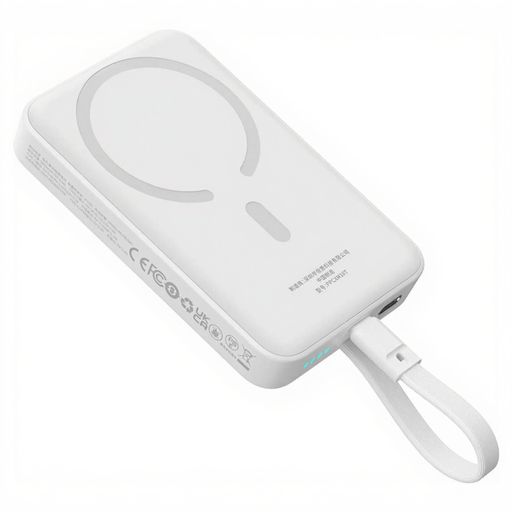
Why it stands out: The Baseus Magnetic Mini is an extremely versatile and compact solution. It combines 30W wired fast charging, a MagSafe power bank function for wireless charging, and an integrated USB-C cable. This 3-in-1 functionality makes it a highly practical companion.
Pros:
Who is it for? Ideal for users of modern smartphones (especially iPhone 12 and newer) who appreciate the convenience of wireless charging and a compact, all-in-one solution without extra cables.
A powerful power bank only reaches its full potential with the right accessories. To take advantage of the high speeds of a fast-charging power bank, a high-quality cable that supports the corresponding charging standard (e.g., Power Delivery at 60W or 100W) is essential.
Discover a selection of matching fast-charging USB Type-C cables to ensure your devices are always charged at maximum speed.
1. How many times can a 10,000 mAh power bank charge my phone? This depends on your smartphone's battery capacity and the power bank's rated capacity. A 10,000 mAh power bank typically has a rated capacity of about 5,800 to 6,500 mAh. A modern smartphone with a 4,000 mAh battery can be fully charged about 1.5 times with it.
2. Can I take a power bank in my carry-on luggage on a plane? Yes, power banks must be transported in carry-on luggage. The International Civil Aviation Organization (ICAO) limits the capacity to 100 watt-hours (Wh) per battery. Most power banks, including 20,000 mAh models, fall below this limit (e.g., 20,000 mAh at 3.7V equals 74 Wh).
3. What is the difference between nominal capacity and rated capacity? The nominal capacity (mAh) indicates the amount of energy stored in the battery cells. The rated power (Wh) is a more precise measure as it takes voltage into account (Wh = mAh × V / 1000). The actual usable capacity (often referred to as "Rated Capacity") is lower because energy is lost during the voltage conversion from the internal 3.7V to the 5V (or more) of the USB output.