
Lieferung heute & morgen

Qualitätsgarantie

Willkommens-Angebote freischalten: KOSTENLOSE Lieferung | Bis zu 80 % RABATT | Kostenlose 30-Tage-JoyPlus-Testphase
App herunterladen
A dead battery on your smartphone, laptop, or headphones is never convenient—especially when you rely on your devices while on the go. A power bank, also known as a portable charger, is the simple solution for reliable mobile power. However, the market offers a bewildering array of models with different capacities, charging speeds, and technologies.
As your Joybuy Product Recommendation Officer, my job is to provide you with clear, objective guidance. This guide will help you understand the technical specifications and make an informed decision that perfectly matches your needs.
Choosing the right model depends on your personal devices and usage habits. Three criteria are particularly crucial: capacity, charging speed, and additional features like wireless charging.
A power bank's capacity is measured in milliampere-hours (mAh) and determines how much energy the battery can store. A higher capacity means more charge cycles, but it usually comes with increased weight and larger dimensions.
The charging speed, measured in watts (W), indicates how quickly a power bank can charge your devices. Modern devices benefit from a fast-charging power bank. The current standard for this is USB-C Power Delivery (PD).
A USB-C power bank with PD support can not only charge smartphones in a short amount of time but is also often suitable as a power bank for laptops. Make sure the output power (e.g., 45W, 100W, or more) meets your laptop's requirements. Many models offer multiple ports, allowing you to charge several devices simultaneously.
A wireless power bank enhances convenience, as no separate cable is needed between the charger and your smartphone. The most common standard is Qi. For Apple users, a MagSafe power bank is particularly practical, as it magnetically attaches to the iPhone, ensuring perfect alignment for efficient charging.
The new Qi2 standard adopts this magnetic profile, making it an open standard for all manufacturers. The result is faster, more efficient wireless charging for a growing number of devices.
Based on these criteria, we have curated a selection of models that cater to different user profiles.
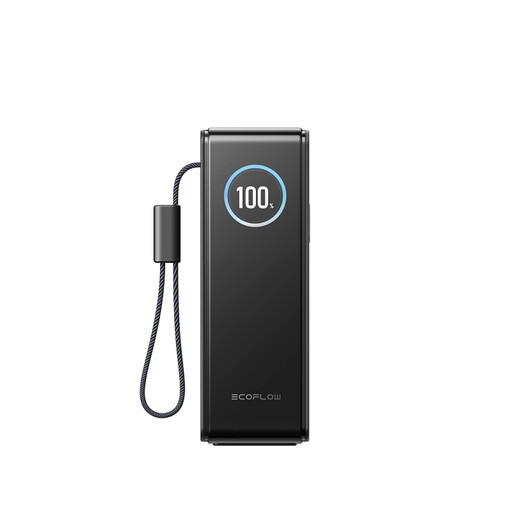
Why it stands out: This model combines a very high capacity with an exceptionally high charging output. The integrated USB-C cables make it an all-in-one solution for demanding mobile workstations.
Pros:
Who is it for? This model is aimed at professionals, creatives, and travellers who need a powerful power bank for their laptop, tablet, and smartphone and refuse to compromise on speed and capacity.
View details for the EcoFlow RAPID 170W

Why it stands out: This power bank is designed for maximum portability and wireless convenience. Thanks to its Qi2 certification and magnetic attachment, it's an ideal companion for modern smartphones.
Pros:
Who is it for? Perfect for iPhone users and owners of other Qi2-compatible smartphones who are looking for a lightweight, hassle-free MagSafe power bank for daily use to extend their battery life on the go.
View details for the EcoFlow Qi2 MagSafe Power Bank
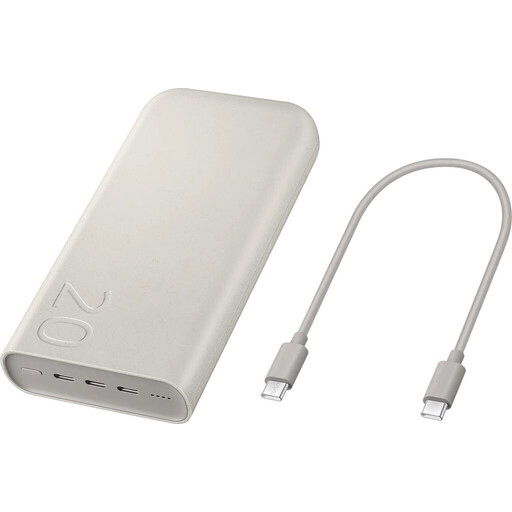
Why it stands out: Samsung delivers a well-balanced package of high capacity, solid fast-charging capabilities, and the ability to power three devices at once.
Pros:
Who is it for? A versatile portable charger for users who need a reliable power source for multiple devices. It's especially suitable for owners of Samsung devices who can benefit from the optimised fast-charging feature.
View details for the Samsung 20,000 mAh Power Bank
This selection represents just a fraction of the available models. Depending on your specific needs, a different capacity, size, or feature set might be a better fit for you. If you'd like to compare more alternatives, you can find a broader product range in our main category.
Discover our entire range of USB Type-C Power Banks and find the perfect solution for your needs.
The number of charges depends on your smartphone's battery capacity and the power bank's efficiency. There are energy losses during transfer, so you can expect an effective usable capacity of about 60–70%. Therefore, a 20,000mAh power bank has an effective capacity of around 12,000–14,000 mAh. A modern smartphone with a 4,000 mAh battery can be fully charged about three to three-and-a-half times with it.
Yes, power banks are generally allowed on airplanes but must be carried in your carry-on luggage. The International Civil Aviation Organization (ICAO) limits the capacity to 100 watt-hours (Wh). Power banks up to 160 Wh may be permitted with airline approval. The watt-hours are calculated as follows: (mAh / 1000) x V = Wh. At a typical voltage of 3.6V, a 25,000 mAh power bank is equivalent to 90 Wh and is therefore suitable for carry-on luggage.
MagSafe is a system developed by Apple that uses magnets for perfect alignment of chargers on an iPhone. It is a proprietary standard. Qi2 is the new, open charging standard from the Wireless Power Consortium (WPC) that uses a similar magnetic profile (Magnetic Power Profile). A wireless power bank with Qi2 therefore offers similar benefits to MagSafe—a secure attachment and efficient charging at up to 15W—but is designed for devices from a wide variety of manufacturers.