
Lieferung heute & morgen

Qualitätsgarantie

Willkommens-Angebote freischalten: KOSTENLOSE Lieferung | Bis zu 80 % RABATT | Kostenlose 30-Tage-JoyPlus-Testphase
App herunterladen
Published on: 2026-07-19 By: Joybuy Product Recommendation Officer
A low battery on your smartphone or tablet is a familiar frustration, especially when you're on the go. It's even more inconvenient when you can't find the right charging cable, or it's tangled deep in your bag. A power bank with a built-in cable solves this exact problem by combining a mobile power source and a charging cable into a single compact device.
This article serves as your guide. We'll introduce various models and explain the key technical features to consider, helping you make an informed decision that suits your devices and lifestyle.
The market for external batteries is vast. To find the right model, a few key technical specifications are crucial.
A power bank's capacity is measured in milliampere-hours (mAh) and determines how many times you can charge your devices.
Charging speed, measured in watts (W), indicates how quickly a power bank can charge your devices. Modern devices support technologies for fast-charging power banks.
The main advantage of these models is convenience. An external battery with a cable means you're always ready to charge. Some models offer a single built-in cable (usually USB-C), while others come equipped with two (e.g., USB-C and Lightning) to ensure broader device compatibility.
Here, we highlight three models that stand out for their specific features, making them suitable for different use cases.
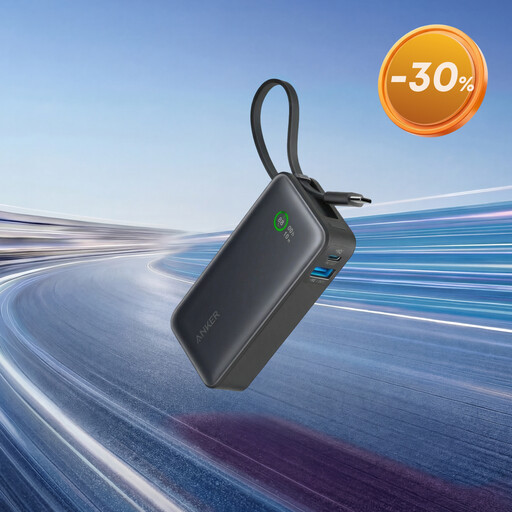
Why It Stands Out: This model from Anker combines a compact design with powerful 30W fast-charging technology, making it a practical companion for daily use.
Pros:
Who Is It For? Ideal for commuters and users looking for a lightweight, discreet charging solution for their USB-C smartphone or tablet who also value fast charging.
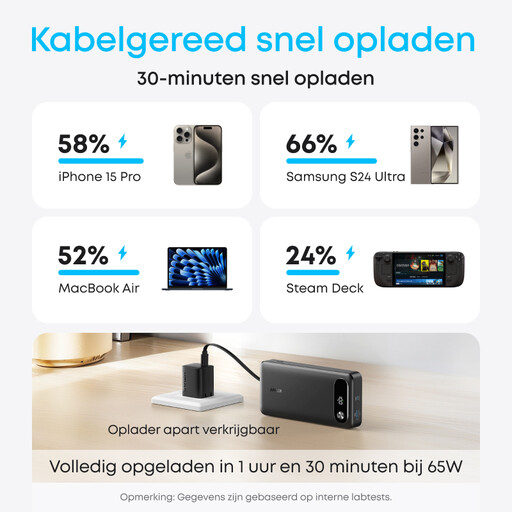
Why It Stands Out: With a high capacity of 20,000 mAh and an impressive total output of 87W, this power bank can handle not only smartphones but also more demanding devices like laptops.
Pros:
Who Is It For? An excellent choice for travellers, digital nomads, and power users who need a single charging solution for all their devices, including a smartphone, tablet, and laptop.
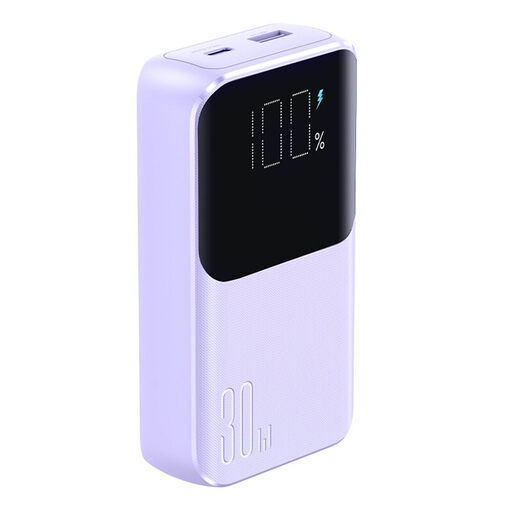
Why It Stands Out: This model stands out for its exceptional flexibility, as it features both a built-in USB-C and a Lightning cable. This makes it especially practical for users with devices from both ecosystems.
Pros:
Who Is It For? Perfect for families, couples, or individuals who own both Apple (older iPhones/iPads) and Android devices and prefer an all-in-one solution without carrying extra cables.
While the focus of this article is on built-in charging cables, high-performance cables are also crucial for other purposes, such as connecting to external monitors. If you need specialised cables for video transmission, you can find suitable options in our USB C Display Cables category.
1. How many times can a 20,000mAh power bank charge a smartphone? This depends on the smartphone's battery capacity. A typical modern smartphone has a battery of around 4,500 to 5,000 mAh. Factoring in energy loss during transfer, a 20,000mAh power bank can fully charge such a device about 2.5 to 3 times.
2. Are power banks with built-in cables durable? The durability of the built-in cable is an important factor. Manufacturers like Anker state that their cables are designed to withstand a high number of bends (e.g., over 10,000). With proper use, where the cable isn't excessively bent or pulled, these models offer long-lasting and reliable performance.
3. Can I take a power bank on an aeroplane? Yes, power banks are permitted in carry-on luggage as long as their capacity does not exceed the 100 watt-hour (Wh) limit. All the models featured here are well below this value. For example, a 20,000mAh power bank (at a typical voltage of 3.7V) has a capacity of 74 Wh, making it suitable for flights as a travel power bank. Placing them in checked luggage is prohibited.