
Lieferung heute & morgen

Qualitätsgarantie

Willkommens-Angebote freischalten: KOSTENLOSE Lieferung | Bis zu 80 % RABATT | Kostenlose 30-Tage-JoyPlus-Testphase
App herunterladen
A power bank with a built-in cable promises ultimate convenience: no more searching for the right cable, no more tangled mess in your bag. But the market is flooded with models whose practical benefits quickly turn into frustration. Many users invest in an all-in-one solution only to find that the charging performance is disappointing, the capacity doesn't live up to expectations, or the built-in cable breaks after just a few months.
As a Joybuy Product Recommendation Officer, I analyse product data to help you make informed decisions. This guide reveals the three most common pitfalls when buying and explains which technical parameters you need to look for to find a reliable and durable portable charger with cable.
Marketing promises often sound tempting, but the devil is in the details. Pay attention to these three points to avoid a bad purchase.
To avoid these pitfalls, you should check three core features before buying. These define the actual performance and longevity of your power bank.
A 10000mAh power bank with a built-in cable is a good compromise between size and power, ideal for the daily commute or short trips. A high-quality mobile battery with a digital display can provide transparency here, as it shows the remaining charge precisely as a percentage, rather than just through vague indicator LEDs. Look for models that specify an energy conversion rate of at least 75%. With this, you can fully charge a modern smartphone with a ~4,000mAh battery about 1.5 to 1.8 times.
A modern 22.5W Fast Charge power bank can charge a compatible smartphone to 50% in about 30 minutes. Ensure the power bank supports the protocols used by your devices, such as Power Delivery (PD) for iPhones or Quick Charge (QC) for many Android devices. For maximum flexibility, a power bank with both Lightning and USB-C connectors is essential. This allows you to charge both Apple devices and current Android smartphones and other gadgets without additional adapters.
A good power bank for travel must be compact and robust. The housing should be made of durable materials like ABS plastic or polycarbonate. For models with an integrated cable, the construction of the cable itself is critically important. Look for flexible yet sturdy sheathing and a reinforced connection to the housing to ensure longevity. Some designs cleverly use the cable as a carrying loop, which can reduce stress on the connection point.
Based on these objective criteria, we have identified some products suitable for different user profiles.
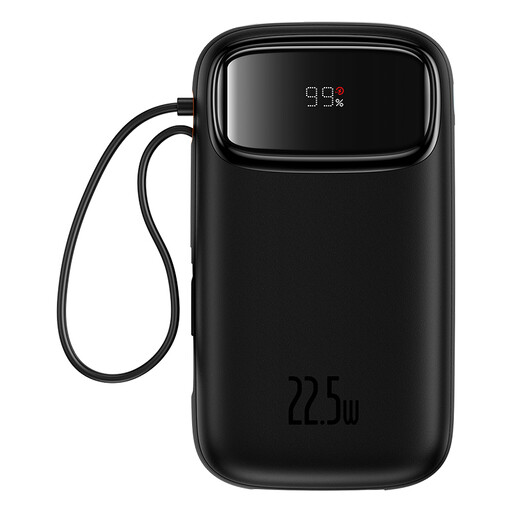
Why This Fits Their Persona: Ideal for users who commute daily between the office, university, and home and need to charge various devices like an iPhone and Android headphones. The integrated cables make separate charging cables obsolete.
The device specifies a charging speed of 22.5W and features both a built-in Lightning and a USB-C cable. The USB-C cable is designed as a durable lanyard, minimising the risk of cable breakage. The digital display shows the remaining charge with precision.
Two built-in cables (Lightning & USB-C) plus additional ports allow for charging up to four devices simultaneously. Compact design and airline-approved.
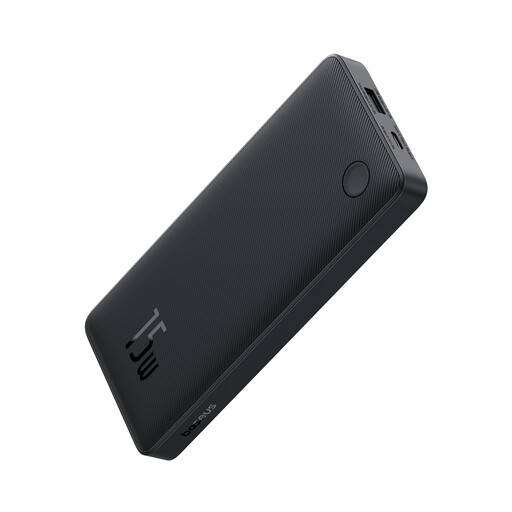
Why This Fits Their Persona: Suitable for students and budget-conscious users who need a high 10000mAh capacity but can do without a permanently integrated cable. The charging cable is included but is separate.
This model bypasses the weak point of a fixed cable by providing a separate, replaceable cable. The charging speed is clearly stated at 15W, offering solid performance for this price point.
Offers a high capacity of 10000mAh at a very accessible price. The included USB-C cable can also be used flexibly for other purposes.
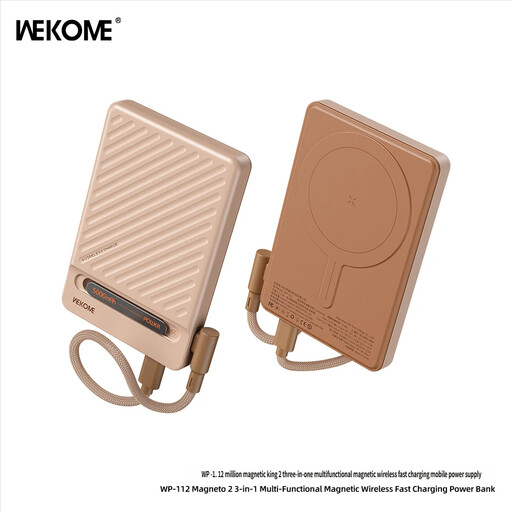
Why This Fits Their Persona: Perfect for iPhone users looking for an extremely compact, wireless charging solution on the go. The magnetic function (compatible with MagSafe) securely holds the power bank to the smartphone, ideal for short trips or as an emergency battery.
This model relies on a specific technology (magnetic wireless charging) instead of integrated cables. The capacity of 5000mAh is clearly declared and matches the compact form factor, which is designed for an emergency boost, not multiple full charges.
Completely wireless experience thanks to magnetic attachment. Extremely lightweight and compact, it fits easily into any pocket. Doubles as a stand.
We've curated a complete, up-to-date list of products that fully meet these strict selection criteria and rigorous safety standards.
The number of charge cycles depends on your smartphone's battery capacity and the power bank's efficiency. A 10000mAh power bank with a realistic efficiency of 75% delivers about 7,500mAh of usable energy. It can charge an iPhone 15 (approx. 3,349mAh) about 2.2 times, or an Android device with a 5,000mAh battery about 1.5 times.
Yes, this is generally not a problem. The International Air Transport Association (IATA) limits the capacity of batteries in carry-on luggage to 100 watt-hours (Wh). A 10000mAh power bank with a standard voltage of 3.7 volts has 37 Wh, which is well below the limit. It's important to note that power banks must be carried in carry-on luggage only, not in checked baggage.
The wattage (W) indicates the speed at which energy is transferred. A 22.5W Fast Charge power bank will charge a compatible device significantly faster than a 15W model. In practice, this can mean charging a smartphone from 0 to 50% in about 30 minutes, whereas a 15W charger might take 45 to 50 minutes for the same task. The actual speed always depends on the smartphone and the charging cable being used.