
Lieferung heute & morgen

Qualitätsgarantie

Willkommens-Angebote freischalten: KOSTENLOSE Lieferung | Bis zu 80 % RABATT | Kostenlose 30-Tage-JoyPlus-Testphase
App herunterladen
Whether for a weekend camping trip, as an emergency power supply during a home outage, or for working in locations without an outlet—a reliable portable power supply is becoming increasingly essential. A power station, also known as a solar generator, offers a flexible and clean alternative to conventional generators. However, the market is vast, and the technical specifications can be confusing.
As your Joybuy Product Recommendation Officer, I'm here to help you understand the key features and make an informed decision. This guide explains the crucial criteria and presents a selection of models for various applications.
To find the right portable power station for your needs, three factors are particularly important: capacity and power, the type of battery used, and the available charging options.
These two values are often confused, yet they describe fundamentally different characteristics:
Most modern power stations use lithium batteries, but there are differences. Many newer models rely on LiFePO4 (Lithium Iron Phosphate) batteries. Compared to conventional Lithium-Ion (Li-Ion) batteries, they offer significant advantages:
A good power station offers flexible charging. Standard methods include charging via a wall outlet and the 12V port in a car. For maximum independence, especially when camping, compatibility with a power station with solar panel is a smart addition. This turns the device into a self-sufficient solar generator.
Another useful feature is the UPS function (Uninterruptible Power Supply). In UPS mode, the power station instantly switches to battery power during an outage. This protects sensitive devices like computers or servers from data loss and is a practical feature for a home emergency power unit.
Here is a selection of models suitable for various requirements and budgets.
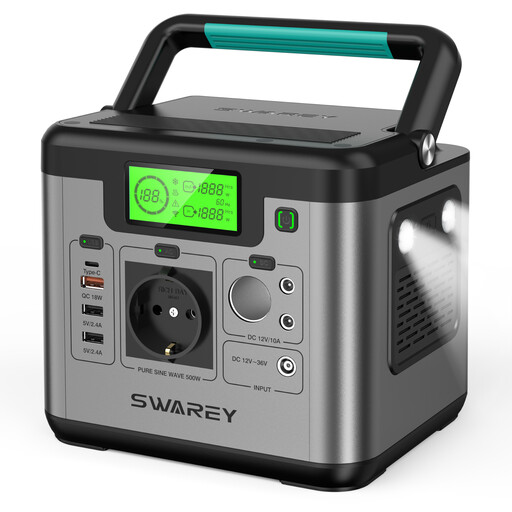
Why it stands out: The SWAREY S500 is a very compact and lightweight model that excels in portability. Weighing just under 4 kg and featuring a foldable handle, it's ideal for life on the go without compromising on connection options.
Advantages:
Who is it for? Ideal for day trips, camping beginners, or as a mobile power source for photographers and drone pilots. It reliably powers laptops, cameras, smartphones, and small cool boxes.
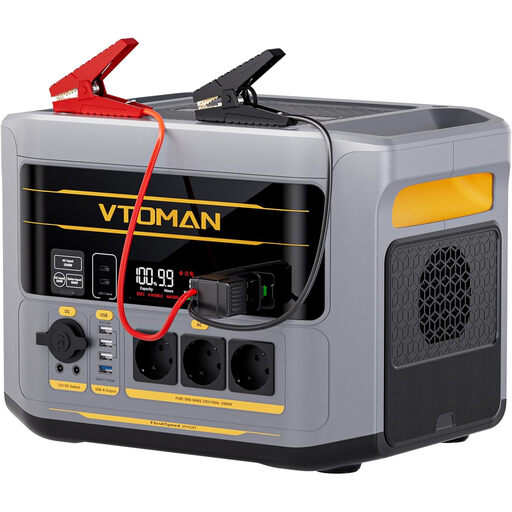
Why it stands out: This model is a powerhouse for demanding tasks. With 2400 W of continuous power, a very fast charging time, and the option to expand its capacity, the FlashSpeed 2400 is designed for both home use as an emergency power unit and for demanding power supply for RVs and workshops. The extremely fast 10 ms switchover time of its UPS function is a clear standout feature.
Advantages:
Who is it for? For homeowners seeking a reliable emergency power solution, as well as for RV owners and tradespeople who need to operate power-hungry devices like microwaves, kettles, or power tools.

Why it stands out: The FlashSpeed 1000 offers a balanced mix of power, capacity, and portability. It features V-Beyond technology, which, according to the manufacturer, allows it to run devices with a rated power of over 1000 W. Its fast-charging capability and durable battery make it a versatile companion as a power station for camping and travel.
Advantages:
Who is it for? For outdoor enthusiasts who need more power than an entry-level model to run devices like a coffee machine, a blender, or small tools, without sacrificing portability.
This selection already covers many use cases. However, depending on your individual needs for capacity, power, or specific ports, a different model might be a better fit. If you're looking for a solution specifically for your vehicle or want to compare other alternatives, you're sure to find the right product in our wide range.
Discover our full range of on-the-go accessories in our RV Accessories category.
This depends on the maximum power output (in watts) of the power station. Smaller models (approx. 300-500 W) are suitable for laptops, smartphones, cameras, lamps, and small cool boxes. Mid-range models (approx. 1000 W) can also power devices like projectors, blenders, or coffee machines. High-performance models (2000 W and up) can even run energy-intensive appliances like microwaves, kettles, or drills.
Yes, most modern power stations support "pass-through charging." This means you can power connected devices while the power station itself is being recharged, for example, via a wall outlet or a solar panel.
A LiFePO4 battery is known for its exceptional longevity. Manufacturers often specify the lifespan in terms of charge cycles. Models like those from VTOMAN are rated for over 3,000 full charge and discharge cycles before the battery capacity drops to about 80% of its original capacity. With weekly use, this equates to a lifespan of over 10 years.