Choose a power station based on the continuous power you need at the same time, the energy required until your next chance to recharge, and the connections you need – not just its stated watt-hour capacity. Charging from your vehicle or solar panels is a useful option only if the specific model, cables and input limits are compatible. If you already have an onboard battery, a portable power station is particularly useful for powering devices connected separately or for use outside the vehicle.
Who is a power station suitable for?
Weekend campers with portable equipment
For short trips, a portable power station can power phones, laptops, lights and selected compatible devices. If you’ll also use it outside the vehicle, check that its weight and handles make it easy to move around frequently. promobil’s camping guide describes power stations as a portable source of electricity for camping and motorhomes.
Travellers staying off-grid for longer
If you need to manage for a while before reaching your next mains connection, you’ll need to consider not only the stored energy but also suitable ways to recharge from your vehicle or solar panels. The ADAC points out that features vary between models depending on how they’re intended to be used.
Motorhome travellers with an onboard battery
A portable power station can power selected devices separately or be used outside the motorhome, while leaving the existing onboard power supply in place. promobil’s camping guide describes it as a flexible extra; a power station does not automatically feed into the vehicle’s permanently installed electrical system.
What should you look for when buying?
Start by working out which devices you’ll use at the same time and how long they’ll need power before you can recharge. Then consider the connections, charging options and portability that best suit your trip.
| What you need |
What to check before buying |
Who this matters most to |
| Power for your time off-grid |
Work out your expected consumption until your next chance to recharge; consider the usable energy available from the output you need. |
If I need to power several devices until I can recharge, the energy actually available matters more than a single headline figure. Around 29% of consumers in this usage scenario consider battery life their top buying priority. |
| Power output and connections |
Check the continuous power draw of the devices you’ll use at the same time, and make sure the station has suitable USB, 12 V and 230 V outputs. |
If you want to connect several devices at once, you’ll need suitable outputs and enough continuous power. For around 24% of consumers, powering multiple devices or meeting their power needs is the top priority. |
| Recharging on the go |
Check the vehicle and PV inputs, compatible cables and which combinations of charging inputs are allowed. |
If I’m staying off-grid for a long time or want to recharge between stops, I need a charging option that’s compatible with my model. Around 23% of consumers prioritise charging from a vehicle or solar panels. |
| Portability and storage |
Compare the weight, dimensions and handles with how often you’ll move the power station and how much storage space you have. |
If you’ll often move the power station between your vehicle and where you’re using it, you’ll need to balance the effort of carrying it against your energy needs. Portability is the top priority for around 12% of consumers. |
| Adding to your onboard power supply |
Decide which devices you’ll power directly from the station and which will continue to run from your existing onboard system. |
If I want to keep my existing onboard battery and power selected devices separately, a power station that can be used on its own is a relevant option. Around 12% of consumers prioritise adding to their onboard power supply. |
Common buying and usage mistakes
-
Assuming the rated capacity is the same as the available 230 V energy
The usable energy available from an output can differ from the rated capacity. In the ADAC test of the Anker SOLIX C800 Plus, the rated capacity was 768 Wh, while the measured net AC capacity was 630 Wh. This measurement applies to the model tested.
Plan how long it will run using figures or measurements for the output you actually need, and factor in your usage until your next chance to recharge.
If you underestimate the capacity you need, you may have to recharge more often.
-
Using vehicle and solar inputs at the same time without checking
The ADAC documented a risk of overvoltage when the Ective BlackBox 10 and Jackery Explorer 1000 v2 were connected to a car and a solar panel in parallel. A model being suitable for each charging method individually does not mean they can be used at the same time.
Check the instructions for the exact model, and only use this combination if it is explicitly approved.
Incorrect connections can damage your vehicle.
-
Assuming a panel’s rated output is its actual charging output
Permitted PV inputs vary by model and determine which panel and connection are suitable. For example, EcoFlow specifies different PV input power for the DELTA 3 and DELTA 3 Plus.
Check that the panel’s specifications and connection match the exact power station and its input limits.
Depending on the device, you may need a compatible panel or an additional cable.
Key brands to consider
Bluetti
The AC180P is one example of a higher-capacity portable power station in the range tested by the ADAC.
- The ADAC awarded the AC180P it tested an overall score of 2.0 and praised its ease of use.
- The test noted a loud fan; the model does have a quiet mode. This assessment applies to the AC180P, not all Bluetti models.
EcoFlow
With the DELTA 3 range, it’s important to check the exact variant, particularly if you plan to charge it using solar panels.
- EcoFlow specifies a capacity of 1,024 Wh, output power of 1,800 W and PV input power of 1,000 W for the DELTA 3 Plus.
- For the DELTA 3, EcoFlow specifies a PV input of 500 W, despite the same stated capacity and output power. The ADAC specifically awarded the DELTA 3 Plus an overall score of 2.1; manufacturer specifications are not independently measured usable energy.
Anker SOLIX
The C800 Plus is a model the ADAC assessed for camping, supplied with vehicle and PV charging cables in the tested package.
- For the model tested, the ADAC measured a net AC capacity of 630 Wh against a rated capacity of 768 Wh.
- The ADAC awarded the C800 Plus an overall score of 2.5 and noted that it cannot be expanded with additional batteries, as well as a loud fan at maximum AC output. Check the model name and what’s included with the specific variant.
DJI
For the Power 1000, make sure the regional model variant and the USB-C power requirements are compatible with your device.
- DJI specifies 220–240 V AC for variant DYM1000H and 100–120 V AC for DYM1000L.
- According to DJI, the stated 140 W per USB-C output requires a compatible PD 3.1 device and an EPR cable.
Power stations at Joybuy
These models are worth considering for powering devices directly and providing portable power while camping or travelling in a motorhome. Check that each variant has the connections and charging options you need. If you’re carrying a power station as a load in a vehicle while driving in Germany, it must be secured safely under § 22 Abs. 1 StVO.
 No image available
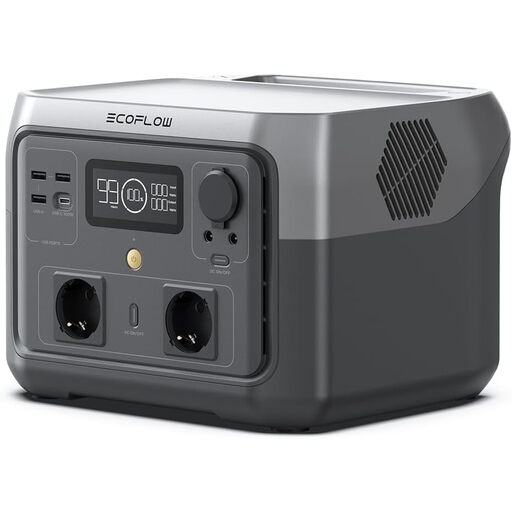
EcoFlow RIVER 2 MAX
For camping and motorhome trips when you want to connect devices directly and recharge on the go.
512 Wh capacity; AC, USB and DC outputs. Also specified are up to 220 W solar input, 100 W USB-C and a 12/24 V vehicle input.
Weight is stated as approximately 6 kg.
View at Joybuy
 No image available
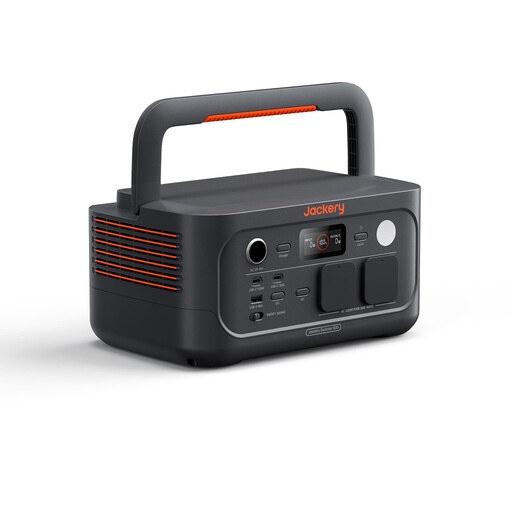
Jackery Explorer 500 V2
For short trips when you want to connect different types of devices directly and consider vehicle or solar charging as options.
512 Wh capacity and up to 500 W continuous power; AC, USB and 12 V outputs are specified.
Weight is stated as 5.7 kg.
View at Joybuy
 No image available
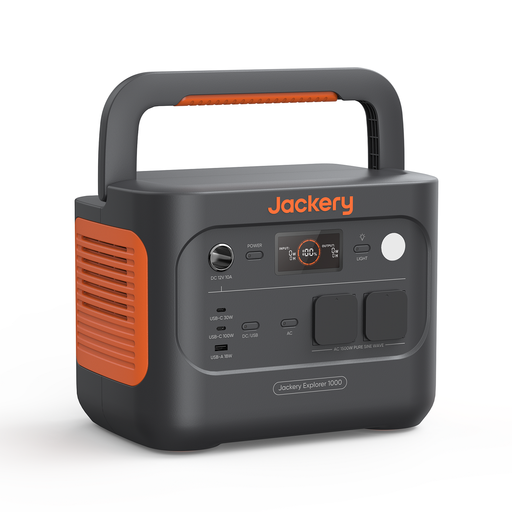
Jackery Explorer 1000 V2
For powering several devices directly, provided the stated capacity and rated output suit your planned use.
1,070 Wh capacity and 1,500 W rated output; AC, USB and 12 V outputs, as well as app control, are listed.
Weight is stated as approximately 10.8 kg. According to the product description, a vehicle charging cable is not included.
View at Joybuy
 No image available
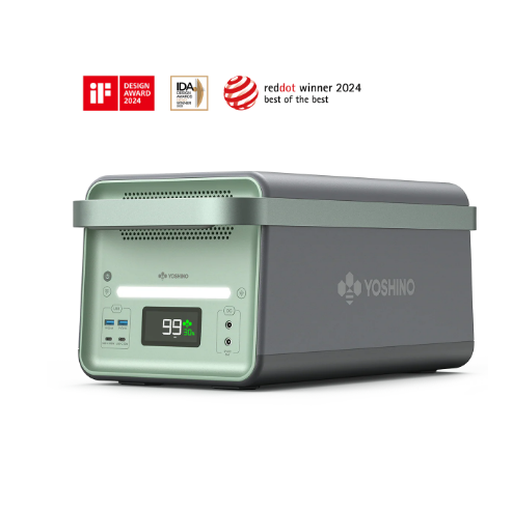
Yoshino B3600SST
For camping when a higher stated capacity and solar charging option suit your planned use.
3,600 Wh capacity; up to 600 W solar input and six AC, DC and USB-C outputs are specified.
Weight is stated as 23.6 kg.
View at Joybuy
 No image available
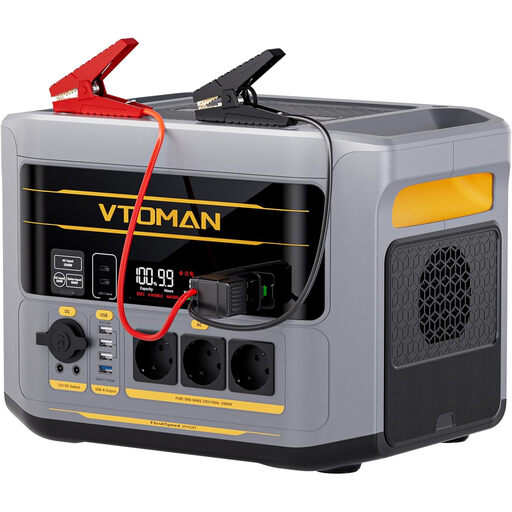
VTOMAN FlashSpeed 2400
For several devices in use at the same time, when the stated power and available charging options meet your travel needs.
1,408 Wh capacity and 2,400 W rated output; twelve outputs, plus vehicle and solar charging, are listed.
Weight is stated as 18 kg.
View at Joybuy
Frequently asked questions
How do I work out what size power station I need?
For each device, note its power consumption and how long you plan to use it before recharging. Also check the total continuous power needed when devices are running at the same time. Where possible, compare this with the usable energy available from the output you need, rather than relying on the rated capacity alone.
Can I connect my car and a solar panel at the same time to charge it?
Not necessarily: the ADAC identified a risk of overvoltage when the Ective BlackBox 10 and Jackery Explorer 1000 v2 were connected to a car and a solar panel in parallel. Only use both charging options at the same time if the instructions for your specific model explicitly allow it.
What should I bear in mind when transporting and storing it?
When travelling in Germany, a power station carried as a load must be secured under § 22 Abs. 1 StVO so that it cannot slide around or tip over, even during emergency braking or a sudden manoeuvre. The German Environment Agency also advises against storing lithium batteries if they are damaged or in hot places, such as a car in the sun. Follow your model’s instructions too.
Who should I contact if there’s a fault after purchase?
If there’s a fault, you have statutory rights against the seller; a manufacturer’s warranty is separate and subject to its own terms. Before buying, check who the seller is and which warranty terms apply to the specific device and accessories.


