Occasional visitors who need lights and chargers
You want to take your power supply home after each visit and can charge the power station away from the garden.


For occasional visits when you need lights and chargers, a portable power station is a sensible place to start, provided its energy capacity meets your needs and you can recharge it away from the garden. If you spend longer there, compatible mobile solar charging may help. For appliances that run regularly or draw a high starting current, check daily energy use and starting power separately. A more permanent off-grid system also requires you to check local rules: the German Association of Allotment Gardeners takes a restrictive stance on supplying power to garden sheds, so you cannot assume that such a system will be allowed.
You want to take your power supply home after each visit and can charge the power station away from the garden.
You need power in the garden repeatedly during the growing season and are weighing up mobile solar charging against bringing a larger energy reserve.
Before choosing a system, you check an appliance’s energy use and, where relevant, its starting power. With a more permanent solution, you also need to check the rules for your location.
A good fit if: You need to power lights, a mobile phone or a few small appliances during occasional visits, and can take the station home with you.
Bear in mind: Without a way to recharge it on site, you can only use it until its stored energy runs out.
A good fit if: You spend longer or return to the garden regularly, and have a suitable spot that gets enough sun.
Bear in mind: The solar input, panel and connections must be compatible. The panel’s rated output does not guarantee a specific amount of energy each day.
A good fit if: You regularly need more power and a permanent installation is allowed at your specific location.
Bear in mind: The battery, charge controller, inverter and appliances need to be planned as one system. You’ll also need to check the installation requirements and local rules.
A good fit if: Your lights or small appliances can run from a compatible DC output.
Bear in mind: The voltage, connector and power output must match the appliance. This will not automatically power 230-V appliances.
Start by working out which appliances you want to run and for how long. Then decide whether a portable energy reserve is enough, or whether recharging and the rules at your location matter more.
| What you need | What to check before buying | Who this matters to |
|---|---|---|
| Portability and short visits | Energy needed in Wh for the length of your visit, suitable outputs, weight and a way to charge the unit away from the garden. | If I only want to power lights and chargers on occasional visits, and take the station home afterwards, having the right energy reserve is essential. Around 33% of consumers put this basic need for portability first. |
| Recharging on site | Compare daily energy needs with realistic charging options; check the solar input, panel voltage, connections and location for the panel. | If I’m spending several days in the garden without access to a mains socket, I want to know whether the system can be recharged effectively on site. Around 25% of consumers prioritise recharging during longer or repeated use. |
| Appliances that run regularly or draw a high starting current | Find out the appliance’s running power and, where relevant, its starting power; compare daily energy use and recharging with the battery capacity. | If I use an appliance regularly during the season, I want to check whether it can actually be powered rather than relying on a wattage figure alone. Around 25% of consumers base their choice primarily on these continuous loads and starting power. |
| Direct low-voltage supply | Compare the rated 12-V or 24-V voltage, current, connector type and specifications of the particular output. | If my small appliances can run on DC, I want to use a suitable output without unnecessarily converting the power to 230 V. Around 17% of consumers prioritise compatible low-voltage appliances. |
For fridges, pumps and other appliances that run regularly, capacity or wattage figures alone are not enough. Find out the actual energy use and check that the power supply can also handle the starting power. If you rent an allotment garden, check the garden rules, tenancy agreement and any required permission before arranging a permanent installation.
Output power in watts and storage capacity in watt-hours describe different limits. A high power rating on its own does not tell you how long an appliance can run.
Work out the energy needed for the planned period of use and, for appliances with motors, check the starting power as well.
If actual daily use exceeds the available energy reserve, you may need an additional or larger battery.
Bundles can include different items, and even a panel from the same brand will not necessarily work with every power station.
Check what’s included, along with the electrical specifications and connections of the exact panel and station you plan to buy.
If the panel or connecting cable isn’t included, you’ll need to buy it separately.
The rules for a portable solution do not automatically tell you whether a permanent installation or power supply to an allotment shed is allowed. According to the Bundestag record reviewed, a proposal to amend the Federal Allotment Gardens Act had not yet been debated.
Before arranging a permanent installation, check the relevant agreement and club rules, and get any required permission from the allotment association and landlord.
A permanent installation may involve extra planning and the potential cost of removal; this depends on local requirements.
The RIVER models are aimed at smaller portable power needs, while the DELTA models sit in a different capacity and output range.
The C300 is a compact option for smaller appliances, while the C1000 Gen 2 belongs to a different output and storage range.
The Explorer 1000 v2 is a portable option for buyers whose energy needs are greater than those met by a small charging station.
A components-based approach for a separately planned off-grid power system, rather than a direct replacement for a portable power station.
The Joybuy products below are portable power stations, some with a solar input; they are not a selection of systems designed for permanent installation. Check that the panel and cables are compatible with each model and included in the offer.
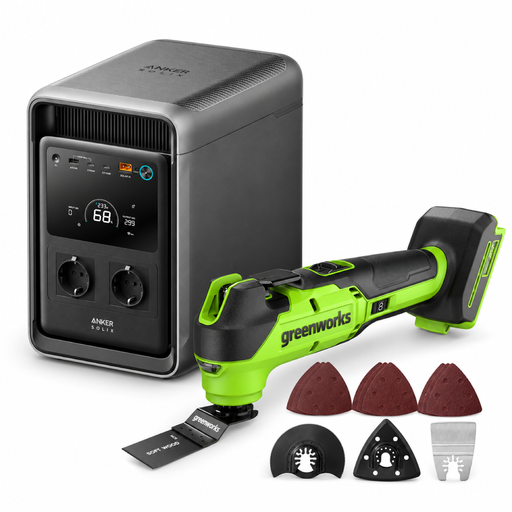 Image unavailable
May be worth considering for longer stays with higher energy needs, provided its portable design suits your plans for transporting it.
The power station is listed with 2,000 Wh, 1,500 W continuous output and a 400 W solar input. According to the description, it does not have a 12-V DC connection. The battery and charger are not included with the multi-tool.
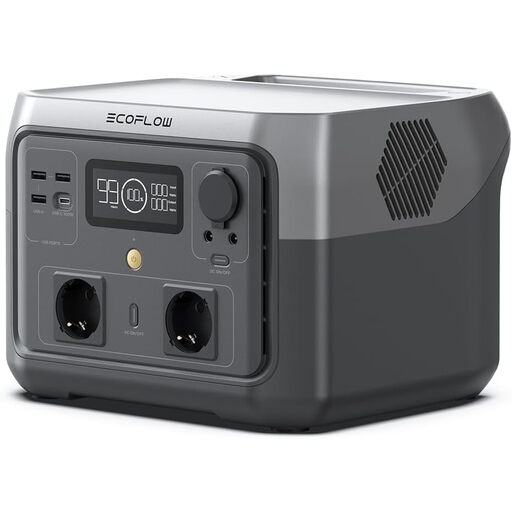 Image unavailable
This portable power station may suit occasional visits when you need lights and chargers, provided 512 Wh is enough for how you plan to use it.
EcoFlow lists 512 Wh and 500 W output. The product description mentions AC, USB and DC outputs, a solar input of up to 220 W and a weight of around 6 kg. Do not use it in the rain or damp conditions; store it somewhere dry and well ventilated.
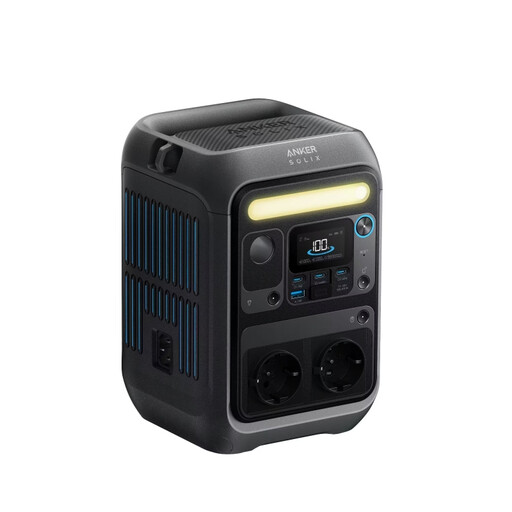 Image unavailable
May suit short visits when you need lights and chargers, provided its capacity matches your energy needs.
The product description lists 288 Wh, 300 W AC rated output, up to 100 W solar input, and AC and USB outputs. Its weight is given as 4 kg. Anker explicitly states that the PS30 panel is not compatible.
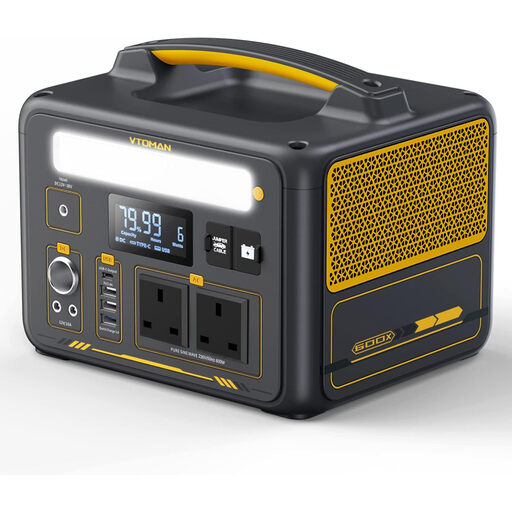 Image unavailable
This power station may suit garden visits when you need lights and chargers, provided its capacity and outputs meet your actual needs.
The product description lists 299 Wh, 600 W AC output, a solar input of up to 100 W, USB and regulated 12-V outputs. Expanding the capacity to 939 Wh requires an additional battery, sold separately.
 Image unavailable
May be worth considering for longer or repeated stays, if its larger energy reserve matches your needs.
The product description lists 828 Wh, 1,000 W rated output and a solar input of up to 400 W. Expanding the capacity to 2,376 Wh requires the FlashSpeed 1500 additional battery, sold separately.
First, measure the energy use of the specific fridge over a representative period. For existing fridges, the consumer advice centre recommends using an electricity meter and taking a longer-term reading. Also check the running and starting power against the power supply’s specifications. Without these appliance details, it isn’t possible to give a reliable estimate of running time.
No. The panel and power station need to be electrically compatible. Check the input specifications, permitted solar input and connections for the exact models. Anker lists up to 100 W solar charging for the SOLIX C300 and explicitly states that the PS30 panel is not compatible.
You cannot assume that they are generally allowed. The German Bundestag describes solar systems as neither explicitly permitted nor prohibited under the Federal Allotment Gardens Act; according to the record reviewed, the proposal to amend the Act described in the Bundestag proceedings had not yet been debated. The German Association of Allotment Gardeners takes a restrictive stance on supplying power to garden sheds. So check the garden rules, tenancy agreement and installation location, and get any required permission from the allotment association and landlord.
Follow the instructions for your specific model on temperature, charge level and how often to check it. Jackery recommends checking the battery regularly during longer-term storage; this manufacturer recommendation does not automatically apply to other models.
According to the official Market Master Data Register guidance, mobile systems such as portable batteries and power stations do not need to be registered. For power-generating units and storage systems, whether they are fixed in place and connected to the grid is particularly relevant. The German Federal Network Agency describes a genuine off-grid system as one with no direct or indirect connection to the public electricity supply network. Temporarily disconnecting a grid-connected system or using zero feed-in does not automatically make it an off-grid system.