
Lieferung heute & morgen

Qualitätsgarantie

Willkommens-Angebote freischalten: KOSTENLOSE Lieferung | Bis zu 80 % RABATT | Kostenlose 30-Tage-JoyPlus-Testphase
App herunterladen
In modern homes and offices, the number of electronic devices often exceeds the available wall outlets. A power strip is the go-to solution. However, the market offers a dizzying array of options, from basic models to smart strips with app control. This guide will help you understand the key features, safety standards, and designs, enabling you to make an informed decision for your specific needs.
As your Joybuy Product Recommendation Specialist, I have compiled information on various models to provide you with an objective foundation for your choice.
Before you decide on a model, there are several technical and safety-related aspects to consider. The right choice depends on the devices you plan to connect and where you'll use it.
Safety is the most important criterion. Look for recognised certification marks. The GS mark ("Geprüfte Sicherheit" or "Tested Safety") is a seal recognised in Germany that confirms a product complies with the requirements of the German Product Safety Act (ProdSG). The CE marking is also mandatory and indicates that the manufacturer declares conformity with EU directives.
For households with children, an integrated child safety feature (usually small plastic shutters that cover the contacts) is a fundamental requirement. A power strip with surge protection can also save valuable electronics like computers or TVs from damage caused by power surges, such as those from a lightning strike in the power grid.
The classic power strip offers only standard AC outlets. Modern variants, however, go far beyond that.
Check the specified total power output of the USB ports (in watts) to ensure it is sufficient for your devices.
A simple power strip with a switch allows you to disconnect all connected devices from the power grid with a single click, thus avoiding standby power consumption.
A smart power strip offers advanced capabilities. These models connect to your home's Wi-Fi and can be controlled via an app or voice assistant (e.g., Alexa or Google Home). It's often possible to switch each socket individually, create schedules, or monitor energy consumption. A Wi-Fi power strip with energy monitoring helps identify "energy hogs" in your household and reduce consumption in a targeted way.
Here is a selection of models that cover different use cases—from simple household use to the connected home office.

Why it stands out: This model focuses on the core functions: safe power distribution and durability. Its certifications and robust construction make it a reliable choice for basic needs.
Advantages:
Who is it for? For budget- and safety-conscious households that need a straightforward and reliable power strip for everyday devices like lamps, chargers, or kitchen appliances.
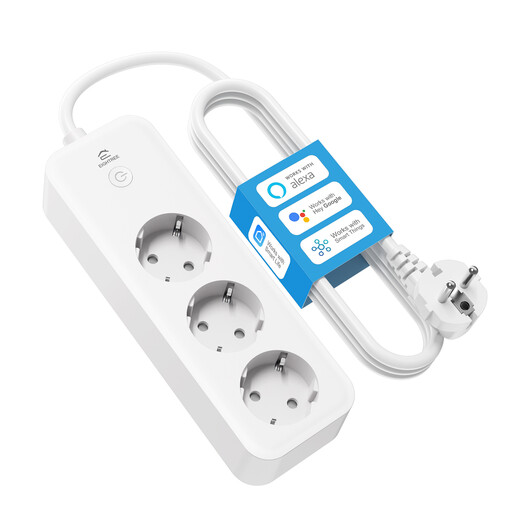
Why it stands out: This strip brings intelligence to your power distribution. The ability to control each outlet individually and analyse consumption in detail offers a high degree of control and optimisation potential.
Advantages:
Who is it for? For tech enthusiasts and smart home users who want to automate their devices, control them remotely, and actively manage their energy consumption.
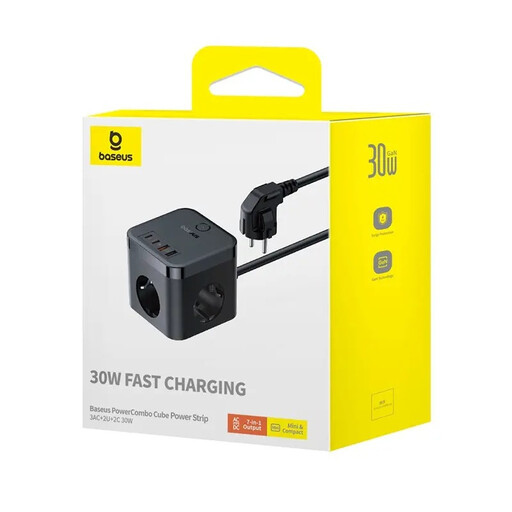
Why it stands out: The cube power strip from Baseus combines maximum port variety in a minimal footprint. It's an all-in-one solution for the modern desk that reduces cable clutter.
Advantages:
Who is it for? For home office professionals, students, and anyone who needs a compact, powerful, and tidy charging station for a variety of devices—from laptops to headphones—right at their workspace.
The models presented cover common scenarios, but everyone's needs are unique. If you are looking for a different number of outlets or specific features, a look at our broader range might be helpful.
→ Discover more models in the 3-outlet power strip category here.
In common usage, both terms are used interchangeably. They refer to a device that allows multiple electrical appliances to be connected to a single wall outlet. Technically, there is no difference.
This is strongly discouraged. Daisy-chaining multiple strips significantly increases the risk of overload and, consequently, a fire hazard. The maximum load capacity of a single wall outlet (typically 3680 watts in Germany) must not be exceeded. Always plug a power strip directly into a permanently installed wall outlet.
Look for the GS mark ("Geprüfte Sicherheit" or "Tested Safety"), which confirms independent testing. A CE marking is also mandatory. Other features include an integrated child safety lock, a robust plastic housing (often described as "flame-retardant"), and an adequately sized power cord (e.g., with the designation H05VV-F 3G1.5mm?).