
Lieferung heute & morgen

Qualitätsgarantie

Willkommens-Angebote freischalten: KOSTENLOSE Lieferung | Bis zu 80 % RABATT | Kostenlose 30-Tage-JoyPlus-Testphase
App herunterladen
An artificial Christmas tree promises a hassle-free and clean alternative to a traditional fir: no shedding needles, no complicated disposal, and a one-time purchase that brings joy for years. However, the market is flooded with models of widely varying quality. Many buyers only discover after unboxing that their tree is sparse, unstable, or has faulty lighting. To help you with your selection, we'll highlight the crucial features and show you how to avoid common purchasing pitfalls.
Before you make a decision, you should be aware of the most common problems often hidden behind attractive product photos.
To find a durable and visually appealing tree, you should pay attention to three key technical parameters.
The appearance of an artificial fir tree is largely determined by the material of its needles.
Integrated lighting should do more than just glow. Check the following points:
An easy-to-assemble fir tree saves time and frustration. The hinged construction has become the standard here. The branches are permanently attached to the trunk and only need to be fluffed into shape after setup. This is much more convenient than hooking in individual branches. A sturdy, foldable metal stand is essential for a 180 cm tree to ensure a secure and upright position.
Here are some recommendations tailored to different needs and living situations.

Why This Fits Their Persona: This 183 cm (6 ft) model is a practical all-in-one solution. Assembly is quick thanks to its hinged system, and the integrated lighting with various modes saves you from untangling light strings—ideal for families who want to enjoy a stress-free holiday season.
The tree comes with a foldable metal stand that ensures stability. The 300 LEDs offer 9 different light modes, which goes far beyond the functionality of simple, fixed lights.
9 Light Modes: Switch between warm white and multi-color lights at the touch of a button. Easy Assembly: Hinged construction for quick setup and storage.
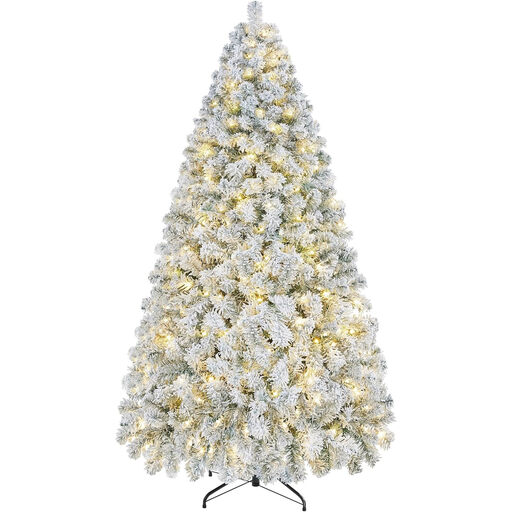
Why This Fits Their Persona: For anyone looking for an especially lush and impressive tree. At 213 cm (7 ft) tall with 1000 tips and dense flocking for a snow-dusted effect, this tree provides an excellent canvas for opulent decorations in larger rooms.
The high tip count is combined with high-quality PVC material, ensuring genuine density. The sturdy metal stand is designed for the tree's size and weight, preventing instability.
Snow Effect: The dense flocking creates a wintry, snow-covered look. High Density: 1000 branch tips create a full, luxurious silhouette.
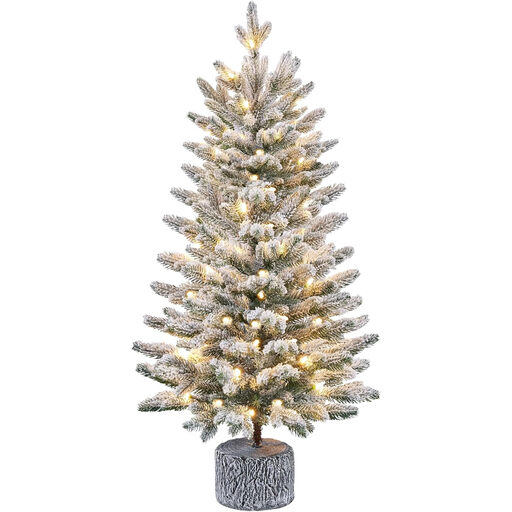
Why This Fits Their Persona: Not everyone has space for a large tree. This 90 cm (3 ft) model is perfect for small apartments, offices, or as an additional decoration on a side table. It comes pre-potted and is illuminated with 50 warm white LEDs.
As a complete unit with an integrated, stable base (pot), this model bypasses the problem of mismatched or wobbly stands for small trees. The lighting is well-proportioned for its size.
Space-Saving: Ideal for tables, windowsills, or small corners. Ready to Use: Unpack, set up, turn on the lights—your Christmas decor is complete.
We have compiled a complete, up-to-date list of products that fully meet these strict selection criteria and safety standards.
1. How long does an artificial Christmas tree last? With proper care and storage (ideally in its original box in a cool, dry place), a high-quality artificial Christmas tree can last 10 to 15 years or even longer. The lifespan of integrated LED lighting is often rated by manufacturers for several thousand hours of operation, which also covers many years of seasonal use.
2. How many lights does a 180 cm tree need? A common rule of thumb is that you need about 50-100 lights for every 30 cm of tree height for appealing illumination. Therefore, for a 180 cm tree, 300 to 600 LEDs is a good benchmark, depending on how bright you want the lighting to be. On pre-lit trees, the number of lights is already optimized by the manufacturer for the tree's density and size.
3. Is setting up an artificial fir tree complicated? Modern artificial fir trees, especially those with a hinged system, are very easy to assemble. Typically, the tree consists of two or three sections that are simply inserted into one another and secured on the included stand. The most time-consuming part is the subsequent "fluffing" of the branches to achieve a natural, dense shape. The entire process usually takes no more than 20 to 30 minutes.