Hosts putting on a holiday breakfast
If family or friends are coming over for brunch, you could serve rustic rolls alongside spelt or multigrain varieties. Check that the ingredients and quantity of each type suit your guests.


For a special holiday breakfast, start by choosing a type of bread roll to suit your taste and the occasion, then plan when you’ll eat it. Freshly bought rolls are best eaten soon after purchase, while part-baked rolls work well for breakfast at a set time if you have a suitable oven. If you need to take allergens into account, check the label on the specific product – don’t rely on the variety name or where it’s sold.
If family or friends are coming over for brunch, you could serve rustic rolls alongside spelt or multigrain varieties. Check that the ingredients and quantity of each type suit your guests.
For breakfast at a set time or food to take on a picnic, the key question is when you need the rolls to be ready. Fresh rolls mean getting the timing of your shopping right; part-baked rolls need a suitable oven.
If you need to avoid gluten or other allergenic ingredients, check the information for the specific bread roll. A variety labelled gluten-free may still contain other allergenic ingredients.
For breakfast, brunch or a picnic, first decide which type you’d like and when you’ll eat it. Then check the ingredients, how many you need and what you can buy at your holiday destination.
| Criterion | What to check when buying | Who it matters to |
|---|---|---|
| Flavour and choice of varieties | Compare the specific varieties and ingredients; sourdough, spelt and multigrain describe different qualities. | For guests, I want to put together a selection with clearly different varieties, rather than relying on the word “premium” alone. This is a priority for around 39% of consumers. |
| Timing and preparation | Check what you can buy locally or, for part-baked rolls, whether you have the right oven and can follow the pack instructions. | If breakfast in the holiday accommodation is at a set time, I need to plan when to shop or bake accordingly. This is a top priority for around 23% of consumers. |
| Ingredients and allergens | For packaged products, read the current label; for loose products, ask for allergen information. | If someone at the table needs to avoid certain ingredients, I need information about the individual bread roll rather than making assumptions based on its variety name. This is the main priority for around 23% of consumers. |
| Quantity and availability | Check that the pack contains the number you need, and confirm availability if you have a particular in-store variety in mind. | For a larger group, I want to make sure I have enough rolls and be ready to choose an alternative if a variety is in limited supply. Around 15% of consumers focus mainly on this. |
A particular variety from an in-store bakery may not be available at every branch or at the time you shop. You can prepare part-baked rolls for breakfast at a set time, but you’ll need to allow time for them to bake.
Choose based on when you’ll be eating, and have an alternative ready if you want a particular in-store variety.
A roll labelled gluten-free may contain other allergenic ingredients. For example, REWE lists soya protein and sesame in its gluten-free REWE frei von hamburger buns.
Check the current label on the specific product. According to Germany’s Federal Ministry of Agriculture, Food and Home Affairs, allergen information must also be available for unpackaged products. Ask if anything is unclear.
Sourdough, organic ingredients and a particular baking time describe different qualities. None of them is a substitute for checking the variety, ingredients and whether it suits your occasion.
Before buying, think about what matters most to you: a particular flavour, when the rolls are baked or a suitable list of ingredients.
ALDI Nord notes that some special-buy products are available in limited quantities. The in-store bakery variety you want also needs to be available at your local branch.
If you need a certain quantity, check the local selection early and plan a similar alternative.
REWE has product pages for different types of bread rolls, including part-baked rolls and hamburger buns labelled gluten-free.
EDEKA features products including a Toscana roll made with sourdough and a part-baked baguette roll.
Lidl describes its in-store bakery as offering products freshly baked several times a day, including spelt and multigrain varieties.
ALDI SÜD and ALDI Nord each describe their own in-store bakery ranges. They are separate regional retail companies, so the selection may differ.
Kamps is a bakery to consider when shopping near your holiday accommodation or home.
Regional bakery Der Meisterbäcker describes its range of bread rolls as being made with long fermentation and natural sourdough. These are claims made by the manufacturer.
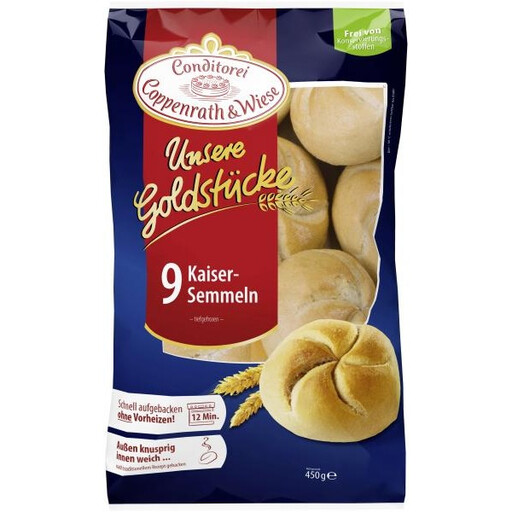
This selection features two packaged bread roll varieties from Coppenrath & Wiese for a planned breakfast, provided you have a suitable oven. If you’re buying freshly baked rolls, the variety and availability at your local branch are what matter.
 No image available
This pack of nine Kaiser rolls is a good choice if you’re planning breakfast for several people. Make sure you have a suitable oven, and check the current pack label before buying if you need to take allergens into account.
 No image available
These multigrain rolls are worth considering if you’d like to serve something different from Kaiser rolls at a planned breakfast. Make sure you have a suitable oven; check the current pack for the quantity and any allergen information.
Choose a variety with qualities to suit your meal, rather than relying on the word “premium”. For example, compare rustic rolls for savoury toppings with other varieties for a mixed selection, then check the ingredients and what’s available locally.
Part-baked rolls are an option for breakfast at a set time if you have a suitable oven. Follow the instructions on the specific pack; EDEKA and REWE give different oven settings for the baguette rolls and Sunday rolls they feature, depending on the type of oven.
Yes, allergen information must also be available for unpackaged products. Germany’s Federal Ministry of Agriculture, Food and Home Affairs explains this; ask before buying if the information isn’t clear at the counter.
No, it doesn’t tell you whether other allergenic ingredients are present. For example, REWE lists soya protein and sesame in its gluten-free frei von hamburger buns. Check the current label before you buy.
No, the dates vary between Germany’s federal states. The Standing Conference of the Ministers of Education and Cultural Affairs publishes holiday calendars for each state, so plan your shopping and meals around your holiday or travel destination.