
Lieferung heute & morgen

Qualitätsgarantie

Willkommens-Angebote freischalten: KOSTENLOSE Lieferung | Bis zu 80 % RABATT | Kostenlose 30-Tage-JoyPlus-Testphase
App herunterladen
A pressure cooker can prepare soups, stews, pulses, meat and steamed dishes in a short time. However, the advertised time saving is not the only thing that matters when buying one. The right capacity, hob compatibility, material quality and a clear safety concept are all crucial.
A pressure cooker with a capacity of 6 litres does not automatically hold 6 litres of food. Pressure cooking requires space for steam inside the pot. The maximum fill level stated in the operating instructions is therefore binding. Free space is particularly important when cooking ingredients that foam, such as pulses, rice or grains.
For a household of one or two people, a model with a capacity of around 3 to 4 litres may be sufficient. A 6-litre pressure cooker is more suitable for families, batch cooking or larger stews. A model that is too small can quickly lead to several cooking cycles, while an oversized appliance requires more storage space and may be impractical for small quantities.
If you use an induction hob, look for a model that is explicitly stated to be suitable for induction. A compatible base must respond to a magnet and sit flat on the hob. Claims such as “suitable for all hob types” should specifically include gas, electric, ceramic and induction in the technical specifications.
The diameter of the hob is also relevant. Several 22-centimetre models in the selection are designed for a hob measuring around 21 or 22 centimetres. A poorly fitting base can impair heat transfer.
An electric pressure cooker or multicooker offers programmes for pressure cooking, slow cooking, browning, steaming and keeping food warm. This can be convenient in everyday use, but it does not replace checking the sealing ring, lid lock and steam outlet.
A classic pressure cooker requires less electronics and works directly on the hob. A steaming pot with an insert is useful when vegetables, fish or dumplings are to be gently cooked over water vapour. It is important not to treat these terms as interchangeable: according to the relevant product description, a pot with “micro-pressure” does not necessarily use the same pressure system as a classic pressure cooker.
Use the number of people in your household and your cooking habits as a guide:
A pressure cooker for families should not only be large enough; it should also have clearly visible pressure or cooking indicators.
18/10 stainless steel is a common material specification for high-quality cookware. The designation refers to approximately 18 per cent chromium and 10 per cent nickel. It describes the composition of the steel, not automatically the overall quality of the product.
Also pay attention to the base construction. A sandwich or multi-layer base with an aluminium core can distribute heat more evenly. With a stainless steel pressure cooker, you should also distinguish between the inner and outer surfaces: polished outer surfaces are visually smooth, while a matt inner surface may make signs of use less noticeable, depending on the model.
Before buying, at least the following points should be clearly explained in the product specifications or instructions:
The same rule applies to every pressure cooker: never force the lid open. The pressure must be fully released before cleaning and before opening the cooker. Steam can cause scalding, so the steam outlet and lid should not be touched directly with your hand.
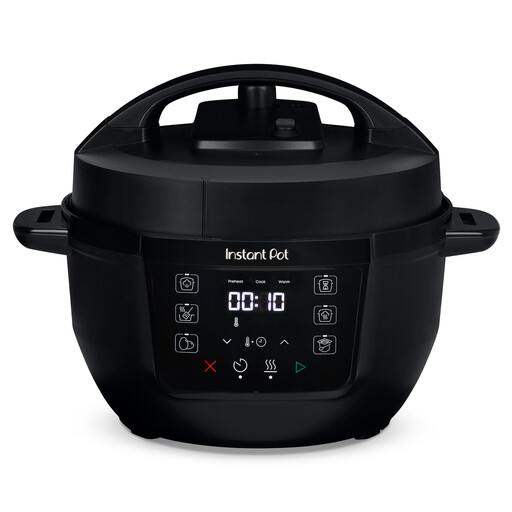
Why this product suits this profile: This compact appliance is designed for small households and up to around four portions. It combines pressure cooking, slow cooking, steaming, browning, egg cooking, yoghurt making and keeping food warm.
The capacity is clearly stated as 3.8 litres. This means users do not end up buying an oversized family appliance for small portions.
Several preset programmes, a stainless steel inner pot and dishwasher-safe components according to the product description.
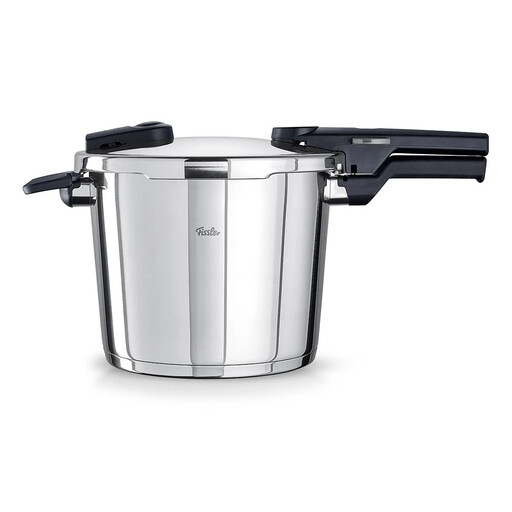
Why this product suits this profile: This classic pressure cooker is made from 18/10 stainless steel, has two cooking settings and, according to the product specifications, is suitable for induction and other hob types.
The positioning aid and locking indicator address two common operating problems: a wrongly positioned lid and an unclear pressure status.
6-litre capacity, Superthermic base and removable handle with a space-saving stacking function, according to the manufacturer.
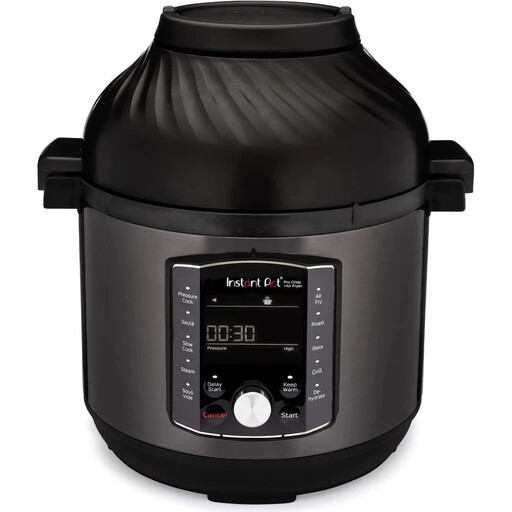
Why this product suits this profile: This model combines pressure cooking and slow cooking with a separate air fryer lid. It is designed for households that want to use several cooking methods in one appliance.
The two removable lids make the range of functions clear and tangible, rather than relying solely on a long list of programmes.
7.6-litre capacity, stainless steel inner pot and, according to the product description, suitability for electric, gas, ceramic and induction hobs.
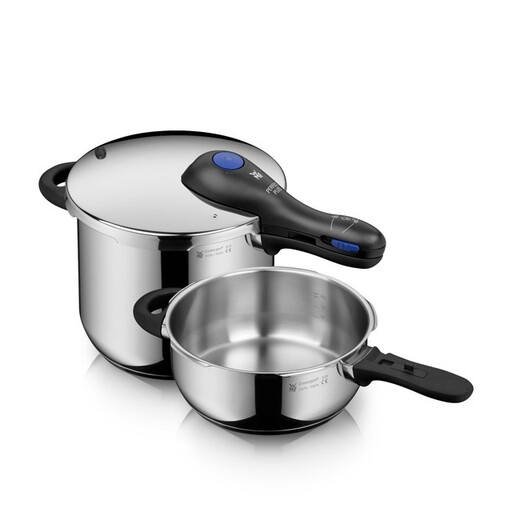
Why this product suits this profile: The set contains a 6.5-litre pressure cooker, a 3-litre sauté pan and a matching lid. This makes it suitable for soups, steaming and braised dishes in different quantities.
The two vessels reduce the need to buy a separate pot for every portion size. The lid handle is removable, making it easier to clean.
TransTherm base, induction compatibility and two cooking settings of 110 °C and 119 °C, according to the manufacturer.
A classic pressure cooker does not require an additional power connection. Actual energy costs depend on the hob, cooking time, quantity and power setting used. An electric pressure cooker also incurs electricity and standby consumption, but its automatic shut-off can reduce the amount of supervision required.
The sealing ring is a wear part. Check it regularly for cracks, deformation or porous areas, and use only suitable replacement parts. After cooking, the lid, valve and seal should be cleaned and dried completely in accordance with the instructions. For dishwasher-safe components, follow the relevant manufacturer’s guidance.
We have put together a complete, regularly updated list of products that fully meet these strict selection criteria and the safety regulations applicable in the EU.
Only if the manufacturer explicitly states that it is. Look for terms such as induction-compatible, a magnetic multi-layer base and a suitable base surface. If you are unsure, consult the technical specifications or operating instructions.
Its service life depends on the material, usage, cleaning and care of the seal. Stainless steel bodies can be used for many years if treated properly. The sealing ring, valve and other safety components should be checked regularly and replaced when worn, in accordance with the manufacturer’s instructions.
There is no simple answer. Compare the power rating, cooking time, capacity and frequency of use. An electric multicooker offers automatic programmes and keep-warm functions, while a classic pressure cooker works on the hob without an additional appliance connection.