
Lieferung heute & morgen

Qualitätsgarantie

Willkommens-Angebote freischalten: KOSTENLOSE Lieferung | Bis zu 80 % RABATT | Kostenlose 30-Tage-JoyPlus-Testphase
App herunterladen
A pressure washer can make the laborious task of cleaning patios, walkways, and vehicles significantly easier. However, the market is flooded with devices whose performance claims often don't hold up in practice. Misleading specifications and low-quality components can quickly lead to a bad purchase. As your Joybuy Product Recommendation Officer, I'll help you identify the crucial features and find a unit that truly fits your needs.
Before we dive into the important technical data, let's look at the typical marketing traps that often lead to disappointment.
To avoid a bad purchase, focus on the following three parameters. They provide insight into the actual performance and durability of a device.
The cleaning performance of a pressure washer is determined by the interplay of water pressure and flow rate.
A good balance is crucial. For most tasks around the house and garden, such as cleaning patios, garden furniture, or car washing, a working pressure between 110 and 145 bar with a flow rate of 400 to 500 l/h is a solid benchmark.
The longevity of your pressure washer depends significantly on the pump's material. There are clear quality differences here:
For regular use, a model with an aluminium pump is a sensible investment.
The right accessories determine whether a pressure washer is just a tool or a versatile cleaning solution. Look for a hose length of at least 6-8 metres for sufficient freedom of movement. An integrated hose reel prevents kinks and makes storage easier.
Depending on the application, specific attachments are indispensable:
For maximum flexibility in places without a power outlet, a cordless pressure washer can be the right solution.
Based on these objective criteria, we have identified a few models that are particularly suitable for specific user profiles.
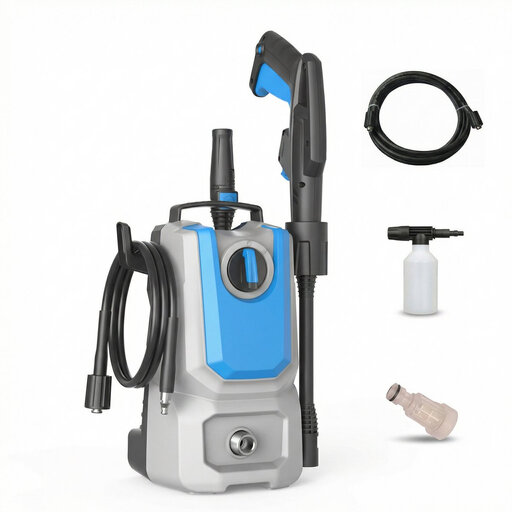
Why This Fits Their Persona: Ideal for users seeking a compact device for occasional cleaning tasks like balconies, garden furniture, or bicycles. The performance is sufficient for these jobs without damaging sensitive surfaces.
This model bypasses the trap of low-quality components in the entry-level segment by using an aluminium pump, which promises greater durability than all-plastic pumps.
Compact design for easy storage; Automatic Total Stop System to reduce wear and energy consumption.
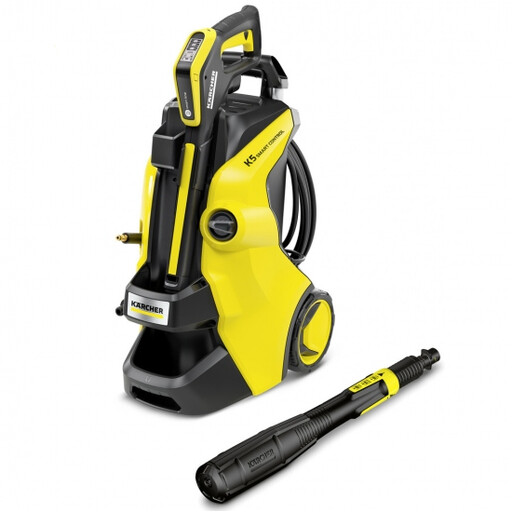
Why This Fits Their Persona: For homeowners who regularly clean large areas like driveways, patios, and vehicles, and who value control, efficiency, and durability.
It avoids the "one-pressure-fits-all" trap with the Smart Control App and the 3-in-1 Multi Jet lance, which allow for precise pressure adjustment for any surface. The water-cooled motor and aluminium pump head signal high durability.
Bluetooth connectivity for application-based tips; Boost mode with extra power for stubborn dirt; high flow rate of 500 l/h.
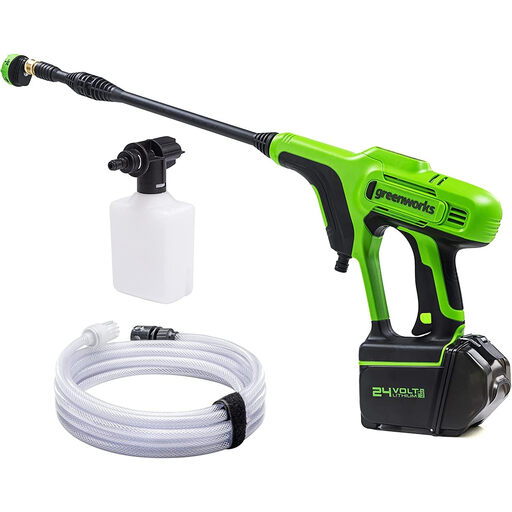
Why This Fits Their Persona: Perfect for users who need to clean in locations without direct power or water access, e.g., in an allotment garden, on a boat, or for a quick mountain bike wash after a ride.
This device bypasses the "immobility trap" of corded models. Its performance specs (24 bar, 180 l/h) are clearly designed for mobile, lighter tasks and don't create false expectations of heavy-duty cleaning power.
Battery-powered operation and self-priming function from any water source (bucket, rain barrel); 5-in-1 nozzle for flexible spray patterns.
We have compiled a complete, up-to-date list of products that fully meet these strict selection criteria and German safety regulations.
For most applications around the home, the pressure range is key. A rough guide:
Generally, yes, but with caution. Never use full pressure or a rotor nozzle on car paint, tyres, or seals. Choose a flat-jet nozzle, maintain a distance of at least 30 cm, and reduce the pressure if your device allows it. Special accessories like a soft wash brush or a foam sprayer are a safe and effective addition for car washing.
Although the terms are sometimes confused, they are two different types of devices. A pressure washer cleans primarily through the mechanical force of a cold or lukewarm water jet and is ideal for removing loose dirt, moss, or mud. A steam cleaner (or hot water pressure washer) heats the water to over 100°C and cleans with hot steam. It is particularly effective for dissolving grease, oil, and for disinfection, but often has a lower water pressure than a pure cold-water pressure washer.