
Lieferung heute & morgen

Qualitätsgarantie

Willkommens-Angebote freischalten: KOSTENLOSE Lieferung | Bis zu 80 % RABATT | Kostenlose 30-Tage-JoyPlus-Testphase
App herunterladen
A pressure washer can clean cars, patios, driveways, garden furniture and fences much faster than an ordinary garden hose. However, impressive advertising figures do not automatically mean a machine is right for you. What matters is whether the pressure, water flow rate, hose length and accessories suit the jobs you have planned.
Figures such as 180-bar pressure washer, 185-bar pressure washer or even 220 bar usually refer to the maximum possible pressure under specific conditions. For everyday use, the working pressure and water flow rate are also important. A machine with high pressure but a low flow rate may work more slowly on large areas than a model with a better-balanced combination.
High pressure is not always an advantage on delicate surfaces such as car paintwork, wood or plastic. An adjustable nozzle and sufficient distance from the surface are more important here.
A 2200-watt pressure washer may be worth considering for large patios and heavily soiled driveways. However, the wattage primarily describes the motor’s electrical power consumption. It does not replace information about the water flow rate, working pressure or equipment supplied.
An electric pressure washer also requires a suitable power supply. The cable, socket and extension lead should be approved for outdoor use and protected against moisture.
A pressure washer with a patio cleaner is particularly suitable for patios, paths and larger level areas. A foam gun or external foam attachment can be useful when cleaning a car, but it does not replace manual follow-up cleaning.
Check the following before buying:
For household use, three specifications are particularly relevant:
For washing a car, a controllable, relatively gentle setting is advisable. For concrete paving slabs, driveways or heavily soiled garden paths, higher pressure and a greater flow rate can be useful. However, water consumption increases with the flow rate. Consider any municipal water-use point, house rules or local restrictions.
An electric pressure washer provides a constant power supply during longer jobs. Models with 1600 or 2200 watts are designed for typical outdoor tasks, but they require an accessible socket.
A battery pressure washer is more flexible and can also be used where there is no mains connection. In this case, runtime, charging time and the battery supplied are crucial. With the Greenworks model, check whether the battery and charger are included in the particular sales package. According to the stated product data, the version is supplied without a battery and charger; compatibility with Greenworks 24-volt batteries is explicitly stated.
Never direct the water jet at people, animals, electrical equipment or the machine itself. A wide, adjustable setting is recommended for vehicles. Rotary or turbo nozzles can be useful on robust stone surfaces, but should not be directed uncontrollably at paintwork, joints, wood or delicate coatings.
Cleaning products should only be placed in containers intended for this purpose and used according to the manufacturer’s instructions. Avoid mixing different products. The operating and safety instructions supplied with each machine must always be followed.
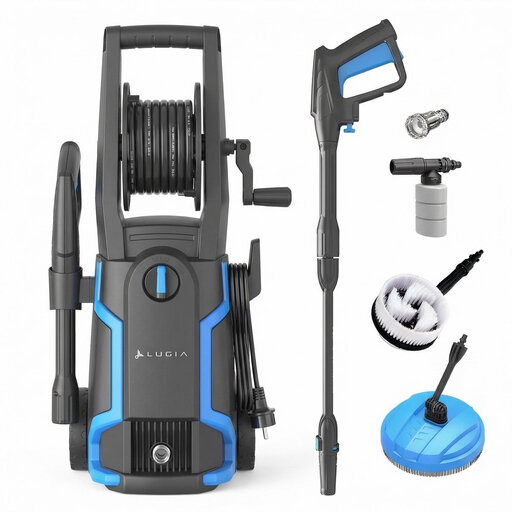
Why this product suits the profile: This corded model combines 135 bar working pressure with 430 l/h, making it suitable for typical cleaning tasks involving cars, bicycles, patios and garden furniture.
The pressure and flow-rate specifications are clearly stated. An adjustable nozzle allows you to adapt the machine to different surfaces.
1600 W motor, 5 m hose, start-stop system, plus patio cleaner, rotary brush, turbo nozzle and external foam gun.
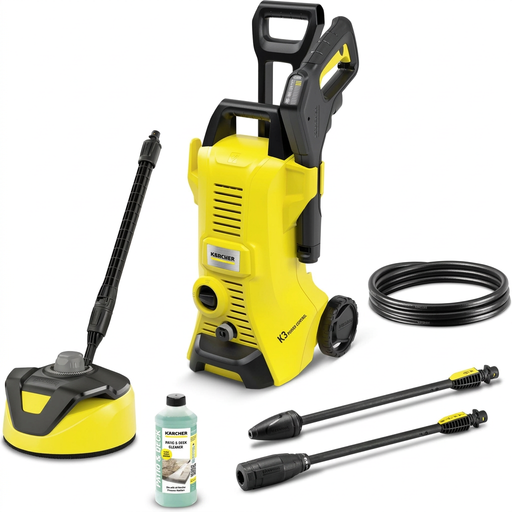
Why this product suits the profile: This set is aimed at users who prefer clearly organised equipment for regular work on patios, fences and garden areas.
The working pressure, flow rate, hose length and accessories are all specified clearly. Pressure adjustment supports controlled use.
Up to 120 bar, 380 l/h, 7 m pressure hose, T-5 patio cleaner and cleaning product for patios and garden areas.
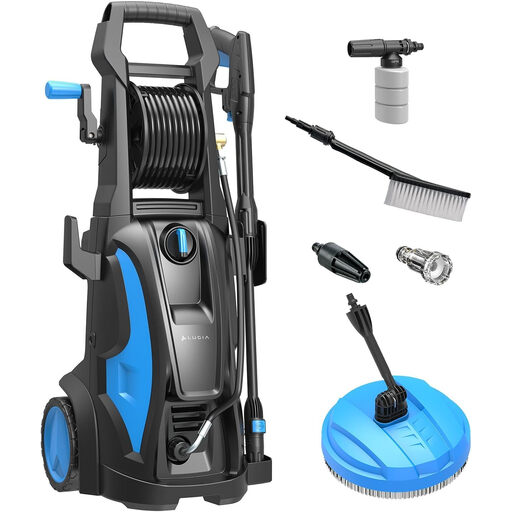
Why this product suits the profile: With 185 bar, 550 l/h and a comprehensive range of accessories, this model is designed for larger areas such as driveways, patios and garden spaces.
The high pressure rating is complemented by a stated flow rate of 550 l/h. This makes it easier to assess the machine’s performance than by looking at bar alone.
2200 W motor, 5 m hose, wheels and carrying handle, plus patio cleaner, rotary brush and turbo nozzle.
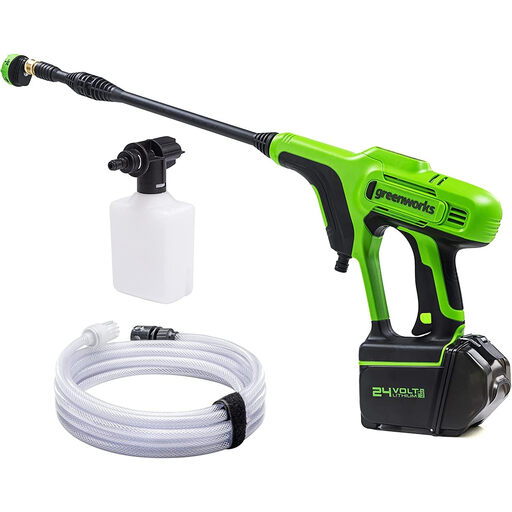
Why this product suits the profile: This battery pressure washer can draw water from a bucket, water butt or another clean container, making it independent of a tap and mains socket.
Its mobility comes not only from the battery, but also from the 6 m suction hose. At 24 bar and 180 l/h, its pressure and flow rate are lower than those of corded machines.
300 W motor, 5-in-1 nozzle, 6 m hose and operation with compatible Greenworks 24-volt batteries.
We have put together a complete, regularly updated list of products that fully meet these strict selection criteria and the safety regulations applicable in the EU.
When washing a car, an adjustable nozzle is more important than the highest possible maximum pressure. Machines with 120 to 185 bar can be suitable, provided you keep the correct distance and use a wide setting. Do not direct the water jet straight at seals, damaged paintwork or electrical components.
The costs consist of electricity, water, cleaning products and, where applicable, replacement parts. With a 2200-watt machine, one hour of operation at full power consumption equals 2.2 kWh. In actual use, the motor often does not run continuously because of the start-stop function. The water flow rate also affects consumption.
The possible operating time depends on the model, surroundings, water quality and maintenance. After use, empty the hose and nozzle, check the water filter and store the machine in a frost-free place. Battery-powered machines should be stored in a dry place with the battery removed. For longer cleaning jobs, follow the breaks and operating times specified by the manufacturer.