
Lieferung heute & morgen

Qualitätsgarantie

Willkommens-Angebote freischalten: KOSTENLOSE Lieferung | Bis zu 80 % RABATT | Kostenlose 30-Tage-JoyPlus-Testphase
App herunterladen
A pressure washer can clean cars, patios, garden furniture, fences and driveways much faster than a garden hose. However, eye-catching figures and extensive accessory lists do not automatically mean you have found the right machine. What matters is whether the power, water supply, ease of use and intended application all work well together.
Figures such as 135 bar, 150 bar or 180 bar often refer to the maximum pressure the machine can reach. In practice, the working pressure and flow rate are also important. A machine with a high maximum pressure but a low water flow does not necessarily clean more efficiently than a model with a balanced pressure-to-water ratio.
High pressure is not always suitable for delicate surfaces such as car paintwork, wood or grout. An adjustable nozzle makes it easier to adapt the intensity to the material.
A 1600 W pressure washer, a 2000 W pressure washer or a 2200 W pressure washer requires a different amount of electrical power. Wattage mainly describes the motor’s power consumption, not the cleaning performance on its own.
Always assess the combination of:
A foam cannon is useful for applying a suitable cleaning product evenly, but it does not replace the right nozzle. A surface cleaner can reduce spray when cleaning patios and driveways, while also making it easier to tackle larger areas. For cars, bicycles and garden furniture, finer or adjustable spray patterns are more important.
Also check whether the accessories are included or need to be purchased separately.
Pressure is measured in bar, while flow rate is measured in litres per hour. A model with 180 bar and 480 l/h is designed for larger outdoor areas in a completely different way from a compact cordless pressure washer with lower performance. However, the higher figure does not mean that every surface should be cleaned at maximum intensity.
For typical households, machines delivering around 120 to 150 bar may be sufficient for vehicles, balconies, garden furniture and medium-sized patios. Heavily soiled driveways or large areas benefit from a higher flow rate and a longer hose.
An electric pressure washer is suitable for regular jobs near a socket. Corded machines usually provide a constant power supply and are practical for longer periods of use. Check the cable length, protection against water, and that the cable and hose can be routed safely.
A battery pressure washer, also known as a cordless pressure washer, offers greater flexibility. It can be used where there is no power socket available. In this case, battery life, charging time, replacement battery availability and the water source are crucial. Some portable machines draw water from a bucket or container, while others require a fixed water connection.
Wheels, a large handle and a compact design make it easier to move the machine between the garage, patio and garden. An integrated hose reel can simplify storage. If you are buying a pressure washer with accessories, check whether the nozzles, trigger gun and hose can be stored on the machine.
It is also worth checking the maximum water temperature, water filter and connection type before buying. These details affect everyday practicality and compatibility with existing connections.
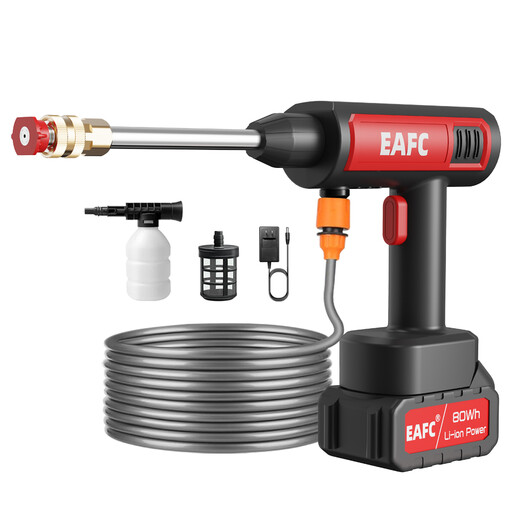
Why this product suits this profile: This cordless handheld machine is designed for mobile use and, according to the product description, can draw water from a container by itself. This makes it suitable for smaller cleaning tasks involving cars, balconies or gardens.
The product description points out typical causes of starting problems, including air in the system, a kinked hose or a flat battery. These points can be checked before use.
Cordless design, adjustable nozzle and foam attachment; suitable for water from a bucket or a mains connection.
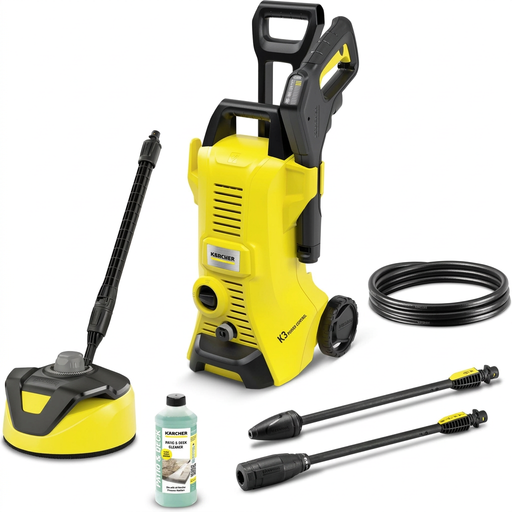
Why this product suits this profile: According to the product data, this electric model delivers up to 120 bar, has a power consumption of 1600 W, a flow rate of 380 l/h and a 7-metre high-pressure hose. The set includes a surface cleaner and pressure control.
The pressure setting allows you to adapt the intensity to different surfaces instead of working permanently at maximum pressure.
Surface cleaner, telescopic handle, app support according to the product details, and an automatic start-stop system.
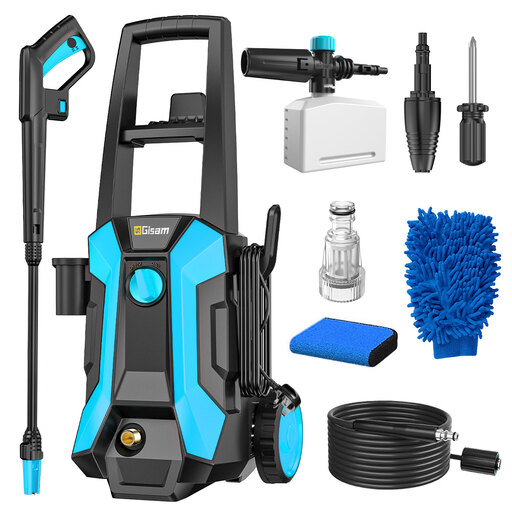
Why this product suits this profile: With a stated 2200 W, 180 bar, 480 l/h and an 8-metre hose, this machine is aimed at users who regularly clean larger outdoor areas, vehicles, fences or driveways.
The technical specifications give the pressure and flow rate together. This makes it easier to compare the machine with models that only highlight the bar rating.
8-metre high-pressure hose, foam nozzle, rotating nozzle and high-pressure trigger gun according to the product description.
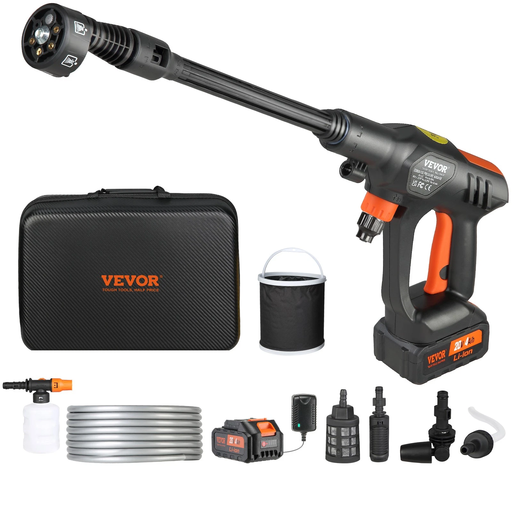
Why this product suits this profile: According to the product data, this battery pressure washer operates at 250 W and 21 V, delivering up to 50 bar and 4 l/min. A 4-litre container, accessories and extension wands support flexible use.
The significantly lower pressure makes it clear that this portable machine is intended for lighter cleaning tasks rather than large concrete areas.
Cordless operation, automatic continuous spray function and several attachments according to the product description.
Start at a greater distance and with a low pressure setting. Do not aim the jet at sockets, cable connections, tyre valves, seals or delicate painted surfaces. For vehicles, a wide spray is more suitable than a concentrated turbo nozzle. Cleaning products should be suitable for both the surface and the machine.
After use, it is advisable to disconnect the water supply and power supply in accordance with the instruction manual, release the residual pressure, and empty the hose and nozzles. Frost can damage the pump system. A clean water filter helps keep particles away from the pump.
We have put together a complete, regularly updated list of products that fully meet these strict selection criteria and the safety regulations applicable in the EU.
For washing a car, high pressure alone is not the deciding factor. A machine with adjustable pressure, a wide nozzle and a suitable foam attachment is usually more practical. Start at a low intensity and keep a sufficient distance from the paintwork.
Electricity costs depend on the power consumption and the actual running time. A 2000 W machine uses 2 kWh during one hour of continuous motor operation. As the motor does not run constantly with start-stop systems, actual consumption may be lower. You will also need to factor in the cost of water and, where applicable, cleaning products.
Its service life depends on how often it is used, water quality, storage and maintenance. After every use, check the filter, hose and nozzles. Storing the machine in a dry, frost-free place and following the instruction manual helps reduce typical strain on the pump and motor.