Active people with a protein target
If you fancy a pretzel after exercise or during a busy day, compare its protein content per 100 g with the amount you actually eat. You can then decide whether to add a separate side to your snack.


If protein is a priority in your afternoon snack, check the nutritional information for the specific pretzel you’re considering. The classic pretzels covered here contain 8.0 to 10.0 g of protein per 100 g, according to Ditsch, EDEKA and REWE. A butter-containing option has a slightly higher protein value, but also contains more fat and energy. If you’re specifically planning your protein intake, you could instead pair a classic pretzel with a separate protein-rich food of your choice. Salt and allergens should also inform your choice.
If you fancy a pretzel after exercise or during a busy day, compare its protein content per 100 g with the amount you actually eat. You can then decide whether to add a separate side to your snack.
For a quick afternoon snack, it’s worth checking the salt content and the ingredients and allergen information for the specific pretzel you choose, as well as its protein content.
If you choose a pretzel with herb butter for its flavour, for example, consider its protein content alongside its energy, fat and saturated fat.
Start by comparing the nutritional values per 100 g with the amount you plan to eat. For flavoured pretzels, or if salt or allergens are a concern for you, check the information for the specific product.
| Criterion | What to check | Who is it important for? |
|---|---|---|
| Protein content | Compare the protein per 100 g with the amount you eat; add a separate side if needed. | After exercise, I want to know how much my pretzel contributes to the protein snack I’ve planned. This is a priority for around 42 % of consumers. |
| Salt and allergens | Check the salt per 100 g, as well as the ingredients, allergens and possible traces listed for the specific product. | If I need to keep an eye on salt or avoid certain ingredients, the product information comes first. Around 33 % of consumers make this their top priority. |
| Flavour and nutritional values | For pretzels containing butter, compare the protein, energy, fat and saturated fat for the same quantity. | I like the flavour of a more indulgent pretzel, but want to know how its other nutritional values compare. Flavour and this balance are the main concern for around 25 % of consumers. |
The Ditsch herb butter pretzel listed by REWE contains 10.6 g of protein, 338 kcal and 11.2 g of fat per 100 g. Ditsch lists 9.5 g of protein, 303 kcal and 5.3 g of fat per 100 g for a classic pretzel. These are different products, not just two protein figures.
Compare the nutritional values for the same quantity, then decide whether you’d prefer a more indulgent pretzel or to put together the protein content of your snack separately.
The salt content varies considerably across the pretzels covered here: Ditsch lists 1.4 g of salt per 100 g for one variety, while EDEKA lists 3.1 g for another. For products supplied with a salt sachet, the amount you use also makes a difference.
Check the salt content of the variety you’ve chosen and, when preparing it, bear in mind how much of the salt sachet you actually use.
Product information can vary. For example, EDEKA lists wheat as an ingredient in one pretzel and says it may contain traces of egg, lupin, milk, nuts, sesame and soya.
If you have an allergy or coeliac disease, check the information on the specific pack or ask for details about the product sold at the bakery counter.
ALDI SÜD notes that its pretzels may come from different suppliers, which can mean their nutritional values vary. EDEKA also points out that online information may differ from what’s shown on the packaging.
Use the latest nutritional information and ingredients for the pretzel you’re actually buying.
Ditsch offers classic pretzels in several varieties. For two of them, Ditsch lists 8.3 and 9.5 g of protein per 100 g respectively.
REWE lists several pretzels, including an Ihle pretzel and a Swabian pretzel.
EDEKA offers classic and frozen pretzels. For two of the products covered here, EDEKA lists 8.0 and 8.1 g of protein per 100 g respectively.
ALDI SÜD describes a Swabian pretzel from its bakery range as vegan and lists 8.5 g of protein per 100 g.
Lidl describes “Unser Brot” as its own brand of bread and baked goods from its in-store bakery.
For a packaged pretzel snack in the afternoon, portion size matters. Values per 100 g don’t necessarily reflect the amount you’ll actually eat. This selection is different from the classic soft pretzels discussed above.
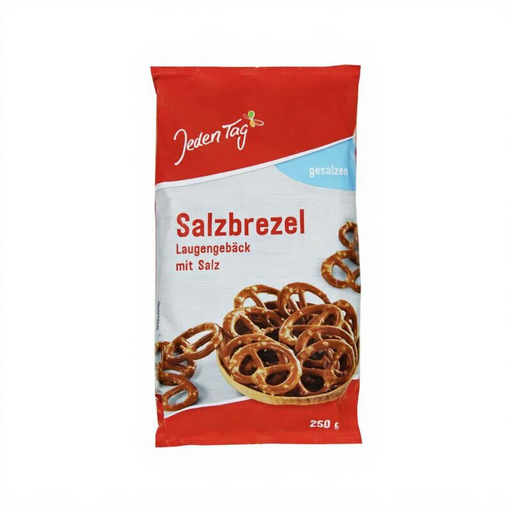 No image available
A packaged pretzel snack for the afternoon, if you’re after something to eat straight from the pack rather than a soft pretzel.
Pack size: 250 g. Check the nutritional information for your portion, and read the ingredients and allergen information on the specific pack.
No. A single protein figure isn’t enough to make that judgement. According to Ditsch, EDEKA and REWE, the classic varieties covered here contain 8.0 to 10.0 g of protein per 100 g. For your snack, the amount you actually eat also matters, as does whether you pair it with something else.
According to the German Journal of Sports Medicine, there’s no scientific evidence that protein has a special, immediate recovery effect. So if you’re planning your protein intake around exercise, consider the snack alongside the rest of your diet, your training goals and how much you exercise.
Check the ingredients and allergen information carefully for the pretzel you’re planning to buy. The product information covered here lists wheat; other ingredients and possible traces vary by variety.
Follow the instructions for the specific product. The varieties described by Ditsch and EDEKA have their own guidance on thawing, salting and baking. Don’t assume the timings and temperatures will be the same for another pretzel.