Hikers who need to eat strictly gluten-free
You need pretzels explicitly labelled gluten-free rather than an ordinary wheat pretzel. Other ingredients and possible traces are also relevant to your personal choice.


If you need to eat strictly gluten-free when hiking, choose pretzel snacks explicitly labelled gluten-free and also check the ingredients and precautionary allergen information on the specific pack. If you eat vegan but don’t need to avoid gluten, classic pretzels are also an option; however, vegan doesn’t mean gluten-free, as the wheat and barley malt ingredients in Lorenz Saltletts Mini Brezel show. Pack size and resealability can make planning a hiking break easier, but they’re no substitute for checking allergens and nutritional information.
You need pretzels explicitly labelled gluten-free rather than an ordinary wheat pretzel. Other ingredients and possible traces are also relevant to your personal choice.
If you need to avoid ingredients or allergens in addition to gluten, check each claim individually. Gluten-free, lactose-free and vegan describe different properties; none of them on its own answers every question about allergens.
A classic vegan pretzel in a small or resealable pack may suit you. However, a vegan label tells you nothing about whether the product contains gluten.
First check for anything you must avoid, then choose a pack that suits your walk and check the nutritional information for the amount you plan to eat. If you have several requirements, check each property of the specific pretzel separately.
| Criteria | What to check | Who it matters to |
|---|---|---|
| Gluten-free | Look for the explicit “gluten-free” claim and read the ingredients and precautionary allergen information on the pack. According to EUR-Lex, the EU claim applies to products containing no more than 20 mg of gluten per kg of finished product. | If I need to avoid gluten strictly, a vegan pretzel without a gluten-free label isn’t enough for me. This is the main priority for around 33 % of consumers. |
| Multiple dietary exclusions | Check the ingredients list for allergens and look for possible traces relating to each of your personal exclusions. | For example, I need gluten-free pretzels and also have to watch out for soya or sesame; one “free from” claim doesn’t answer that. Around 27 % of consumers prioritise these combined requirements. |
| Pack size and portion | Match the pack size and resealability to your planned breaks, and follow the storage instructions on the pack. | For my hiking break, I want to pack an amount that’s easy to manage on the go. This is a priority for around 20 % of consumers. |
| Vegan recipe | Check the vegan label and ingredients; if you also need to avoid gluten, check for the gluten-free label too. | I’m mainly looking for a plant-based pretzel and don’t have a gluten restriction. A vegan recipe is the top priority for around 13 % of consumers. |
| Salt content | Compare the salt per 100 g in the nutritional information and relate it to the portion you actually plan to eat. | I want to take the salt content of my snack into account when planning my food for the day, rather than looking only at the size of the bag. This is a priority for around 7 % of consumers. |
Lorenz describes Saltletts Mini Brezel as vegan, but the recipe still contains wheat flour and barley malt extract.
If you need to avoid gluten, also look for an explicit gluten-free label and check the current ingredients list.
Schär Salinis are described as gluten- and lactose-free, but REWE says they contain soya lecithin and may contain traces of sesame. REWE also notes that Hammermühle Bio Hafer Brezeln may contain traces of soya.
Check each of your dietary exclusions against the ingredients list and every relevant precautionary allergen statement.
The amount of salt depends on the product and how much you eat. The German Nutrition Society gives up to 6 g of table salt per day as a general guide for adults, not as personal medical advice.
Read the amount per 100 g and work it out for the portion you plan to pack.
When it comes to ingredients, allergens and storage instructions, the labelling on the pack you actually buy is what matters.
Check the pack again before you set off, especially if you need to avoid particular ingredients or allergens.
Salinis are a salted pretzel option explicitly labelled gluten-free.
REWE describes the 80-g pack of Bio Hafer Brezeln as gluten-free and vegan.
Saltletts Mini Brezel are classic vegan pretzels available in handy formats for when you’re out and about.
EDEKA’s product range includes classic salted pretzels in a 250-g pack.
This pretzel may suit a vegan hiking snack selection if you don’t need to avoid gluten. If you need to avoid gluten or sesame, check the ingredients and allergen information particularly carefully.
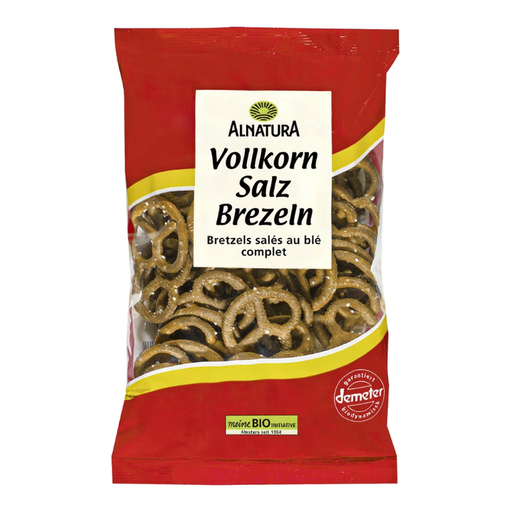 No image available
This pack may suit a vegan pretzel break if you don’t need to avoid gluten.
Check the current ingredients list before buying: the wheat and barley gluten ingredients listed rule this out as a gluten-free option; sesame is also relevant when checking allergens.
No. Lorenz Saltletts Mini Brezel are described as vegan, but contain wheat flour and barley malt extract. If you need to avoid gluten strictly, look for a separate gluten-free label and check the ingredients on the current pack.
According to EUR-Lex, a food can be labelled “gluten-free” in the EU if the finished product contains no more than 20 mg of gluten per kg. The claim doesn’t replace checking for other ingredients and allergens.
No, people may tolerate gluten-free oats differently. REWE specifically points this out for Hammermühle Bio Hafer Brezeln; your individual professional advice and the information on the pack should guide your own diet.
Check the ingredients, allergens, precautionary allergen information, pack size, nutritional information and storage instructions for the product you’ve bought. If you have specific dietary exclusions, don’t rely solely on a product description you read earlier.
First compare the salt per 100 g, then work it out for the portion you plan to eat. The German Nutrition Society gives up to 6 g of table salt per day as a general guide for adults; this is separate from any personal medical advice.