For anyone keeping an eye on lunchbox portions
You’re looking for a savoury snack for school and want to compare the energy per 100 g with the amount you’ll actually pack.


When packing a school lunchbox with calories in mind, start by considering how much of the pretzel snack will actually be eaten. The classic pretzels and pretzel sticks compared here range from 368 to 408 kcal per 100 g; choosing wholemeal or organic does not, by itself, tell you how much energy a portion provides. Also compare salt, fibre and the ingredients in the specific pack.
You’re looking for a savoury snack for school and want to compare the energy per 100 g with the amount you’ll actually pack.
You want to consider the ingredients and fibre content of a pretzel snack, rather than choosing based on the kcal figure alone.
For your lunchbox, the salt content and the ingredients and allergen information on the current pack matter just as much as portion size.
First, decide how much snack you’ll pack for the school day. Then compare the nutritional values per 100 g and check which ingredients matter to the person who’ll be eating it.
| What to compare | What to check when buying | Who it matters to |
|---|---|---|
| Energy and portion size | Compare kcal per 100 g and work out the value for the number of grams you plan to pack. | If I want to pack only a small amount in the lunchbox, I need to know how much will actually be eaten. Around 40% of consumers would prioritise the energy in a portion. |
| Wholemeal and fibre | Read the ingredients list and fibre information; check the kcal separately from any wholemeal claim. | For my lunchbox, I want to choose a snack whose wholemeal and fibre claims I can understand, without assuming that this means fewer calories. Around 30% of consumers would put this comparison first. |
| Salt and allergens | Compare salt per 100 g and check the ingredients and allergen information on the current pack. | If salt or particular allergens are a concern for us, I need the details for the specific product before it goes into the lunchbox. This would be the main buying consideration for around 30% of consumers. |
Lorenz lists Saltletts Wholemeal at 392 kcal per 100 g and its PausenCracker with wholemeal and seeds at 467 kcal per 100 g. The wholemeal claim doesn’t answer the question of how many calories a product contains.
Compare kcal per 100 g and your planned portion; use the fibre information as a separate point of comparison.
The products compared range from 3.5 to 6.76 g of salt per 100 g. So a lower kcal value doesn’t automatically mean less salt.
Compare energy and salt side by side, and work out both values for the amount you’ll pack in the lunchbox.
The pack size doesn’t tell you how much will be eaten during the break. Without deciding on an amount, comparing products per 100 g is of limited help when planning.
Measure out the amount you plan to pack into a container, or check the weight if you’re buying a smaller pack.
Ingredients and allergen information vary between products. For example, Lorenz lists wheat in Saltletts Pretzels, and notes that they may contain traces of milk, egg and sesame.
If allergies or intolerances are a concern, check the ingredients list and allergen information on the current pack.
The products considered include pretzels, wholemeal sticks and a PausenCracker. Compare the nutritional values for each specific product.
Bio Prinzess Pretzels are classic mini pretzels that provide a point of comparison for energy and salt.
The pretzel sticks and pretzels from ALDI SÜD make it possible to compare two types of snack from the same own-label brand.
The pretzels considered offer another point of comparison for classic pretzel snacks.
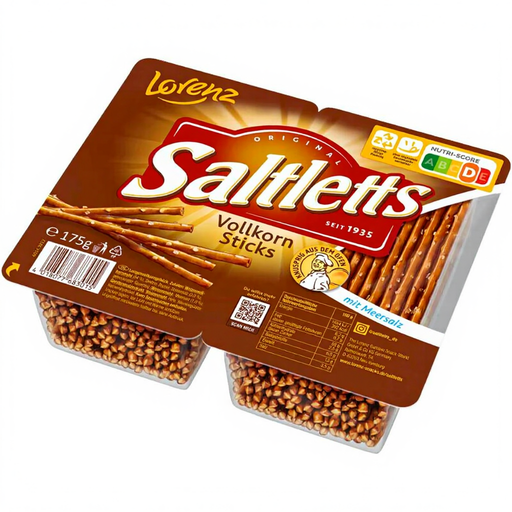
These wholemeal pretzel sticks are an option if you want to take fibre into account when packing a school lunchbox. For a calorie-conscious comparison, portion size and energy and salt per 100 g remain the key considerations.
 No image available
For a lunchbox where you want to compare fibre as well as the energy in your portion.
Lorenz lists Saltletts Wholemeal at 392 kcal, 6.0 g of fibre and 3.5 g of salt per 100 g. The 175-g pack size doesn’t tell you how much to pack for one break, so decide on that amount separately.
No. Wholemeal ingredients alone don’t mean a product has less energy. Lorenz lists Saltletts Wholemeal at 392 kcal per 100 g, while EDEKA24 lists Huober Bio Prinzess Pretzels at 368 kcal per 100 g. Compare the kcal independently of the wholemeal claim.
Decide on a weight in grams and work out the kcal based on the amount per 100 g. Using the 392 kcal per 100 g listed by Lorenz, 40 g of Saltletts Wholemeal works out at around 157 kcal; the whole pack isn’t automatically a single portion for a school break.
Because the salt content varies significantly between the products considered. Lorenz lists Saltletts Wholemeal at 3.5 g of salt per 100 g, while ALDI SÜD lists SUNSNACKS pretzel sticks at 6.76 g per 100 g. Work out the value for the portion you actually plan to pack.
Check the ingredients list and allergen information on the specific pack, rather than relying on the product name or snack shape. The products considered include wheat; some also list possible traces of sesame, milk or egg in their ingredients and allergen information.
Don’t rely on a pretzel snack alone as a complete school lunch. The German Nutrition Society recommends that children and young people get an appropriate balance of energy from carbohydrates, protein and fat. So include more than just the snack when putting a meal together.