For a stash of dry snacks
You want to keep salted pretzels handy, ready to eat without any preparation. Check whether your chosen pack should be stored in a dry place and how much it contains.


If you want a stash of dry snacks you can eat without any preparation, pretzel sticks and mini pretzels are good options. Frozen soft pretzels, on the other hand, are only suitable if you have room in the freezer and time to defrost or heat them. Check the salt content, ingredients, allergens and storage instructions on each pack. If ‘medium sliced’ is meant to indicate a particular size, check the individual product details.
You want to keep salted pretzels handy, ready to eat without any preparation. Check whether your chosen pack should be stored in a dry place and how much it contains.
You may need to avoid wheat or take account of possible traces of other allergens, for example. Check the labelling on every pack; the shape of the snack alone won’t tell you whether it’s suitable.
You want to know how much salt your chosen snack contains. The figure per 100 g makes it easy to compare packs; your portion size also determines how much salt you actually eat.
First decide whether you want a snack you can eat straight from the cupboard or whether a frozen soft pretzel suits the occasion. Then check the information on the specific pack.
| What to check | What to look for | Who it matters to |
|---|---|---|
| Ready to eat and storage | Check the storage instructions and preparation details. | I want a snack I can eat without defrosting or heating; around 36% of consumers prioritise convenience and easy storage. |
| Salt content | Compare the salt per 100 g and the portion you’ll actually eat. | When I eat salted pretzels, I want to understand their salt content in the context of everything else I eat. Around 29% of consumers prioritise this comparison. |
| Gluten and allergens | Read the ingredients, highlighted allergens and ‘may contain’ warnings; if necessary, look for an explicit gluten-free label. | I need a pack whose labelling meets my gluten or allergen requirements; around 21% of consumers put this check first. |
| A warm soft pretzel | Check you have room in the freezer, along with the defrosting or heating instructions. | For my occasion, I’d prefer a soft pretzel I can heat rather than a ready-to-eat savoury snack. Around 14% of consumers prioritise this type of preparation. |
Dry mini pretzels and frozen soft pretzels need different storage and handling. Ditsch says that some of its frozen soft pretzels need to be defrosted or heated before eating.
Before comparing products, decide whether you want a ready-to-eat savoury snack or a pretzel to defrost or heat.
A mini pretzel isn’t lower in salt than pretzel sticks just because of its shape. What matters is the nutritional information for the individual recipe.
Compare the salt per 100 g and take into account how much you actually plan to eat.
The GUT&GÜNSTIG pretzel sticks listed by EDEKA contain wheat. Some other salted pretzel products may also contain traces of additional allergens.
Check the ingredients, highlighted allergens and ‘may contain’ warnings on every pack. If you need gluten-free pretzels, look for an explicit gluten-free label.
ALDI SÜD notes that the nutritional information for SUNSNACKS pretzel sticks may vary between suppliers.
Check the ingredients and nutritional information on the pack you actually buy.
Ditsch sells soft pretzels to defrost or heat, as well as filled pretzel snacks.
EDEKA’s own-brand range includes classic pretzel sticks in a 250-g pack.
REWE’s own-brand range includes pretzel sticks with sea salt in a 250-g pack.
ALDI SÜD sells pretzel sticks under this own brand in a 250-g pack.
Hammermühle offers organic pretzel sticks in portion-sized packs, explicitly labelled gluten-free.
This selection includes pretzel sticks and mini pretzels for a snack stash that doesn’t need baking. Factors to consider when choosing between them include the shape you prefer, pack size and the information on each individual pack.
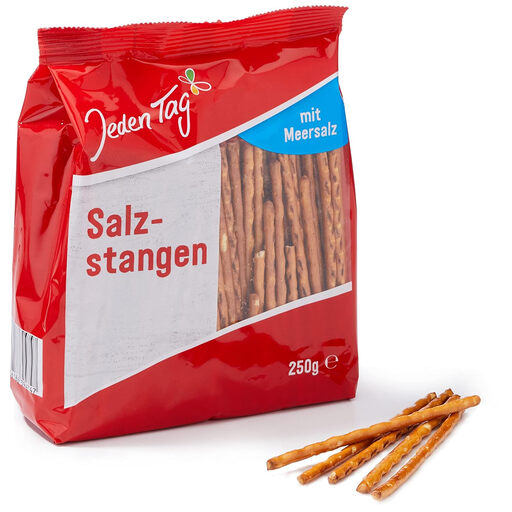 No image available
Pretzel sticks are a good option if you’d prefer sticks to mini pretzels for your snack stash.
Pack size: 250 g. Check the salt per 100 g, allergen information and storage instructions on the pack when making your choice.
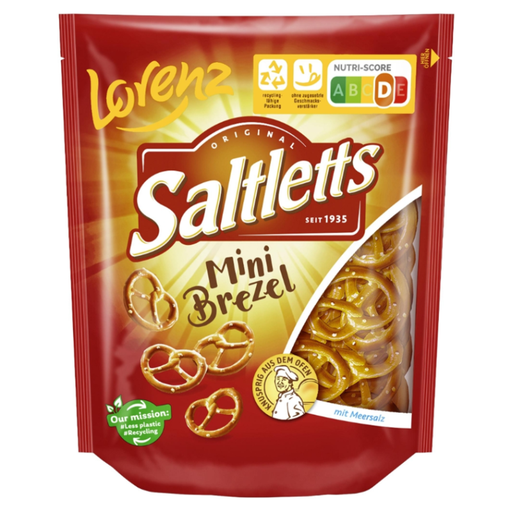 No image available
Mini salted pretzels are a good option if you’d prefer this shape to sticks for your snack stash.
Pack size: 150 g. Before buying, compare the salt per 100 g, ingredients and allergen information on the specific pack.
No. The classic GUT&GÜNSTIG pretzel sticks listed by EDEKA contain wheat. If you need gluten-free salted pretzels, choose a pack explicitly labelled gluten-free and also check the ingredients and allergen information.
Follow the storage instructions for the specific product. For dry pretzel sticks, pay particular attention to the storage information on the pack. Frozen soft pretzels, on the other hand, come with instructions for freezing, defrosting and, where applicable, heating.
First compare the salt per 100 g, then take your actual portion into account. The guideline of up to 6 g of table salt a day given by the German Nutrition Society refers to your total daily intake, not to a single snack.
For packaged salted pretzels, check the ingredients list, highlighted allergens and any ‘may contain’ warnings on the pack you actually buy. The Verbraucherzentrale explains that labelling requirements differ for packaged and unpackaged foods; a category description or product image is no substitute for checking the specific label.