Festival-goers keeping an eye on fat
You want to pack pretzels and compare the fat content of similar products per 100 g, rather than relying solely on descriptions such as ‘light’.


For festival camping without access to an oven, ready-to-eat pretzels that can be stored dry are the more practical choice. If you’re watching your fat intake, compare similar products using the nutrition information per 100 g, and check the energy and salt content too. Bake-at-home pretzels are only suitable if you have time to defrost them and access to a suitable oven.
You want to pack pretzels and compare the fat content of similar products per 100 g, rather than relying solely on descriptions such as ‘light’.
If you snack on pretzels throughout the day, the amount you actually eat and the pack size matter just as much as the salt content per 100 g.
You need a ready-to-eat snack that you can carry dry and store as directed on the pack. Bake-at-home pretzels are only suitable if you can prepare them when you arrive.
First, work out whether you need pretzels you can eat without an oven. Then, for suitable products, compare the fat, energy and salt content using the nutrition information per 100 g.
| Criterion | What to check | Who it matters to |
|---|---|---|
| Fat content | Compare the fat and energy figures per 100 g for similar pretzels; a lower fat figure does not automatically mean fewer calories. | I want to choose a variety with less fat when packing, without assuming that fat and energy are the same thing. Around 42% of consumers prioritise this comparison. |
| Salt content | Check the salt per 100 g and take into account how much you actually eat. | If I’m snacking for hours, I want to know how much salt I’ll get from my whole portion. Salt content is the main consideration for around 33% of consumers. |
| Preparation and storage | Check whether the pretzels are ready to eat or need to be defrosted and baked, and follow the storage instructions on the pack. | Without an oven, I need pretzels I can eat straight away and store appropriately while camping. For around 25% of consumers, this everyday practicality is the most important factor. |
REWE lists ja! Mini Pretzels as containing 4 g of fat and 401 kcal per 100 g; EDEKA24 gives the figures for Gut & Günstig Salted Pretzels as 7.3 g of fat and 397 kcal per 100 g. So, for these products, the lower fat content does not go hand in hand with a lower energy value.
For similar products, compare both figures per 100 g and check the salt content too.
REWE lists ja! Mini Pretzels as containing 3.7 g of salt per 100 g. If you eat the whole 250-g pack, that works out at 9.25 g of salt from this product alone.
Before the festival, think about how much you actually want to eat and, if necessary, divide a larger pack into portions.
According to the manufacturer, Ditsch’s 160-g bake-at-home pretzel needs to thaw for around 30 minutes, then bake at 180 °C for approximately 12–15 minutes.
Choose this option only if you have a suitable oven and time to prepare it; otherwise, ready-to-eat pretzels are the more practical choice.
Without an oven, you won’t be able to prepare the dough piece as intended when you arrive.
REWE says ja! Mini Pretzels may contain traces of sesame, milk and soya. ALDI SÜD notes that the nutrition information for SUNSNACKS Salted Pretzels may vary depending on the supplier.
Check the label on the specific pack when you buy it, especially if you need to avoid allergens or compare nutrition values accurately.
REWE’s own-brand range includes ready-to-eat mini pretzels in a 250-g pack, making them a snack that needs no baking.
EDEKA’s own-brand range includes classic salted pretzels in a 250-g pack, which could work as a ready-to-eat camping snack.
Ditsch offers a range of pretzels, including a 160-g bake-at-home version and a freshly baked pretzel sold in its shops.
ALDI SÜD’s own-brand range includes ready-to-eat salted pretzels in a 250-g pack.
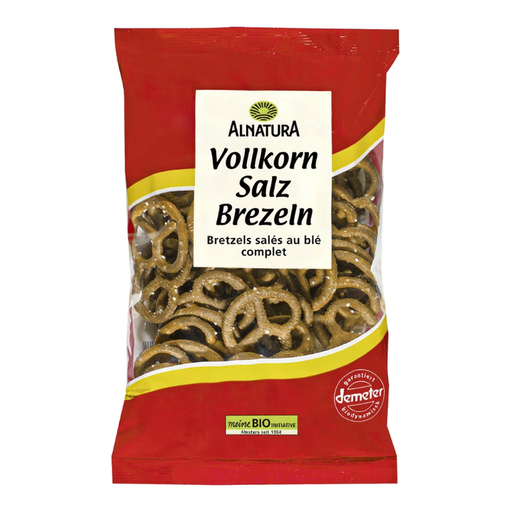
These salted pretzels in a 125-g pack could make a handy snack to take with you. If you’re specifically looking for a lower fat content, compare the nutrition information on the pack with that of other pretzels before you buy.
 No image available
The 125-g pack is an option if you’re looking for salted pretzels to take on the go. Check the nutrition information on the pack to see whether the fat, energy and salt content suit your needs.
No. You need to compare fat and energy values separately. REWE lists ja! Mini Pretzels as containing 4 g of fat and 401 kcal per 100 g, while EDEKA24 gives the figures for Gut & Günstig Salted Pretzels as 7.3 g of fat and 397 kcal per 100 g.
For ja! Mini Pretzels, the 3.7 g of salt per 100 g listed by REWE works out at 9.25 g for the entire 250-g pack. What matters for your choice is how much you actually eat; the German Nutrition Society recommends up to 6 g of table salt per day as a guideline.
Follow the storage instructions on the relevant pack, and keep salted pretzels dry and away from heat if the pack advises this. REWE also recommends keeping ja! Mini Pretzels away from light. Make sure they stay dry after opening, too.
Ditsch’s 160-g bake-at-home pretzel is not a ready-to-eat camping snack unless you have access to a suitable oven. According to the manufacturer, it needs to thaw for around 30 minutes, then bake at 180 °C for approximately 12–15 minutes.
Read the ingredients and allergen information on the specific pack before buying or sharing pretzels. REWE lists wheat and possible traces of sesame, milk and soya for ja! Mini Pretzels; this information does not apply to other products.