For planned holiday snacks at home, unfilled frozen pretzels with salt you can add separately are an option if you’re more concerned about fat content than eating them straight away. REWE lists 1 g of fat per 100 g for its Beste Wahl version, based on unbaked pretzel dough without added salt. This figure isn’t directly comparable with the values for baked pretzels or ready-to-eat salted pretzels. For a snack on the go, an option that doesn’t need baking may be more convenient.
Which pretzels might suit you
Parents keeping an eye on fat content
If you’re planning holiday snacks at home, check the fat content per 100 g and the state of the product the nutrition information refers to. A figure for unbaked dough isn’t directly comparable with one for a ready-to-eat pretzel.
Families thinking about salt, too
If children will be sharing the snack, portion size and salt content matter as well as fat. With pretzels that come with salt separately, you can choose how much to sprinkle on before baking.
Families planning days out
A ready-to-eat pretzel can save you the effort of baking when you’re out and about. If several children will be sharing, check the ingredients and allergen information for the specific product before handing them out.
What to look for when buying
Frozen pretzels
A good fit if: You want to bake your holiday snack at home and decide how much of the supplied pretzel salt to use.
The trade-off: REWE lists the fat content of its Beste Wahl pretzels for unbaked dough without added salt. You’ll also need to allow time for baking.
Baked pretzels
A good fit if: You want to eat a pretzel without baking it yourself.
The trade-off: Ditsch lists 5.3 g of fat and 2.05 g of salt per 100 g for its classic pretzel; wheat is listed as an allergen.
Dry salted pretzels
A good fit if: You’re looking for a ready-to-eat savoury snack for a day out.
The trade-off: EDEKA lists 7.2 g of fat and 4.4 g of salt per 100 g for GUT&GÜNSTIG salted pretzels; ALDI SÜD lists 7.3 g of fat and 4.51 g of salt per 100 g for SUNSNACKS salted pretzels.
| What to check |
What to look for |
Who it matters to |
| Fat content |
Fat per 100 g and the state the nutrition information refers to: unbaked, baked or ready to eat. |
If I can bake at home, I want to understand the fat content rather than rely on a description on the pack. For around 42% of consumers, this comparison comes first. |
| Salt and portion size |
Salt per 100 g, whether salt for sprinkling is included separately, and the planned portion size. |
When choosing a snack for children, I want to decide for myself how much salt goes on the pretzel and how large the portion should be. This is the main concern for around 33% of consumers. |
| Availability and ingredients |
Preparation time and storage, as well as the ingredients and allergen information for the specific product. |
For a day out or a group snack, I need something I can prepare in time or take along as it is, and whose ingredients I can check beforehand. Around 25% of consumers put this practical consideration first. |
Common comparison mistakes
-
Comparing unbaked dough with ready-made pretzels
According to REWE, the 1 g of fat per 100 g for REWE Beste Wahl pretzels refers to unbaked pretzel dough without added salt. The figures for baked and dry pretzels refer to products in different states.
Before comparing nutrition values, check which state of the product the information on the pack refers to.
-
Looking at fat content alone
For the dry salted pretzels checked, EDEKA and ALDI SÜD list 4.4 g and 4.51 g of salt per 100 g respectively. Fat content alone doesn’t tell you enough about the snack.
Look at the fat and salt figures together, and decide on the portion size before serving.
-
Treating a lower-fat pretzel as anything other than a snack
Even if you’re keeping an eye on the fat content, a pretzel is still a snack. The Verbraucherzentrale includes salty snacks in its recommendations for children’s snacks.
Plan pretzels as a snack portion rather than serving them continuously just because of their fat content.
-
Assuming allergens based on the type of product
Ditsch lists wheat for the pretzels checked. EDEKA’s salted pretzels list wheat and gluten, as well as possible traces of milk. You can’t assume the same applies to other products.
If you have an allergy, check the current labelling on the pack or ask for specific allergen information when buying loose bakery items.
Brands and product ranges to help you choose
REWE Beste Wahl
The frozen pretzels featured are unbaked dough pieces supplied with pretzel salt separately.
- REWE lists 1 g of fat and 1.2 g of salt per 100 g for unbaked pretzel dough without added salt. Use the supplied salt as much or as little as you like.
- These nutrition values aren’t directly comparable with those for ready-to-eat pretzels. You’ll need to bake them before eating.
Ditsch
The pretzels featured include a classic pretzel and a part-proofed “Schwäbische Art” version.
- Ditsch lists 5.3 g of fat and 2.05 g of salt per 100 g for its classic pretzel. Its baked “Schwäbische Art” version contains 4.1 g of fat and 1.74 g of salt per 100 g.
- Wheat is listed for both versions featured. Their values aren’t directly comparable with those for unbaked dough pieces.
EDEKA GUT&GÜNSTIG
The salted pretzels featured are a dry snack that’s ready to eat.
- EDEKA lists 7.2 g of fat and 4.4 g of salt per 100 g for these salted pretzels.
- The product information lists wheat and gluten, as well as possible traces of milk. Check the information on the pack you buy.
SUNSNACKS (ALDI SÜD)
The salted pretzels featured are a dry, ready-to-eat savoury snack.
- ALDI SÜD lists 7.3 g of fat and 4.51 g of salt per 100 g for SUNSNACKS salted pretzels.
- Before you shop, check whether the specific product is stocked at your local store.
Pretzels at Joybuy
This selection features pretzel dough pieces for planned holiday snacks at home, where you can store them frozen and bake them. It isn’t intended for snacks that need no preparation.
 No image available
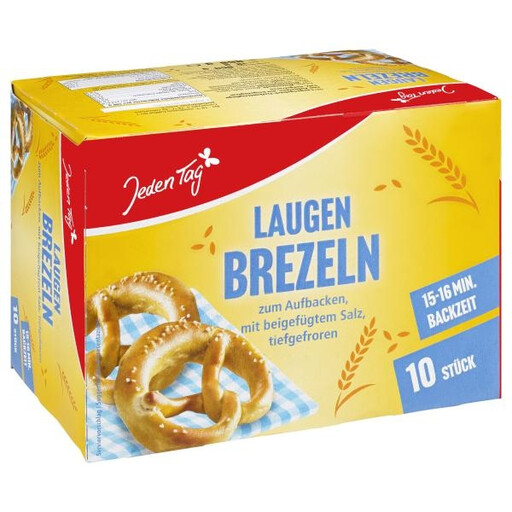
Jeden Tag Pretzels, 10 × 86,8 g
For a planned snack at home, when you can store the pretzel dough pieces frozen and bake them thoroughly before eating.
To compare fat and salt content, check the pack to see which state of the product the nutrition information refers to and how the supplied salt is accounted for. If you have allergies, follow the labelling on the specific pack.
View at Joybuy
Frequently asked questions
Does a pretzel with a low fat content automatically count as “reduced fat”?
No. A single fat-content figure doesn’t substantiate a permitted claim that a product is reduced in fat. Regulation (EC) No 1924/2006 governs nutrition claims, so don’t assess a specific comparative claim based on a nutrition figure alone.
Can I control how much salt goes on a frozen pretzel?
Yes, for the REWE Beste Wahl pretzels featured here. According to REWE, pretzel salt is supplied separately and can be added as you like before baking. The nutrition values given refer to the unbaked product without added salt.
What should I check when buying pretzels for a holiday group where someone has allergies?
Before handing out the pretzels, check the ingredients, listed allergens and possible traces for the specific product. For loose bakery items or food for a group, ask for the relevant allergen information rather than assuming what’s in them based on the type of product.


