
Lieferung heute & morgen

Qualitätsgarantie

Willkommens-Angebote freischalten: KOSTENLOSE Lieferung | Bis zu 80 % RABATT | Kostenlose 30-Tage-JoyPlus-Testphase
App herunterladen
Selecting the right material is a critical step for the success of any 3D printing project. Given the vast array of available filament types, deciding which 3D printer filament is best suited for your specific needs can be challenging. Whether you want to create decorative objects, functional prototypes, or high-strength components, the choice of material significantly influences the print quality, stability, and appearance of the final product.
This guide serves as an objective reference. It is designed to help you understand the properties of the most common filament types and make an informed decision when you buy 3D printer material.
To find the right filament for your project, you should consider a few fundamental criteria. These will help you narrow down the options and avoid print failures.
The two most widely used materials for FDM 3D printing are PLA and PETG. Each has specific advantages and disadvantages.
The most common standard for desktop 3D printers is 1.75mm filament. Before purchasing, check your printer's specifications to ensure the filament is compatible. A precise and consistent diameter is crucial for jam-free extrusion and uniform layer adhesion.
Based on material properties and application areas, we have compiled a selection of filaments that cover a broad spectrum of projects.

Why It Stands Out: This matte PLA from CAILAB Filament features a new formula that produces an elegant, non-glossy surface. The texture minimises visible layer lines and gives printed objects a professional, artistic look that stands out from conventional, shiny plastic.
Advantages:
Who It's For: Users of all skill levels who want to create aesthetically pleasing models, art objects, or prototypes with a high-quality, low-reflection surface. Ideal for designers, artists, and hobby makers.
To the Product: CAILAB Matte PLA Filament

Why It Stands Out: This blue PETG combines the toughness of ABS with the ease of use of PLA. It is a versatile solution for functional components that need to be both durable and visually appealing. The glossy surface and good transparency provide a professional finish.
Advantages:
Who It's For: Advanced users and hobbyists who want to print durable, functional parts for daily use, mechanical components, or enclosures that require greater durability than PLA.
To the Product: CAILAB PETG Filament
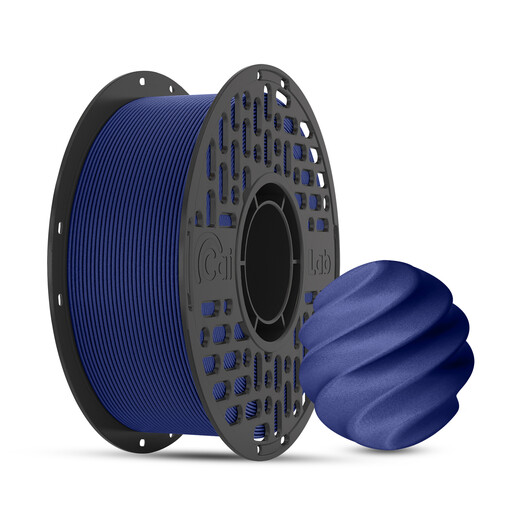
Why It Stands Out: This high-strength filament is reinforced with carbon fibres to achieve exceptional stiffness and strength. It is the choice for engineering applications where lightweight construction and high mechanical stress are paramount.
Advantages:
Important Safety Notes:
Who It's For: Professional users, engineers, and experienced makers who need high-strength, lightweight, and dimensionally stable components for engineering prototypes, drones, RC vehicles, or functional tools.
To the Product: CAILAB PETG Carbon Fibre Filament
If you prefer a different colour or specific material variants, you may find the right product in our broader selection.
Discover our selection of blue 3D filament
1. What is the main difference between PLA and PETG filament? PLA is easier to print, stiffer, and ideal for visual models. PETG is more flexible, durable, and resistant to heat and chemicals, making it better for functional parts.
2. How should I store 3D printer filament? Filaments, especially PETG and Nylon, are hygroscopic, meaning they absorb moisture from the air. This can lead to brittle material and poor print quality. Therefore, always store your filament spools in an airtight container or bag, ideally with a desiccant (silica gel).