
Lieferung heute & morgen

Qualitätsgarantie

Willkommens-Angebote freischalten: KOSTENLOSE Lieferung | Bis zu 80 % RABATT | Kostenlose 30-Tage-JoyPlus-Testphase
App herunterladen
Whether you're on the train, in a café, or in an open-plan office, the feeling of someone looking over your shoulder at your smartphone screen is uncomfortable. Private messages, business emails, or banking details are sensitive information not meant for prying eyes. A privacy screen protector, also known as a privacy filter or privacy film, offers an effective solution. It not only protects your privacy but also shields the display from scratches and impacts.
However, the market is crowded, and many products don't deliver on their promises. Before you make a decision, it's important to know the common pitfalls to avoid making a poor investment.
Choosing the right protector can be complicated. Marketing terms often obscure flaws that only become apparent in daily use. Pay attention to these three points:
To avoid these problems, you should focus on a few core technical features when making your selection. These define the quality and functionality of a privacy screen protector.
The material is the foundation of effective protection. While simple films made of PET (polyethylene terephthalate) offer only minimal scratch protection, tempered glass is a much more robust solution. Look for the 9H tempered glass designation. This hardness rating means the material is resistant to scratches from everyday objects like keys or coins. Such a scratch-resistant protective glass combines privacy with a durable shield for your display.
The privacy function is achieved through a special micro-louver technology. These tiny, vertically aligned slats only allow light to pass through at a straight angle. When someone looks at the screen from the side, the light is blocked, and the screen appears black.
A good protector must be cut precisely for the specific smartphone model to leave cutouts for the camera and sensors and to prevent bubbles from forming at the edges. Useful additional features include:
Based on these criteria, we have identified several products that are suitable for different user profiles and their specific needs.
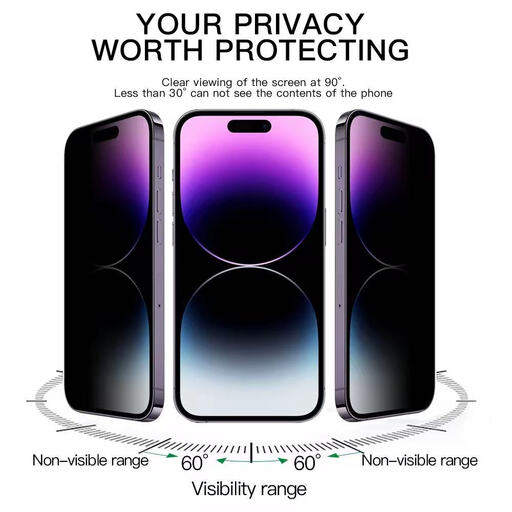
Why This Fits Their Persona: For users who commute daily by bus and train, robust all-around protection is crucial. This product combines privacy protection with the resilience of tempered glass, making it a practical solution for life on the go.
It avoids the pitfall of insufficient physical protection because it's designed as 9H tempered glass with a privacy filter, not just a thin film.
Combines 4-way (360°) privacy protection with 9H hardness and an oleophobic coating against fingerprints. An installation aid is included.
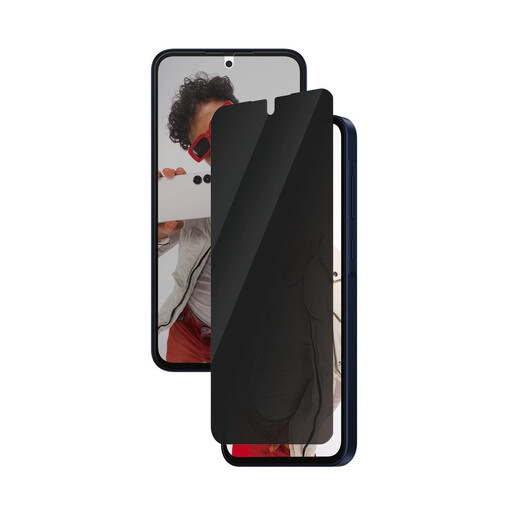
Why This Fits Their Persona: Anyone who owns a specific device model values a precise fit and reliable performance. This product is specifically designed for the Samsung Galaxy A36 5G, ensuring optimal coverage and compatibility.
Its model-specific design avoids the trap of a poor fit, which often leads to unprotected edges or covered sensors with universal protectors.
According to the manufacturer, it offers scratch and impact resistance, as well as a smudge- and moisture-repellent surface. The included EasyAlligner installation aid simplifies application.
Why This Fits Their Persona: Owners of a high-end smartphone like the iPhone 17 Pro Max expect protection that matches the value of their device. This product is aimed at users who refuse to compromise on protection and functionality.
It addresses the concern of poor display quality. According to the manufacturer, high light transmittance ensures that the original image quality is preserved and touch response is not affected.
Offers a comprehensive feature set: 9H hardness, 360° privacy, hydrophobic and oleophobic coatings, and additional features like a blue light filter.
We've compiled a complete, up-to-date list of products that fully meet these strict selection criteria and safety regulations.
1. Does a privacy screen protector reduce my display's brightness? Yes, a slight reduction in brightness is inherent to the micro-louver technology. However, high-quality protectors are designed to keep this effect minimal, so readability is barely affected during normal use. You typically only need to increase the display brightness slightly to compensate.
2. How difficult is it to apply a privacy screen protector? Most modern products, especially those made of tempered glass, come with a complete installation kit. This typically includes cleaning wipes, a dust removal sticker, and often an alignment frame. This frame is placed over the smartphone and guides the protector into the exact position, enabling a bubble-free application even for novices.
3. Will the in-display fingerprint sensor work with a privacy film? Compatibility with in-display fingerprint sensors (ultrasonic or optical) can vary. Some privacy screen protectors are specifically optimised for them and work flawlessly, while others, particularly thicker glass protectors, can impair functionality. It is crucial to check the manufacturer's product description before purchasing to see if compatibility with the fingerprint sensor is explicitly mentioned.