
Lieferung heute & morgen

Qualitätsgarantie

Willkommens-Angebote freischalten: KOSTENLOSE Lieferung | Bis zu 80 % RABATT | Kostenlose 30-Tage-JoyPlus-Testphase
App herunterladen
A high-quality professional food slicer in your kitchen promises perfect, uniform slices of bread, cured meats, cheese, or ham—just like from a gourmet deli counter. However, the path to the right appliance is often paved with marketing promises that don't hold up in practice. Many home cooks invest in a device that soon proves to be inadequate or even a safety hazard. Before you make a purchasing decision, it's crucial to understand the most common pitfalls.
The 2 Most Common Traps When Buying a Food Slicer:
To find a durable and precise machine that meets professional standards, you should carefully examine three core features. These define the performance, safety, and versatility of your future kitchen assistant.
A true all-metal slicer is distinguished by the fact that not only the housing but all load-bearing and power-transmitting parts are made of metal. This includes the motor body, the stop plate, and, most importantly, the carriage. A solid build ensures a secure footing and low-vibration operation. Pay attention to the total weight of the device—a higher weight is often an indicator of a robust metal construction and stability. Appliances marked as a bread slicer Made in Germany often adhere to high manufacturing standards designed for longevity.
While an electric food slicer is standard, the type of motor makes all the difference. Inexpensive models often use noisy alternating current (AC) motors. Professional-grade devices, in contrast, rely on high-torque yet quiet direct current (DC) motors. A key feature for demanding users is electronic speed control. It allows you to precisely adjust the cutting speed to the food being sliced—slow for soft cheese, fast for hard salami.
The choice of blade depends directly on your primary use case. There are two basic types:
For maximum flexibility, some models include both blade types or allow for a simple, straightforward swap.
Choosing the right appliance depends on your individual requirements and budget. Here are recommendations tailored to different user profiles.
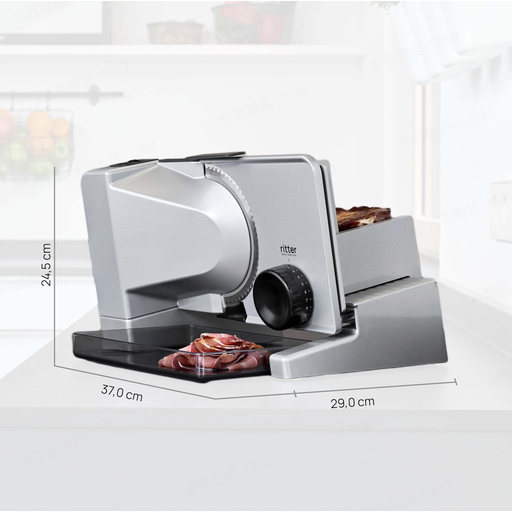
Why This Fits Their Persona: This model is designed for users who value durability, precision, and "Made in Germany" engineering. The ritter food slicer is ideal for slicing a wide variety of foods, from crusty bread to paper-thin prosciutto, consistently delivering professional results.
The consistent all-metal construction and the powerful, adjustable DC motor of the serano 7 model bypass the typical weaknesses of plastic gears and underpowered motors.
Both a serrated blade and a smooth ham/deli blade are included, offering maximum flexibility. The tilted design ensures ergonomic operation.
If you are primarily looking for a reliable bread slicer and only occasionally slice deli meats, a mid-range model is a smart choice. Here, you should look for a stable base, a motor powerful enough for bread crusts, and a high-quality serrated blade. Even in this segment, it is advisable to look for a model that allows for easy, tool-free removal of the carriage and blade for cleaning. Cheap plastic models often lack the necessary stability and durability.
We have compiled a complete, up-to-date list of products that fully meet these strict selection criteria and German safety regulations.
1. How do you properly clean a professional food slicer? Cleaning is crucial for hygiene and longevity. Look for models where the carriage, blade cover plate, and the blade itself can be easily removed without tools. These parts can typically be cleaned with warm water and dish soap. The housing should be wiped down with a damp cloth. Never immerse the entire appliance in water.
2. Do I really need both a smooth blade and a serrated blade? For occasional bread slicing, a serrated blade is sufficient. However, if you regularly want to slice paper-thin ham, carpaccio, or sausage, a food slicer with a smooth blade is indispensable. Only a smooth blade can achieve clean, smooth cuts without fraying. A set with both blades offers the greatest versatility.
3. How can I identify a genuine "Made in Germany" bread slicer? Look for established brands with a long company history in Germany, such as ritter. Transparent information about the materials used, a solid construction, and the availability of a long-term repair service are also strong indicators of manufacturing focused on quality and sustainability, rather than short-lived consumption.