
Lieferung heute & morgen

Qualitätsgarantie

Willkommens-Angebote freischalten: KOSTENLOSE Lieferung | Bis zu 80 % RABATT | Kostenlose 30-Tage-JoyPlus-Testphase
App herunterladen
A programmable robot serves as an interactive gateway to the world of technology and logic. Choosing the right model depends on specific criteria, including the construction type, control methods, and the intended learning curve for the child. This guide analyses the technical specifications of various robot types to provide a solid basis for an informed decision.
The decision to purchase an educational robot should be based on an objective evaluation of its features and capabilities. The following aspects are of key importance.
The control method defines the interaction with the robot. Common methods include:
The manufacturer's age recommendation is a key indicator of the robot's complexity. It considers both the motor skills required for assembly and the cognitive abilities needed for programming. A good STEM toy grows with the child's skills by initially offering simple control modes and later unlocking more complex programming logic.
Within the EU, toys must meet the requirements of the Toy Safety Directive 2009/48/EC and bear the CE mark. Commonly used materials like ABS plastic are known for their durability and safety. It is advisable to check the manufacturer's material specifications and any warnings regarding small, swallowable parts, especially for products intended for younger children.
The following models represent different approaches in the field of programmable robotics and cater to various age groups and interests.

Why We Recommend This Product This set combines the construction aspect of an interlocking brick system with modern robotics technology. With 604 pieces, you can build five different models, offering high replay value and creative variety. The dual control option via a 2.4 GHz remote and an app appeals to both beginners and advanced users. The app control includes four modes: Driving, Gravity Sensor, Path Drawing, and a visual programming function that provides an accessible entry into coding. The integrated 300 mAh battery is USB-rechargeable, reducing the need for disposable batteries.
Pros
Who It's For This set is designed for children aged 6 to 12 who enjoy building and construction and want to gain their first experience with remote-controlled vehicles and basic programming.

Why We Recommend This Product The Miika AI robot from KOSMOS focuses on the topic of artificial intelligence. Instead of just executing commands, this robot can be trained using gestures and voice commands. The accompanying app works offline, ensuring data privacy as no internet connection is required. Developed in collaboration with the Tübingen AI Center, the product aims to make abstract AI concepts tangible. The robot responds with movements, sounds, and an LED display that can show symbols and faces.
Pros
Who It's For This model is aimed at older children and teenagers aged 10 and up with a strong interest in technology and the principles of artificial intelligence. It is less of a classic toy robot and more of an interactive experimental kit.
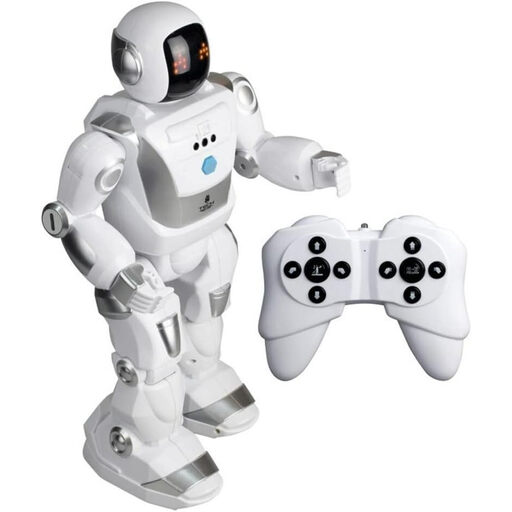
Why We Recommend This Product The Programm A BOT X is a 40 cm tall, pre-assembled robot that offers instant fun. Its strength lies in its extensive programmability, allowing for up to 48 consecutive commands. Control is managed via an infrared remote or through an innovative gesture control feature, where the robot follows hand movements. Motorised arms and legs enable human-like movements, including a gliding mode for "moonwalk" effects. LED eyes and sound effects complete the interactive experience.
Pros
Who It's For This remote-controlled robot is ideal for children aged 5 and up who are looking for a straightforward introduction to the world of programmable robots. The focus is on direct play experience and experimenting with movement patterns.
The models featured here cover a range of different use cases. If you are looking for more specialised robots or other building kits, our main category offers a broader overview. Explore our full range of robot toys.
1. From what age is a programmable robot suitable? Entry is possible from around age 5, typically with pre-assembled models that feature simple remote or gesture controls. Robot building kits and models with more complex visual programming environments are generally suitable for children aged 8 and up. Models that deal with abstract topics like AI are often designed for children aged 10 and older.
2. What is the difference between an educational robot and a standard remote-controlled toy? A classic remote-controlled robot executes commands in real-time. An educational robot or programmable robot takes it a step further: it allows the user to define a sequence of commands in advance, which the robot then executes autonomously. This promotes logical thinking, planning, and an understanding of algorithmic processes—core competencies of the STEM toy approach.
3. Is a smartphone always required for control? No, not necessarily. Many models, such as the HOGOKIDS set or the Programm A BOT X, offer alternative control via an included physical remote. However, an app-controlled robot usually provides an expanded range of features, especially for programming. Some models, like the KOSMOS Miika, use an app that is intentionally designed to work offline.