What should you check before buying?
First decide whether you want to try different varieties or buy several bars of one particular flavour for future breaks. Then check the details for each variety in the box. A suitable portion size alone tells you nothing about its ingredients.
| What to consider |
What to check |
Who it matters to |
| Variety of flavours |
Check which varieties are included and how many bars of each you’ll get. |
If you enjoy trying different flavours with your coffee, you won’t want to accidentally buy a whole box of just one variety. Around 27% of consumers prioritise variety. |
| Protein and portion size |
Compare the weight of each bar and the nutritional values per bar and per 100 g. |
If you plan to have one bar during a short break, some consumers are mainly interested in the protein content of that portion. Around 27% of consumers place the greatest importance on this. |
| Ingredients and allergens |
Read the ingredients list and allergen information for each variety. If you want a vegan option, check that the specific variety is labelled as such. |
If you need to avoid certain ingredients or are looking for plant-based bars, every variety in the box needs to have a suitable recipe. This is the top priority for around 26% of consumers. |
| Value of the pack |
Compare the number of bars and the mix of varieties with how many of them you’ll actually want to eat. |
A large box isn’t much use for an occasional snack if several varieties aren’t suitable. That’s why around 20% of consumers focus primarily on the value of the pack as a whole. |
Protein bars at Joybuy
These 12-packs could suit you if you take regular coffee breaks and have a favourite variety. The varieties are specified, but if you’re specifically looking for a mixed box with several flavours, check the pack contents before you buy.
 Image unavailable
Barebells Vegan Protein Bar Peanut Caramel, 12 × 55 g
This pack is an option if you’re looking for several individual portions of Peanut Caramel. It’s described as vegan; the listed ingredients include wheat and soya protein, as well as peanuts, maltitol and sucralose. The protein content for each 55 g bar is highlighted as 15 g, while the nutrition table lists 14.3 g – check the figures before you buy.
View at Joybuy
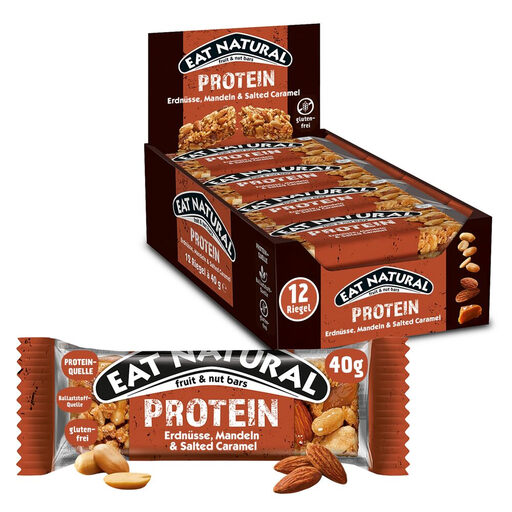 Image unavailable
Eat Natural Protein Bars Peanuts Almonds & Salted Caramel, 12 × 40 g
This pack could suit you if you want several 40 g bars of the specified variety. The listed protein content is 21.6 g per 100 g; to assess an individual portion, take the nutrition information into account accordingly. The ingredients and allergen information list peanuts, almonds, soya and milk, and may contain traces of other nuts.
View at Joybuy
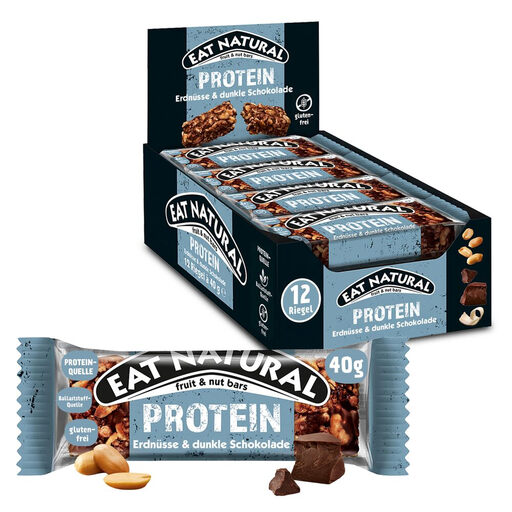 Image unavailable
Eat Natural Protein Bars Peanuts & Dark Chocolate, 12 × 40 g
This pack contains twelve 40 g bars of the specified variety for regular breaks. The nutrition information lists 19.5 g of protein and 24.9 g of sugar per 100 g; remember to factor in the weight of each bar when comparing individual portions. Peanuts and soya are listed as allergens, while milk and other types of nuts may be present as traces.
View at Joybuy
Frequently asked questions
Is a protein bar automatically a replacement for breakfast?
No, you can’t tell that from the term ‘protein bar’ alone. For your coffee break, you can consider the portion size and its nutritional values; whether a single bar fits in with the rest of your morning meal is a separate question. The Verbraucherzentrale points out that, in general, people in Germany don’t need extra protein to meet their nutritional requirements.
Should I compare protein bars per bar or per 100 g?
Both figures serve different purposes: the value per bar tells you about the portion for your break, while the value per 100 g helps you compare products of different weights. The nutritional values per 100 g include energy, fat, sugar, protein and salt, among other things. Values per portion may also be provided.
Is a protein bar labelled ‘no added sugar’ also sugar-free?
No, ‘no added sugar’ doesn’t automatically mean ‘sugar-free’. Check the nutrition table for the sugar content and the ingredients list for sweeteners. According to the Verbraucherzentrale, sugar alcohols can have a laxative effect if consumed in large quantities.
How do I check a mixed box for allergens and vegan varieties?
Check every variety in the box using its own ingredients list, allergen information and, where relevant, vegan labelling. One suitably labelled variety doesn’t automatically make every bar in the box suitable. For example, Barebells doesn’t describe its Original and Soft Bars as vegan.


