Students on a tight budget
You want to pair a bar with everyday foods on a busy evening, rather than plan it as a complete dinner.


For a student dinner after a workout, a protein bar is better thought of as an addition than a meal replacement. Compare the stated grams of protein per bar and check the ingredients for the specific flavour. According to Verbraucherzentrale, you can generally get enough protein from everyday foods.
You want to pair a bar with everyday foods on a busy evening, rather than plan it as a complete dinner.
After a workout, you’re looking for a snack with a clearly stated protein content, so you compare the figures per bar.
Before buying, you check the specific flavour for allergens, may-contain warnings and sweeteners, rather than relying on the product name alone.
First, decide what role the bar should play alongside dinner. Then use the portion information and labelling for the flavour you’ve chosen to help you decide.
| Criterion | What to check when buying | Who it matters to |
|---|---|---|
| Dinner and budget | Think about what else will make up the meal and whether you’ll have the bar regularly or just occasionally. | If I’m working with a tight dinner budget, the bar should remain an addition and not replace the rest of the meal. For around 44% of consumers, planning meals this way is a priority. |
| Protein per serving | Compare the grams of protein per bar with its weight. Figures per 100 g alone don’t tell you how much you’ll get in the portion you eat. | After a workout, I want to know how much protein is in an individual bar, rather than just seeing a percentage on the front. Around 33% of consumers put this portion information first. |
| Ingredients and tolerability | Read the ingredients list, allergen information and may-contain warnings for the specific flavour. Also look out for polyols. | If I need to avoid certain ingredients or sweeteners, I need to be able to decide whether that particular flavour is right for me. For around 23% of consumers, checking the ingredients comes first. |
The protein content of a snack doesn’t tell you everything about the meal. Verbraucherzentrale also points out that extra protein is generally unnecessary to meet your needs.
If you need one, plan the bar as an addition, and decide separately which everyday foods you’ll have for dinner.
A figure per 100 g isn’t the same as the amount in an individual serving. The Sportness Peanut Caramel described by dm contains 34 g of protein per 100 g; in a 40 g bar, that works out to 13.6 g.
To compare servings, use the grams of protein per bar or calculate the amount per bar from the figure per 100 g and the bar’s weight.
This claim doesn’t answer questions about allergens or polyols. Some of the bars described carry a warning that excessive consumption may have a laxative effect.
Before buying, check the ingredients, allergen information and consumption advice on the pack of the flavour you want.
dm’s own brand offers protein bars in a range of flavours and portion sizes.
Barebells offers classic protein bars and Soft Bars, with different amounts of protein per bar listed for each range.
One flavour described by REWE is Chocolate Caramel, available in a 40 g format.
EDEKA24 describes the ESN Designer Bar Dark Chocolate Raspberry as a 45 g protein bar.
REWE launched its own-brand range in September 2026, including six protein bars.
These protein bars could work as snacks alongside a student dinner. Pack sizes vary, so when choosing, check the information for an individual serving and the labelling for the flavour you want.
 No image available
A handy post-workout snack if you want to compare the protein content of an individual serving.
For Chocolate Caramel, REWE lists 20 g of protein per 40 g bar. Check the allergen information on the specific pack before buying.
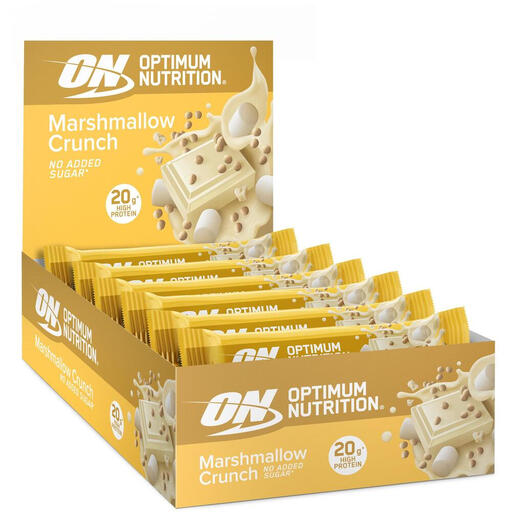 No image available
A multipack for anyone planning to have a bar as a snack before or after a workout.
The pack contains ten 65 g bars. Check the nutritional and allergen information on the specific pack before comparing its portion with other flavours.
 No image available
An option if you’re looking for a protein bar to have alongside a meal and prefer the Cookies & Cream flavour.
The pack contains twelve 55 g bars. Check the information for this specific flavour on lactose and possible traces.
 No image available
A single 40 g bar for comparing smaller snack portions.
‘Low Carb’ is part of the product name. When choosing, refer to the nutritional information, ingredients and allergen details for the specific pack.
 No image available
A multipack for anyone who wants to take a bar along occasionally as an addition to dinner.
The pack contains twelve 50 g bars. If you need to avoid nuts or other allergens in particular, check the labelling on the pack you choose.
No, a protein bar isn’t essential. According to Verbraucherzentrale, you can get enough protein from everyday foods. A bar can be a convenient snack, but it doesn’t automatically replace dinner.
The wording alone doesn’t specify a set number of grams in the portion you eat. Compare the protein content per bar, or use the bar’s weight to work out the portion amount from the figure per 100 g.
No. Barebells points out that products with no added sugar aren’t automatically low in calories or reduced in calories. Check the nutritional information and ingredients list for the specific flavour.
Check the ingredients and consumption advice on the pack you choose. For the Sportness and Premier Protein flavours described, there’s a warning that excessive consumption may have a laxative effect. This doesn’t apply to every protein bar.
Read the allergen information and any may-contain warnings on each specific pack. According to Lebensmittelverband Deutschland, ingredients are listed in descending order by weight. Information for one flavour can’t automatically be applied to another.