What should you look for when buying?
First, decide which requirement is the main priority for you. Then compare the nutritional information for the specific portion and, finally, check that the pack size and ingredients suit your mid-morning routine.
| What to consider |
What to check |
Who is this important for? |
| Protein content |
Compare the protein per bar with the amount per 100 g, and check the bar’s weight. |
If I want to top up my daily protein intake, I need to know how much a single snack contributes. Around 33% of consumers put this question first when choosing. |
| Snack portion and nutritional values |
Check the energy, sugar and fat per bar; don’t assume ‘no added sugar’ means ‘low in calories’. |
For a break between breakfast and lunch, I want to choose a portion that fits with my other meals. For around 27% of consumers, the snack itself is the main consideration. |
| Ingredients and suitability |
Check the vegan labelling, ingredients list, allergens, traces and warnings for the exact variety. |
If I avoid animal-derived ingredients or need to watch out for certain ingredients, this immediately narrows down my options. For around 20% of consumers, this is the top priority. |
| Portions for everyday use |
Check the bar’s weight and the number of bars in the pack against how you plan to eat them. |
If I plan to have a mid-morning snack regularly, individual portions in a suitable size are especially handy. Around 20% of consumers place the greatest importance on being able to plan ahead. |
Brands to help you choose
The examples below highlight different product ranges and ingredient considerations. Whether a bar is right for you depends on the labelling for the specific variety.
Barebells
Barebells offers Original, Soft and plant-based protein bars.
- dm lists 15 g of protein per 45-g bar for Barebells Pistachio Spread; Barebells gives 20 g per bar for Salty Peanut.
- Barebells says its Original and Soft Bars are not vegan. Check the ingredients and allergen information for each variety.
ESN
ESN offers Designer Bars, among other products, with nutritional values listed for each variety.
- dm lists up to 15 g of protein per 45-g bar for Dark Chocolate Salted Almond.
- The ingredients listed for this variety include milk protein, collagen peptides, almonds and maltitol. Check the labelling if any of these ingredients are relevant to you.
PowerBar
PowerBar offers Protein Soft Core bars, which have a soft filling.
- This product range has a different texture from a bar that’s firm all the way through.
- For Exotic Cream, dm lists milk, soya and wheat, along with guidance on consumption and a warning that excessive consumption may have a laxative effect. This information applies to this specific variety.
Sportness
dm’s own brand offers protein bars, including the Yoghurt-Cereal variety.
- For the 40-g Yoghurt-Cereal bar, dm lists 33 g of protein and 13 g of fibre per 100 g; the bar’s weight is also important when comparing portions.
- The ingredients listed for this recipe include milk, soya, collagen hydrolysate and peanuts. Check the ingredients and warnings on the pack.
KoRo
KoRo also offers protein bars labelled as vegan; REWE lists some of these varieties.
- A specifically labelled vegan variety may suit you if you want to avoid animal-derived ingredients.
- Vegan labelling doesn’t replace the need to check the protein content, ingredients and any allergens relevant to you for each variety.
Protein bars at Joybuy
These bars could work as portioned mid-morning snacks. Packs and varieties differ, so compare the nutritional information and ingredients on the relevant product pack when choosing.
 No image available
Barebells Protein Bar Cookies & Cream, 12 × 55 g
The individually portioned bars are easy to plan as a mid-morning snack.
For this variety, check the information on milk protein, collagen, soya and maltitol, as well as the warning about excessive consumption.
View at Joybuy
 No image available
BE-KIND Protein Caramel Nut, 12 × 50 g
The 50-g portions are a good option if you want to decide on the size of your mid-morning snack in advance.
Check the pack for information on peanuts, milk, soya and possible traces of other nuts.
View at Joybuy
 No image available
ESN Protein Designer Bar Hazelnut Nougat, 12 × 45 g
The 45-g bars offer a set portion for a snack between meals.
Check for milk, soya, hazelnuts and possible traces of other nuts, as well as the information on polyols and the consumption guidance for this variety.
View at Joybuy
 No image available
Frankonia Sugar Free Nutrition Bar Chocolate Brownie, 50 g
The 50-g bar is an individually portioned option for a mid-morning snack; the product name alone doesn’t replace a comparison of the nutritional values.
Check the ingredients for milk, soya and polyols, as well as the warning about excessive consumption.
View at Joybuy
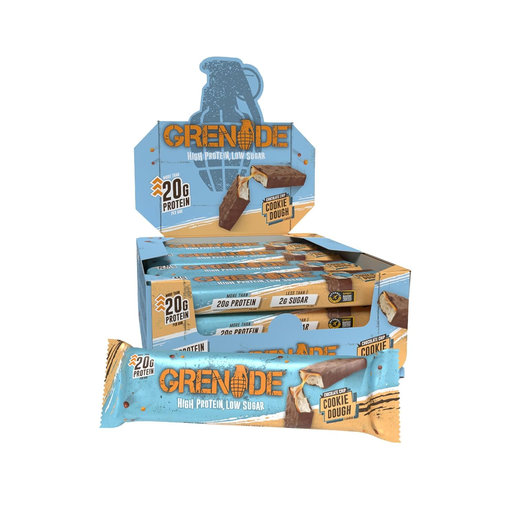 No image available
Grenade Carb Killa Choc Chip Cookie Dough, 12 × 60 g
This pack of 60-g bars could suit you if you’re looking for a larger individual portion to take out and about.
Compare the energy and sugar per bar using the information on the pack. Also check the details on milk, soya and collagen, along with the warning about excessive consumption.
View at Joybuy
Frequently asked questions
How do I compare the protein content of two bars?
First, compare the protein per bar, then use the amount per 100 g to compare portions of different sizes. The dm guide gives a range of 15 to 60 g of protein per 100 g, depending on the recipe; the amount you actually eat also depends on the bar’s weight.
Is a protein bar with no added sugar also low in calories?
No, the claim ‘no added sugar’ doesn’t mean that it is. Barebells itself points out that its bars are not low-calorie or reduced-calorie. Compare the energy and fat in the portion you plan to eat.
Are all Barebells protein bars vegan?
No. Barebells says its Original and Soft Bars are not vegan, although it also offers a plant-based range. Look for clear vegan labelling and check the ingredients of the variety you want.
If I have allergies, is checking the flavour enough?
No, you need to check the ingredients and allergen information for the exact variety. For example, a Barebells bar sold by dm lists milk, pistachio and soya, as well as possible traces of other allergens.


