If you’re keeping an eye on calories per serving
If you fancy something sweet with your coffee, the calories in the whole bar or the portion you actually eat are more useful than the figures per 100 g alone.


For a calorie-conscious coffee break, first compare the kcal in the bar you’ll actually eat, then check the protein per serving, ingredients and allergens. A smaller bar may contain fewer calories per serving, but also less protein than a larger one. ‘No added sugar’ doesn’t mean it’s unsweetened, or tell you how many kcal are in a serving.
If you fancy something sweet with your coffee, the calories in the whole bar or the portion you actually eat are more useful than the figures per 100 g alone.
If protein matters to you in a snack, compare the grams of protein and kcal for the same serving. A high percentage on the front of the pack doesn’t automatically tell you how much protein is in one bar.
If you need to avoid certain ingredients or want to check sweeteners, read the label on the specific bar. The recipes discussed here include milk, soya and other allergens, as well as sugar replacers.
Start with the amount you’d actually want to eat with your coffee. Then compare the protein per serving and check the ingredients before choosing a flavour for regular coffee breaks.
| What matters to you | What to check | Who it matters most to |
|---|---|---|
| Calories per serving | Compare the bar’s weight and kcal for the amount you’ll actually eat; convert figures per 100 g if needed. | I’d like a small portion with my coffee and want to know how much energy it contains in advance. Around 36% of consumers put calories per serving first. |
| Protein per bar | Compare the grams of protein in each bar with the calories in that serving; don’t read percentages as grams per bar. | I care more about getting a larger amount of protein in my snack than choosing the lowest kcal option. For around 29% of consumers, protein per serving comes first. |
| Ingredients and allergens | Read the current ingredients list, highlighted allergens, may-contain warnings and information about sweeteners. | I need to avoid certain ingredients, so I can’t choose based on the nutrition information alone. Ingredients and suitability are the main considerations for around 21% of consumers. |
| Buying again | Check whether your chosen flavour will be available again when you need it, and whether the serving size and labelling still meet your needs. | I want to find a flavour I can choose again for regular coffee breaks. Around 14% of consumers put ease of repurchasing first. |
A percentage refers to the product’s weight, so a 45 g bar containing 50% protein does not contain 50 g of protein. Lebensmittelklarheit also points out that protein claims on the front of packs are often based on 100 g.
Look for the number of grams per bar. If the pack only gives a figure per 100 g, use the bar’s weight to work out the amount in your serving.
Lebensmittelklarheit explains that products carrying this claim may still contain sweeteners or sugar replacers. Products containing certain sugar replacers may also carry a warning about the laxative effect of excessive consumption.
Read the ingredients list and warnings for the specific bar rather than assuming the claim tells you how sweet it is or how well you’ll tolerate it.
Bars of different weights make for different-sized snacks. For example, product information from dm-drogerie markt and Barebells gives 125 kcal for a 35 g bar and 192 kcal for a 55 g bar, respectively.
Compare the weight and kcal side by side for the amount you actually want to eat.
Protein bars may contain allergenic ingredients and carry additional may-contain warnings. If you have an allergy, check the label on the specific pack rather than relying on a brand’s general description.
Check the ingredients and may-contain information before buying, and check again if the recipe changes.
The 45 g Sportness Crispy White Chocolate bar, with 50% protein, shows why protein content and calories per serving should be considered separately.
Barebells makes dessert-inspired protein bars, and describes Espresso Swirl specifically as a snack for your coffee break.
The Mixed Berries Skyr Protein Bar has a smaller stated serving size, making it an option to compare for a coffee break.
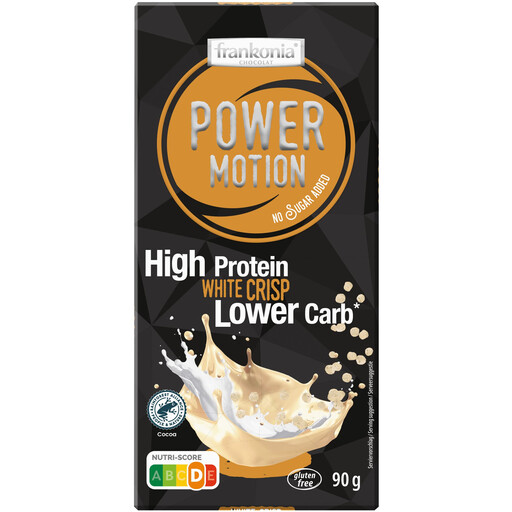
For a light coffee break, you could consider portionable chocolate with a protein claim or a multipack of protein bars. Compare the amount you’ll actually eat: the 90 g chocolate bar isn’t equivalent to a single 45 g protein bar.
 No image available
If you only want some of the chocolate with your coffee, you can set aside the portion you want; the whole bar weighs 90 g.
The stated serving size of 22.5 g is a quarter of the bar. Check the nutrition information for the amount you’ll actually eat, along with the current ingredients and allergen information.
 No image available
If you’re looking for individually portioned bars for several coffee breaks, this multipack of twelve 45 g bars could be a convenient option.
The 30% protein claim doesn’t replace comparing protein and kcal per 45 g bar. Also check the current ingredients and allergen information.
First compare the kcal in the whole bar or the amount you’ll actually eat. Then compare the grams of protein for the same serving and check the ingredients and allergens. A big protein claim on the front of the pack doesn’t tell you everything about the serving.
No. ‘No added sugar’ doesn’t mean a bar is unsweetened or has a particular number of calories. Lebensmittelklarheit points out that sweeteners and sugar replacers may still be present, so check the ingredients list and nutrition information too.
For each bar, check the highlighted allergenic ingredients and any may-contain warnings on the current pack. The recipes discussed here include ingredients such as milk or soya; you can’t assume that information for other flavours from the same brand also applies.
No, you don’t need a protein bar to have a snack with your coffee. The Federal Centre for Nutrition points out that high-protein products are usually unnecessary as part of a balanced diet, so choose according to the portion you want and the information for the specific product.