People with a set calorie budget
You want to plan in a snack you can take with you, so you start by checking the calories in the portion you’ll actually eat.


If you keep an eye on calories and protein when snacking, compare both per bar you’ll actually eat: a smaller serving may contain fewer calories, but it may also provide less protein. Also check the ingredients and allergens for the specific variety before choosing a bar.
You want to plan in a snack you can take with you, so you start by checking the calories in the portion you’ll actually eat.
You’re looking for a clearly stated amount of protein in a snack for on the go, and compare the grams of protein and calories per bar.
You need to avoid certain allergens or want to check the protein sources and sweeteners for a specific variety before buying.
Start with the bar’s weight and its nutritional information per serving. Only then can you judge what a prominent protein percentage means for your snack. The examples listed by dm-drogerie markt show the difference: the 35 g all stars Skyr Protein Mixed Berries bar is listed at 125 kcal and works out at around 8.4 g of protein. The 40 g PowerBar 40% Protein+ Crisp Caramel Peanutbutter bar works out at around 149 kcal and 16 g of protein. The serving sizes differ, so neither figure on its own should determine your choice.
| What to consider | What to check when buying | Who it matters most to |
|---|---|---|
| Calories per bar | Energy per 100 g and the weight of the portion you’ll actually eat. | If I want a snack to fit my calorie budget, the whole portion matters more to me than the figure per 100 g. Around 42% of consumers would choose the energy per serving as their top criterion. |
| Protein per serving | Grams of protein per bar; consider percentage figures alongside the bar’s weight. | When I’m out and about, I want to know how much protein is in an individual bar, even if the pack mainly highlights a percentage. For around 33% of consumers, the protein per serving would be the priority. |
| Ingredients and suitability | Ingredients list, highlighted allergens, may contain statements and warnings for the specific variety. | If I need to avoid certain ingredients, a suitable calorie or protein figure on its own won’t help. Suitability would be the main criterion for around 25% of consumers. |
A bar can contain fewer calories than another without meeting the legal requirements for a “low energy” claim. Under EU Regulation (EC) No 1924/2006, solid foods must contain no more than 40 kcal per 100 g to make this claim.
Compare the calories per bar for the portion you’ll eat. If a pack says “low energy”, also check the energy value per 100 g.
A percentage describes the proportion of the product’s weight, not the amount of protein in the snack itself. The NRW Consumer Advice Centre points out that 20 g of protein and 20% protein are very different figures for a 50 g bar.
Check the grams of protein per serving, or work them out using the bar’s weight. Then compare the calories for the same serving.
Depending on the variety, the examples listed by dm-drogerie markt contain ingredients such as milk, beef collagen peptides, peanuts, soya or wheat. Some bars also carry relevant warnings about consumption.
Check the ingredients, allergens, possible traces and consumption advice for each specific variety – even if you’ve already tried another bar from the same brand.
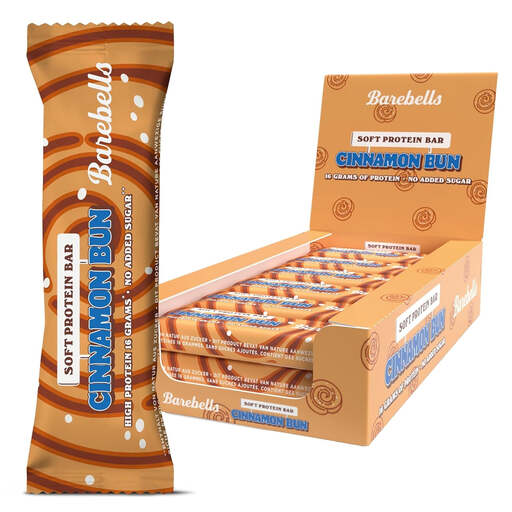
Barebells offers a range of protein bars. The brand states that its classic bars contain up to 20 g of protein per bar; the specific variety is what matters when comparing them.
PowerBar makes protein bars with different protein percentages. For the 40% Protein+ Crisp Caramel Peanutbutter variety listed by dm-drogerie markt, the 40 g bar weight and nutritional information per 100 g work out at around 16 g of protein and 149 kcal per bar.
The ESN Designer Bar Fudge Brownie listed by dm-drogerie markt contains 14 g of protein per 45 g bar.
These protein bars come in different sizes and flavours. Compare the nutritional information and ingredients for each variety to help you choose; a smaller serving alone doesn’t tell you how much protein it contains.
 No image available
If you want to compare the serving values of a 55 g protein bar, check the calories and grams of protein per bar.
Also check that the ingredients, allergens and consumption advice for this variety meet your needs.
 No image available
To compare it with other 55 g bars, look at the protein and calories per bar.
Check the ingredients and allergen information for the Cookies & Cream flavour.
 No image available
If you’re looking for a smaller bar, compare its calories and protein with the figures for larger bars.
The 32% figure describes the proportion of protein; the 35 g bar weight also matters when working out the grams of protein per snack.
 No image available
If you’re looking for a product labelled as vegan, check the labelling for the specific variety before choosing.
Also compare the nutritional values per serving and check the ingredients and allergen information for Peanut Caramel.
 No image available
When choosing a 45 g bar, look at the calories and protein per serving as well as the protein percentage.
Check the nutritional information, ingredients and allergens for this flavour.
For solid foods, the “low energy” claim is only permitted under EU Regulation (EC) No 1924/2006 when a product contains no more than 40 kcal per 100 g. A bar containing fewer calories than another bar doesn’t automatically meet this requirement; check the energy value per 100 g.
For an individual snack, the grams of protein per bar are the more direct measure to compare. The percentage is based on the product’s weight; as the NRW Consumer Advice Centre explains, 20 g of protein and 20% protein don’t mean the same thing in a 50 g bar.
No, a protein bar isn’t essential. If you’re planning to have one as a snack, consider its protein content alongside the calories in the portion you’ll eat and the ingredients, rather than relying on the “protein bar” label alone to guide your choice.
First, check that the ingredients, allergens and consumption advice for the specific variety are suitable for you. Also check the best-before date and storage instructions on the pack before buying several bars of the same variety.