Strength trainers looking for a protein boost
If you want your gym-bag snack to provide protein, compare the nutritional information for lentil cakes and lentil crackers with that of classic rice cakes. How much you actually eat matters too.


If you want the cake itself to add protein to your snack, lentil cakes are worth comparing: EDEKA and REWE each state that their respective lentil cakes contain 25 g of protein per 100 g, while EDEKA lists 8.7 g per 100 g for its Bio Reiswaffeln Natur. Classic rice cakes can make a simple base, but you’ll need a separate source of protein if you want a protein-focused snack. For your gym bag, the amount you actually eat also matters, as do the salt content and ingredients of seasoned crackers.
If you want your gym-bag snack to provide protein, compare the nutritional information for lentil cakes and lentil crackers with that of classic rice cakes. How much you actually eat matters too.
A ready-to-eat pack can be handy on your way home from training or to the office. Check the pack size, protein per pack and storage instructions before leaving it in your gym bag for a long time.
If you prefer a cake with a short ingredients list as a base, check the allergen information for the specific variety as well as its protein content. If you want a protein-focused snack, you may also want to bring a separate source of protein.
For a protein-focused snack, start by comparing the figures per 100 g and for your portion. The product format also helps you decide whether to pack a plain cake or a ready-seasoned snack.
A good choice if: You want the cake itself to provide protein; EDEKA and REWE each state that their respective lentil cakes contain 25 g per 100 g.
The trade-off: These are made with lentils rather than rice. If you choose a salted variety, check the salt content too.
A good choice if: You want a savoury, ready-to-eat pack; REWE states that a 40 g pack of Reis-fit Risbellis Tomate & Paprika contains 10 g of protein.
The trade-off: This variety contains a seasoning mix and sunflower oil, and is labelled as containing 1.45 g of salt per 100 g.
A good choice if: You’re looking for a plain cake as a snack base and are happy to add protein separately if needed.
The trade-off: EDEKA states that its Bio Reiswaffeln Natur contain 8.7 g of protein per 100 g, so what you eat with them matters if you want a protein-focused snack.
| What to consider | What to check when shopping | Who it matters most to |
|---|---|---|
| Protein content | Compare protein per 100 g and for the amount you’ll actually eat. | If I want my snack itself to provide protein, a claim on the pack isn’t enough for me. Around 50% of consumers prioritise this amount of protein when shopping. |
| Convenience on the go | Check the pack size and storage instructions. | After training, I want to be able to eat something straight from my bag without preparing it. For around 30% of consumers, this convenience is the most important factor. |
| Ingredients and allergens | Read the ingredients list and allergen information on the specific pack. | If I snack regularly, I want to know what the cake is made from and which allergen information is relevant to me. Around 20% of consumers put this check first. |
The product name alone tells you little about its protein content: EDEKA states that its Bio Reiswaffeln Natur contain 8.7 g of protein per 100 g, compared with 25 g per 100 g for its Bio High Protein Linsen-Waffeln. These cakes are made from different base ingredients.
Compare the nutritional information on a like-for-like per-100-g basis, then work out the amount for the portion you plan to eat. If you want a classic rice cake, add a separate source of protein if needed.
REWE states that Reis-fit Risbellis High Protein Tomate & Paprika contains 26 g of protein as well as 1.45 g of salt per 100 g. The seasoning mix makes this variety a different choice from a plain lentil cake.
For savoury varieties, read the ingredients list and compare the salt content per 100 g rather than choosing on the product name alone.
The German Federal Institute for Risk Assessment points out that rice cakes are among the rice products that can contain relatively high levels of inorganic arsenic.
If you snack regularly, alternate rice cakes with other suitable snacks or grains.
The lentil cakes with sea salt are an alternative to classic rice cakes if you want to compare the base ingredient and protein content.
The product information mentioned here from EDEKA covers both classic Bio Reiswaffeln Natur and lentil cakes.
Risbellis High Protein Tomate & Paprika are seasoned lentil crackers for eating straight from the pack, not classic rice cakes.
According to REWE, the vegan Bio Protein Waffeln combine maize and pulses rather than being made exclusively from rice.
Organic Lightly Salted is a wholegrain rice cake, making it most relevant when comparing classic varieties.
This selection features a lentil cake for anyone considering a pulse-based snack for their gym bag. Check the nutritional information on the pack for the portion you’ll eat.
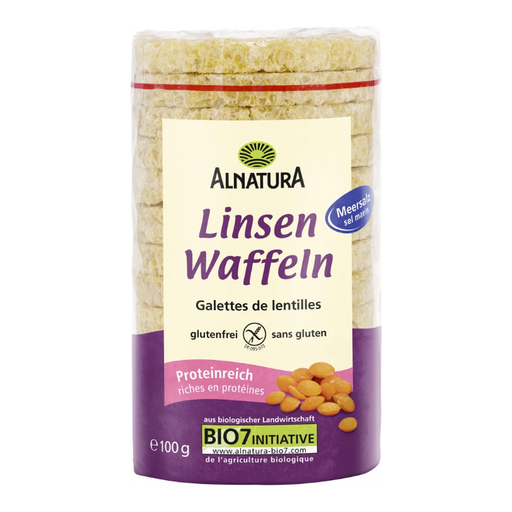 No image available
A lentil cake for anyone who’d prefer a pulse-based option to a classic rice cake.
Pack size: 100 g. Check the protein content for your portion and the allergen information on the pack.
No. Protein content depends on the specific product and how much you eat. EDEKA states that its Bio Reiswaffeln Natur contain 8.7 g of protein per 100 g, compared with 25 g per 100 g for its Bio High Protein Linsen-Waffeln. Check the amount in your portion as well as the figure per 100 g.
Not necessarily. According to the German Nutrition Society, healthy adults who exercise for no more than five hours a week do not have increased protein requirements. Whether a particular snack suits your diet can’t be determined by when you eat it after training alone.
Yes. Always check the labelling on the specific pack. For example, EDEKA notes that its Bio Reiswaffeln Natur may contain traces of sesame. A simple ingredients list doesn’t replace checking the allergen warning.
It’s a good idea to vary your snacks if you eat them regularly. The German Federal Institute for Risk Assessment points out that rice cakes can contain relatively high levels of inorganic arsenic. You can alternate them with other suitable snacks and grains.
Follow the storage instructions on the pack and keep the products away from heat and moisture. For the products mentioned, Verival and Reis-fit recommend storing them in a dry place.